
Restaurant accounting services should record paid gift card sales as a liability, reduce that liability when cards are redeemed, and reconcile the remaining balance to the gift card system each month. For a Florida restaurant in 2026, that means separating gift card payments from meal revenue and tracking refunds, promotional credits, and adjustments separately. Unused balances are not automatically income; breakage recognition and applicable legal requirements need their own review.
- Restaurant accounting services should reconcile gift card liabilities monthly, not treat every deposit as restaurant revenue.
- Florida restaurant owners should separate paid gift cards from promotional credits and document refunds and adjustments.
- Evaluate Full Plate on a written monthly reconciliation scope, clear responsibilities, and access to supporting records.
How should restaurant accounting services track gift card activity?
Track gift cards through issuance, redemption, and the outstanding balance—not just through the bank deposit. A deposit shows cash received. It does not establish whether your restaurant earned meal revenue or accepted payment for a future visit.
Your monthly restaurant bookkeeping scope should identify who prepares the gift card reconciliation, who reviews differences, and what records you receive. A line labeled gift cards on a financial statement is not enough without supporting activity.
| Activity | Bookkeeping treatment | Supporting record | Mistake to avoid |
|---|---|---|---|
| Paid gift card issued | Increase cash or processor receivable and gift card liability | Issuance report and payment record | Recording the sale as meal revenue |
| Gift card redeemed | Reduce gift card liability and record the underlying sale appropriately | Redemption report and guest check | Recording redemption as new cash received |
| Unused card refunded | Reduce the liability and record the refund payment | Refund authorization and transaction record | Leaving the refunded balance outstanding |
| Promotional credit issued | Track separately under a documented policy | Promotion terms and issuance record | Treating unpaid promotional value as a paid gift card |
| Balance adjusted | Record the adjustment according to its documented cause | Adjustment log and approval | Using an unexplained entry to force agreement |
| Breakage recognized | Apply the relevant accounting policy and legal review | Supporting analysis and approval | Treating every old balance as revenue |
The central check is straightforward: opening liability plus paid issuance, less redemptions and refunds, with documented adjustments, should explain the closing liability. Investigate any difference rather than burying it in sales.
Why this matters for Florida restaurant owners
Gift cards separate the date you receive money from the date you serve the guest. A holiday promotion can bring cash into your Florida restaurant before the related meals appear on guest checks. Counting both events as revenue overstates sales.
For your 2026 books, the practical goal is a clear answer to two different questions: how much did guests spend on meals, and how much prepaid value remains outstanding? Your bank balance cannot answer both.
This matters when you compare busy and quiet periods, review operating results, or prepare records for your tax professional. Clean gift card records also let you investigate a disputed balance without rebuilding the transaction history from scattered emails.
What should the monthly gift card process include?
A useful monthly process connects the gift card system, the point-of-sale system, payment settlements, and the general ledger. It also leaves a record that you can review without needing to recreate the bookkeeper's work.
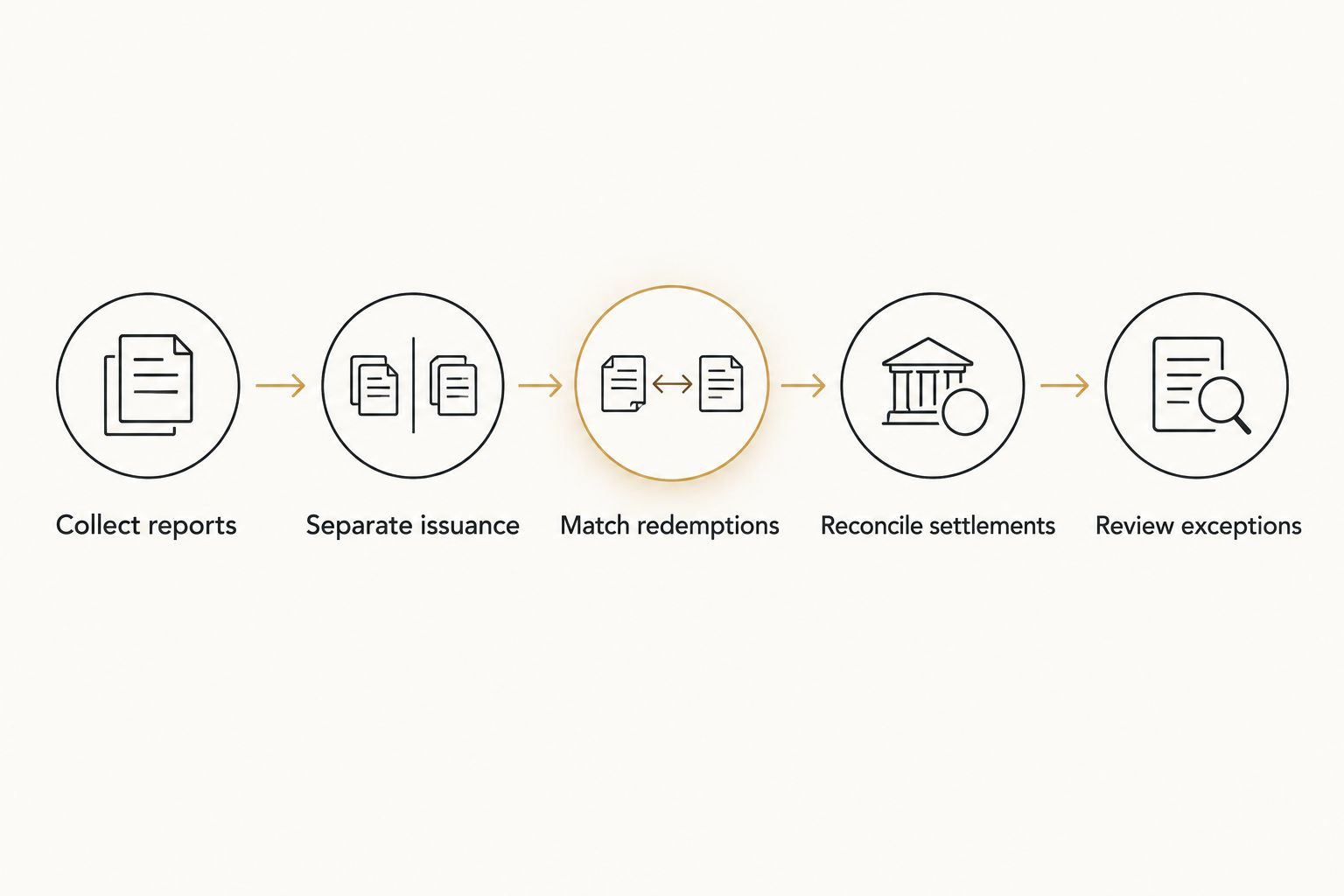
1. Collect the activity and outstanding-balance reports
Keep 2 reports for the same reporting period: a transaction activity report and an outstanding-balance report. The activity report explains movement; the balance report shows what remains.
Use consistent cutoff dates. A calendar-month ledger balance should not be compared with a report that includes transactions from the following morning.
If your restaurant sells cards online and at the counter, identify whether those channels share a balance system. Separate systems require separate supporting records before their totals can be combined.
2. Separate paid issuance from promotional value
A guest buying a gift card creates a different transaction from your restaurant issuing a complimentary credit. Keep those activities identifiable, even when the same platform handles both.
For example, a card purchased as a birthday present should not disappear into the same category as a manager-issued apology credit. Ask your bookkeeper to document how each category reaches the ledger and how staff should label it at issuance.
3. Match redemptions to guest checks
The redemption report should connect to gift card tender recorded in the point-of-sale system. Your bookkeeper should also check whether the sales posting already includes those guest checks.
A gift card redemption is a payment method, not an additional sale on top of the guest check. This distinction prevents duplicate revenue when separate system exports feed the books.
Check how gift card payments cover food, applicable sales tax, and tips. Those components need the correct ledger treatment rather than one undifferentiated revenue entry.
4. Reconcile settlements separately
Match card-sale collections to processor settlements and bank deposits. Record processing fees separately instead of reducing the gift card obligation to the net amount deposited.
Timing differences should have an explanation. A pending settlement is different from missing issuance activity, and the reconciliation should make that distinction visible.
5. Review exceptions and close the period
Review 1 month of activity at a time, carrying the agreed closing balance into the next period. List unresolved items with the transaction date, cause under investigation, and person responsible.
Document refunds, voids, transfers, and manual changes. A reconciliation is complete when the records agree or the remaining differences are specifically identified—not when someone posts an unexplained adjustment.
Why gift card tracking varies between restaurants
The accounting principle stays the same, but the work depends on how your restaurant issues, accepts, and changes balances. Describe these details before requesting a bookkeeping proposal:
- Sales channels: Counter sales and online sales need a clear connection between issuance and payment records.
- System connections: Separate gift card and point-of-sale systems require matching records across both.
- Promotional activity: Complimentary credits need an identifiable policy rather than being mixed with purchased value.
- Refunds and adjustments: Manual changes require supporting records and approval.
- Locations and ownership: Cards accepted across locations need a documented allocation process, particularly when separate entities are involved.
- Reporting cutoffs: Different settlement dates and report boundaries create timing differences that need explanation.
Give prospective bookkeepers actual report names and a description of your checkout process. Saying that you accept gift cards tells them much less than explaining where cards are sold, where guests redeem them, and who can change a balance.
Can you track gift cards yourself?
Yes. DIY bookkeeping is a reasonable choice when you can obtain reliable reports, understand the postings, and consistently reconcile the liability. The deciding factor is whether you can explain the balance—not whether you use professional accounting software.
You can handle routine record collection, maintain staff permissions, and review unusual refunds yourself. You also remain the best source for explaining operational events, such as a manager correcting a guest's card balance after a service problem.
Professional help becomes useful when the gift card system and ledger repeatedly disagree, multiple channels complicate settlement matching, or unresolved items carry into later months. Hiring a bookkeeper should transfer the recurring reconciliation work, not remove your ability to inspect it.
| Approach | Best for | Main advantage | Main limitation |
|---|---|---|---|
| Owner-managed bookkeeping | Owners who can reconcile the records consistently | Direct knowledge of restaurant activity | The owner must investigate and document differences |
| Ongoing bookkeeping service | Owners who want recurring preparation and exception tracking assigned | Clear responsibility when the scope is written well | Staff explanations and owner review are still necessary |
Full Plate belongs on a Florida restaurant owner's shortlist only if monthly gift card reconciliation is included in writing. Apply that same test to every service you consider; a broad promise to keep the books does not define this work.
What should you ask before hiring a bookkeeper in 2026?
Ask for 3 sample outputs: a gift card liability reconciliation, an exception list, and a monthly financial statement showing the liability separately. An anonymized example or blank template is sufficient to discuss the process without exposing another restaurant's records.
Then ask who supplies each source report. Your monthly bookkeeping records should include gift card activity alongside the sales, settlement, and bank records needed to check it.
Use these questions when discussing Full Plate or another prospective provider:
- Does the monthly scope include reconciling the gift card liability to the underlying system?
- Who checks whether point-of-sale sales already include redeemed gift cards?
- How are promotional credits separated from paid cards?
- Who investigates manual adjustments and unexplained differences?
- What happens to unresolved items at month-end?
- Who reviews breakage treatment and Florida legal questions?
Get the answers into the engagement scope. Also identify who retains access to exports and historical reports if you later change bookkeeping providers.
A useful handoff changes who prepares the work while preserving your oversight. You should receive an understandable closing balance, a list of exceptions, and clear requests for anything your staff needs to explain.
When can unused gift card balances become revenue?
Unused gift card balances do not become revenue merely because the restaurant wants to clear old records. Under accrual accounting, breakage treatment depends on the applicable revenue-recognition guidance, the evidence supporting expected nonredemption, and any legal obligation affecting the balance.
Ask your accountant to document the policy before posting breakage. A card's age alone does not establish that the restaurant has earned the balance or can legally extinguish it.
Florida's gift certificate rules appear in section 501.95 of the Florida Statutes, which generally restricts expiration dates and fees, subject to exceptions. For a 2026 policy review, have a qualified adviser check the specific card terms and any applicable unclaimed-property obligations; do not assume accounting recognition settles the legal question.
Keep the analysis separate from routine monthly reconciliation. Your bookkeeper can maintain accurate records without making an unsupported decision about when unused value becomes income.
What changes when gift cards cover more than one location?
Cards accepted at multiple restaurants need a clear answer to who received the original payment and who provided the meal. This becomes especially important when locations operate through separate legal entities.
Track issuance and redemption by location where the system supports it. Then document any intercompany settlement process rather than treating every cross-location redemption as ordinary bank activity.
Before you add another Florida location in 2026, check whether existing card terms and reporting can support the intended arrangement. Resolve that question before staff begin accepting balances across separate systems or entities.
FAQ
Should restaurant accounting services count gift card sales as revenue?
Restaurant accounting services should generally record paid gift card issuance as a liability under accrual accounting, not immediate meal revenue. Revenue is recognized as the restaurant fulfills the obligation, with any breakage handled under a documented policy.
How often should my restaurant reconcile gift cards?
Reconcile gift cards monthly as part of the bookkeeping close. Match the ledger liability to the gift card system and document issuance, redemptions, refunds, and adjustments for the same period.
Can I do gift card bookkeeping myself?
You can handle gift card bookkeeping yourself if you can obtain the reports, record transactions correctly, and explain the closing liability. Professional help becomes useful when differences persist or the reconciliation repeatedly falls behind.
Does a gift card redemption create another cash deposit?
A gift card redemption does not create another cash deposit for the prepaid portion of the check. It reduces the gift card liability while the underlying sale receives its appropriate accounting treatment.
Should promotional gift cards be tracked with purchased cards?
Track promotional credits separately from purchased gift cards. Their accounting depends on the arrangement, and mixing them makes it harder to explain the liability backed by customer payments.
Can my Florida restaurant write off old gift cards in 2026?
Your Florida restaurant should not write off gift cards in 2026 solely because they are old. Have an adviser review the applicable accounting policy, card terms, Florida requirements, and any unclaimed-property obligations before adjusting the liability.
What should I ask Full Plate about gift card bookkeeping?
Ask Full Plate whether monthly gift card liability reconciliation is expressly included in the engagement. Confirm who obtains reports, investigates differences, approves adjustments, and provides the supporting reconciliation.
One last thing
Check the gift card tender mapping before assuming the problem is missing cash. If your sales import already records the guest check, posting the redemption report as additional sales can duplicate revenue even when the bank reconciliation looks correct.
For your next 2026 monthly close, follow a redeemed card from the guest check through the gift card report and into the ledger. Ask your bookkeeper to explain each posting in plain language; that walkthrough reveals more than a promise that the systems are connected.