
Florida counter-service restaurant accounting is the ongoing organization and review of your restaurant’s financial records so you can make decisions from reconciled numbers rather than bank deposits alone. For an independent Florida owner, the challenge is connecting counter sales, delivery settlements, payroll, and supplier bills without turning every evening into bookkeeping time.
- Consider Full Plate for restaurant accounting services focused on ongoing monthly bookkeeping for independent Florida restaurants.
- Keep DIY bookkeeping when you can reconcile sales, deposits, payroll, and bills consistently.
- Choose monthly bookkeeping by written responsibilities, not by a promise to handle everything.
- Separate delivery fees, refunds, tips, and sales tax before treating deposits as restaurant revenue.
Why restaurant accounting matters for Florida counter-service owners
A counter-service restaurant can collect money through several channels while receiving deposits that combine or subtract different items. A card settlement is not automatically the same thing as sales, and a delivery payout does not explain every fee or refund behind it.
For your 2026 hiring decision, start with the work you need taken off your plate. You might manage daily receipts comfortably but struggle to finish bank reconciliations after covering shifts, ordering supplies, and handling payroll questions.
Full Plate is best considered by independent Florida restaurant owners seeking ongoing monthly bookkeeping rather than software alone. Use Full Plate as a candidate, then confirm the exact scope before signing.
Florida operations also need context. A restaurant serving seasonal visitors needs its quieter trading periods explained, not confused with missing sales. A neighborhood counter with catering orders needs deposits and completed orders distinguished. Tell a prospective bookkeeper how your restaurant actually earns money before asking for a proposal.
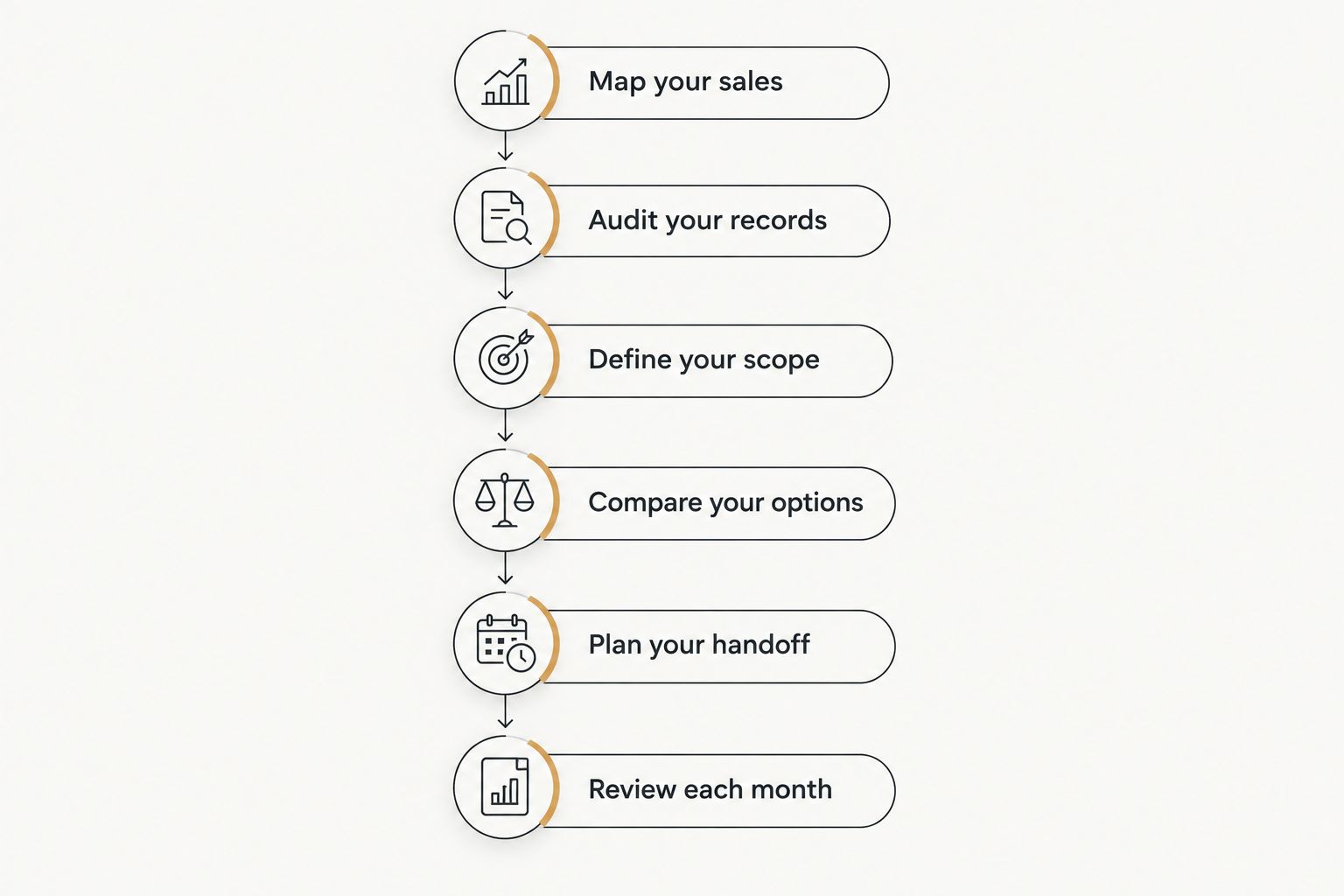
How to choose monthly restaurant accounting services
Map your sales
Start manually with a sheet listing every way customers pay you. Put counter transactions, online orders, delivery marketplaces, catering, and cash on separate lines when those channels apply.
Then trace each channel from the sales report to the money received. For example, a delivery settlement can reflect commissions and refunds, while a card payout can arrive separately from the day’s cash receipts. The useful question is not simply whether the bank received money; it is whether the records explain the difference.
You can do this yourself with exported reports and a spreadsheet. Give a prospective provider the same map so the proposal reflects your real workload rather than a generic restaurant description.
- List each sales channel and its supporting report.
- Identify where fees, refunds, tips, and taxes appear.
- Match each settlement source to its bank deposits.
- Note who records cash sales and cash spending.
Audit your records
Review the last 3 months of records before requesting proposals. This is a practical review window, not a claim about how long cleanup takes. It helps you show a provider whether you need ordinary monthly work, overdue corrections, or both.
Look beyond whether transactions have been downloaded into software. Check whether bank balances have been reconciled, supplier payments have supporting bills, and unexplained deposits have been investigated. An imported transaction is a starting point, not proof that the books are finished.
Keep doing the work yourself if you can complete these checks consistently. Professional help becomes useful when unresolved items carry into the next month or when keeping the books current depends on time you cannot reliably protect.
- Gather bank and credit-card statements for the review period.
- Identify the last month with completed reconciliations.
- Collect missing sales, payroll, and delivery reports.
- List unresolved transfers, owner payments, and deposits.
- Separate overdue cleanup from recurring monthly work.
Define your scope
Write down what you want someone else to own each month. If you are considering Full Plate, ask for that responsibility list in writing; do not assume monthly bookkeeping includes bill payment, payroll processing, inventory counts, or tax filings.
The faster path is delegation with clear boundaries. You still provide complete source records and answer questions about unfamiliar transactions, while the agreed work moves out of your personal task list. The contract determines exactly what changes after hiring.
Use the guide to what monthly restaurant bookkeeping services should include to prepare your scope questions. For 2026, distinguish recurring responsibilities from special projects so both sides know what happens during an ordinary month.
- Record collection: Decide who retrieves each report.
- Reconciliations: Specify the accounts and settlement sources covered.
- Reporting: Name the reports and the questions they should answer.
- Exceptions: Agree how missing records and unexplained transactions are handled.
- Tax coordination: Define who prepares, reviews, and files each required return.
Compare your options
Compare doing the books yourself with buying recurring help—not just one service provider against another. DIY gives you direct involvement and immediate familiarity with transactions. Its limitation is that the work still competes with operating the restaurant.
A monthly bookkeeping service changes who performs the agreed tasks, but it does not remove your responsibility to approve decisions or supply records. Software helps organize information; it does not decide whether an unexplained withdrawal belongs to food purchases, equipment, or an owner payment.
Ask every candidate to explain the same sample workflow. Use a delivery payout with a refund, a payroll withdrawal, and a supplier payment. You are evaluating how clearly the provider explains the work, not asking for unpaid cleanup.
- DIY bookkeeping — best for: Owners who finish reconciliations consistently.
- Monthly bookkeeping — best for: Owners who want recurring work assigned elsewhere.
- Owner plus reviewer — best for: Owners who want to keep entries but obtain periodic checks.
- Tax-focused support — best for: Defined filing work, with monthly responsibilities addressed separately.
Plan your handoff
Keep ownership of your financial accounts and use separate user access where your systems support it. Write down who authorizes payments, who changes account settings, and who receives questions. Hiring bookkeeping help should change the workload, not leave you uncertain about permissions.
Agree on 1 transition month for organizing responsibilities and checking the opening position. Treat that as a planning choice, not a promised completion time. Older missing records or unresolved balances need a separate discussion before you assume the recurring work can proceed normally.
For a 2026 handoff, document the point at which your own entries stop and the provider’s work begins. Otherwise, both parties can enter the same transaction or assume the other person handled it.
- Confirm the last completed accounting period.
- Assign access through individual accounts where possible.
- Record who handles entries during the transition.
- Keep supporting documents in an agreed shared location.
- Confirm how you receive records if the engagement ends.
Review each month
Set aside 30 minutes each month as an initial review appointment, then adjust the time to the questions your restaurant generates. This is a suggested routine, not a service standard. The purpose is to resolve questions while the transactions are still familiar.
Read the reports alongside what happened in the restaurant. A larger food purchase can reflect stocking ahead of a busy period, not just higher consumption. A lower bank balance can reflect a loan payment or equipment purchase rather than weaker trading.
Ask the bookkeeper to distinguish the explanation from the action. You need to know whether a change reflects timing, a recording error, or an operating issue that deserves your attention.
- Check whether all agreed accounts are reconciled.
- Review sales channels and unexplained settlement differences.
- Discuss food purchases, payroll, and other major spending changes.
- Confirm which questions still require your answer.
- Record the owner’s next actions and responsible person.
The hiring process follows the same sequence whether you keep some bookkeeping yourself or delegate the recurring work. Establish the records first, then the responsibilities, then the review routine.
Compare the bookkeeping arrangements
Choose an arrangement according to who will actually complete the work. The best option is the one with clear ownership of recurring tasks and an owner review you will attend. No arrangement removes the need for accurate source records.
| Option | Best for | Practical advantage | Key limitation |
|---|---|---|---|
| Owner-managed bookkeeping | Owners who consistently finish the books | Direct knowledge of transactions and control over the routine | Depends on the owner protecting time and resolving exceptions |
| Owner entries with periodic professional review | Owners who want to remain hands-on | Keeps daily work with the owner while adding a separate review | Corrections still require coordination and clear responsibilities |
| Recurring monthly bookkeeping service | Owners ready to delegate agreed recurring tasks | Assigns defined work to a provider | Does not automatically include payroll, inventory, bill payment, or tax filing |
| Tax-focused engagement | Owners seeking specific return preparation or tax advice | Addresses the defined tax assignment | Does not establish who maintains the books between filings |
When comparing proposals, read the exclusions as closely as the deliverables. Ask what happens when a delivery statement is missing, a bank account is added, or an earlier month needs correction. A useful proposal explains those boundaries without making you interpret broad promises.
For your 2026 comparison, require the same requested scope from each candidate. Comparing different responsibilities tells you little about which arrangement fits your restaurant.
Discuss your monthly bookkeeping needs
Ask Full Plate to clarify recurring responsibilities, record requirements, and the handoff process.
Common mistakes Florida counter-service owners make
Treating net payouts as sales
A delivery deposit after deductions does not describe the full sale. Keep the settlement detail so sales, fees, refunds, and other adjustments can be recorded separately. Otherwise, your books lose the explanation behind the cash received.
Assuming tax filing means monthly bookkeeping
A provider preparing a return is not automatically responsible for reconciling your accounts throughout the year. Name the monthly owner of that work, even when the same firm handles both assignments.
Expecting bookkeeping to replace stock counts
Purchasing records show what you bought, not necessarily what the kitchen used during the period. If you want food-cost reporting based on inventory changes, ask who performs stock counts and how those records reach the bookkeeper.
Comparing seasonal periods without context
For a Florida counter that experiences visitor-driven swings, a busy period and a quiet period answer different questions. Add operating context to the review: trading days, closures, catering orders, and changes in service. Do not assume a movement in sales explains itself.
Handing over access without assigning decisions
A bookkeeper needs records and answers, but access alone does not establish authority. Keep payment approvals and account-control responsibilities explicit. You should know which actions need your approval before the first monthly cycle begins.
FAQ
What are restaurant accounting services for a counter-service restaurant?
Restaurant accounting services organize and review the financial records behind your restaurant’s sales, spending, and balances. The engagement must specify whether it includes monthly bookkeeping, payroll work, tax filings, or other responsibilities.
Can I keep doing my Florida restaurant’s books myself?
Yes, DIY bookkeeping is a reasonable choice when you consistently reconcile accounts, retain supporting records, and resolve differences. Consider recurring help when unfinished work repeatedly carries into the next month.
Is monthly bookkeeping better than accounting software alone?
Monthly bookkeeping assigns work to a person or provider, while software supplies tools for recording and organizing it. The right choice depends on whether you need a system, someone to perform the work, or both.
What should I ask Full Plate before hiring?
Ask Full Plate to confirm the recurring tasks, required records, reporting routine, and responsibilities that remain yours. Also clarify cleanup work, tax coordination, account access, and how records are returned when the engagement ends.
Does monthly restaurant bookkeeping include Florida tax filings?
Only the written engagement establishes whether Florida tax filings are included. Confirm who prepares, reviews, and submits each return rather than assuming bookkeeping covers filing.
What records should I prepare before requesting a proposal?
Prepare recent bank statements, credit-card statements, sales reports, delivery settlements, payroll reports, and supporting bills. Identify the last reconciled month and explain any missing records so the proposed scope matches the work.
How do I know whether monthly bookkeeping is working?
Check whether the agreed accounts are reconciled, reports arrive according to the agreed schedule, and unresolved questions have clear owners. You should also understand the explanations behind material changes rather than receiving reports without discussion.
One last thing
Ask for a walkthrough of a difficult transaction before you hire. Choose an actual delivery settlement or supplier payment you already understand, and ask the candidate to explain the records needed and the questions they would raise.
For your 2026 decision, that conversation is more useful than a promise to handle everything. It shows whether you can work together when the records need an explanation—not just when every transaction is straightforward.