
Choose a restaurant accountant in Florida by checking how they handle restaurant transactions, what monthly work they include, and which decisions stay with you. For your 2026 search, separate ongoing bookkeeping from tax preparation: hiring someone for one does not establish responsibility for the other.
- Choose a restaurant accountant by checking monthly scope, restaurant experience, reporting, and owner access—not the job title alone.
- Full Plate is best for Florida restaurant owners considering ongoing monthly bookkeeping, subject to confirming the written scope.
- Keep DIY bookkeeping when records stay current and reconciled; consider professional help when unresolved work prevents a dependable monthly close.
- Compare written proposals using the same restaurant records, responsibilities, and reporting requirements.
Why this matters
Your restaurant needs books that explain the business, not just a folder ready for tax season. Card settlements, delivery payouts, supplier bills, payroll, and sales tax records need to fit together without counting money twice or overlooking deductions from deposits.
For Florida owners considering Full Plate, restaurant accountant selection should start with the work you want off your plate. Write down whether you need monthly bookkeeping, historical cleanup, tax preparation, payroll support, or coordination among separate providers. Then ask which responsibilities the proposed engagement actually covers.
Hire for a defined monthly process, not an impressive list of accounting terms. You should understand what gets checked, what you receive, and what still requires your approval.
How do you choose a restaurant accountant in Florida?
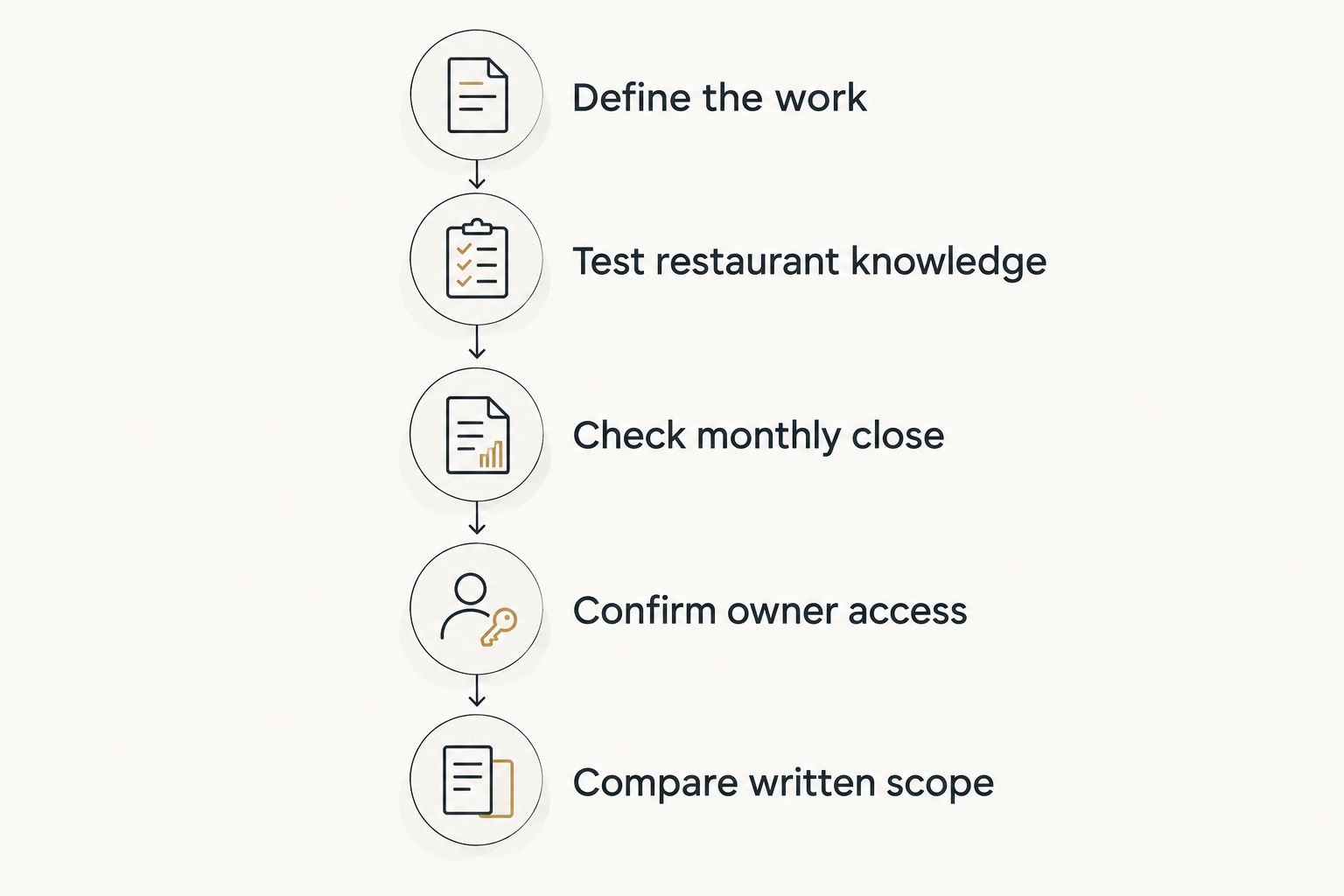
Use the same selection process for every candidate. A useful proposal explains how your restaurant's records become completed books and who resolves the questions along the way.
- Define the work. List the tasks you handle now and the tasks you want someone else to own. Separate current monthly work from unfinished historical records.
- Test restaurant knowledge. Ask the candidate to explain how sales reports, payment settlements, delivery deductions, tips, and payroll records fit together.
- Check the monthly close. Ask what they reconcile, how they identify missing information, and what prevents them from finishing a month.
- Confirm owner access. Establish who controls the accounting account, how access is granted, and whether you can retrieve your records when the engagement ends.
- Compare written scope. Review deliverables, exclusions, communication, and responsibility for filings before you sign.
Ask each candidate to walk through 1 completed month of your restaurant's records during the selection process. Use the same month for each conversation so differences in their explanations are easier to identify. Share sensitive information only through an agreed secure method.
Compare the kind of help, not just the provider
A restaurant owner, a monthly bookkeeper, and a tax accountant can have different jobs. Do not assume that choosing one removes the need to define the others.
| Approach | Best for | Main benefit | Main limitation |
|---|---|---|---|
| DIY bookkeeping | Owners who keep records current and can reconcile accounts | You retain direct involvement and knowledge of transactions | You remain responsible for completing and checking the work |
| Ongoing monthly bookkeeping | Owners who want recurring recordkeeping and reconciliation support | A defined engagement assigns recurring work to a provider | You still supply information, answer questions, and review results |
| Tax-focused accounting engagement | Owners seeking help with tax preparation or tax advice | The engagement addresses specified tax responsibilities | Monthly bookkeeping is not included unless the agreement says so |
DIY bookkeeping is a valid choice when the work is complete and dependable. Professional help becomes useful when you need someone else to own recurring tasks, investigate unresolved items, or establish a consistent close.
What restaurant experience should you look for?
Ask for explanations that follow money through your business. A candidate should be able to discuss a dine-in sale, a card settlement, a delivery order, and a supplier payment without treating every bank deposit as sales revenue.
For a delivery-heavy Florida restaurant, ask how the provider would separate sales activity from platform deductions and the resulting payout. For a restaurant accepting event deposits, ask how they distinguish money received before an event from revenue recorded when the service is provided.
These are interview scenarios, not a request for unpaid bookkeeping. You are checking whether the candidate understands the questions that need answering before recording transactions.
Ask about Florida responsibilities explicitly
Ask who handles Florida sales tax records, return preparation, filing, and payment authorization. These are separate responsibilities; the proposal should assign each one rather than leave them under a general promise to handle the books.
If a candidate will provide regulated professional services, verify the credentials relevant to that work through the appropriate licensing authority. Do not treat the words accountant, bookkeeper, and CPA as interchangeable evidence of qualifications.
For a 2026 engagement, ask how the provider confirms current requirements and communicates changes affecting your restaurant. You need a clear responsibility, not an interview answer based on a remembered tax rate.
What should ongoing monthly bookkeeping include?
Start with the records your restaurant generates and ask how each becomes part of the monthly close. The written scope should distinguish work performed routinely from work that requires a separate engagement.
Request 3 sample documents: a profit and loss statement, a balance sheet, and a monthly close checklist. Blank or anonymized examples are sufficient; another restaurant's confidential information is not necessary.
Ask the candidate to explain the documents in plain English:
- Profit and loss statement: How will sales and operating expenses be grouped so you can review restaurant performance?
- Balance sheet: How will cash, amounts owed, loans, and other balances be checked?
- Monthly close checklist: What work must be completed before the reports are treated as ready for review?
Then ask what the reports do not establish. Completed bookkeeping does not automatically explain why food usage changed, whether a menu item needs repricing, or whether you should add another shift. If you want help interpreting results, put that discussion in the scope.
Separate cleanup from recurring work
Historical cleanup and current monthly bookkeeping need separate definitions. Ask which records require attention, who supplies missing documents, and how unresolved items will be presented to you.
A proposal should also explain whether current work continues while older records are being corrected. Otherwise, you can agree on cleanup without agreeing on how the restaurant avoids falling behind again.
Why restaurant accountant scope varies
Restaurant accounting work varies because the records and responsibilities vary. For your 2026 comparison, use these factors to explain differences between proposals rather than assuming every monthly engagement covers the same work.
- Sales channels: Counter service, table service, delivery platforms, catering, and events produce different records to review.
- Payment flows: Card settlements, cash deposits, refunds, and platform deductions need a clear connection to sales activity.
- Payroll records: Ask where payroll processing ends and bookkeeping review begins, including the treatment of tips and payroll liabilities.
- Record condition: Missing statements, unreconciled balances, and unfinished periods create work distinct from maintaining current books.
- Reporting needs: A completed report and a discussion of operating results are different deliverables.
- Assigned responsibilities: Tax filings, bill payment, payroll processing, and owner approvals belong in the agreement if included.
Give every candidate the same description of your restaurant. Comparing proposals is not useful when one assumes clean records and another includes resolving unfinished work.
What can you keep doing yourself?
You can keep collecting receipts, approving payments, reviewing sales activity, and explaining unusual transactions even after you hire monthly help. Those tasks preserve your knowledge of the business; outsourcing bookkeeping does not require giving up operating control.
If you continue doing the books yourself, use a written close checklist. Confirm that bank and card balances reconcile, investigate unexplained transactions, and review reports before relying on them. Record questions as they arise rather than depending on memory at tax time.
The decision is about reliable completion, not whether an owner is capable of bookkeeping. A restaurant owner who completes the work consistently has a different need from an owner whose unresolved records keep accumulating.
What changes when you hire Full Plate?
When considering Full Plate for restaurant accountant support, define which monthly tasks move from you to the provider. Ask for a written division of responsibilities covering records, reconciliations, questions, reporting, and approvals.
Keep the limits visible too. Hiring monthly help does not remove your responsibility to provide business context or review the results. Confirm the actual services before treating tax filings, payroll, bill payment, or advisory discussions as included.
How should you compare proposals before signing?
Compare 2 written proposals against one shared checklist. This is a practical selection method, not a requirement to choose the provider with the longest service list.
For each proposal, identify:
- The recurring work and the records it covers.
- The historical work excluded from the monthly engagement.
- The information you must supply and how questions reach you.
- The conditions required to complete each reporting period.
- The reports and explanations you receive.
- Your account access and the process for ending the engagement.
Ask candidates to correct anything that remains vague. Terms such as full service and monthly support do not tell you whether someone reconciles a delivery clearing balance or simply records the bank payout.
Before starting a 2026 engagement, also confirm how changes in scope are approved. Adding a sales channel, opening another location, or requesting historical corrections should trigger a discussion rather than an assumption about responsibility.
Do I need a restaurant accountant or a bookkeeper?
You need ongoing bookkeeping when the main job is maintaining transaction records, reconciling accounts, and producing agreed monthly reports. If you also need tax advice, return preparation, or other professional services, confirm who provides those services and under what engagement.
The title alone does not answer the question. Ask the provider to describe the work they will complete, the qualifications relevant to it, and the work they will refer elsewhere.
When should I stop doing my restaurant's books myself?
Consider outside help when you cannot consistently finish reconciliations, resolve unexplained balances, or produce reports you trust. A growing pile of unanswered questions is a reason to change the process, even if you understand how to enter transactions.
If your books are current and you can explain the balances, continuing DIY is reasonable. You can also hire help for a defined problem without assuming that every task must move outside the restaurant.
FAQ
What's the best way to choose a restaurant accountant in Florida?
Choose a restaurant accountant by checking restaurant transaction knowledge, written monthly scope, reporting, and owner access. Ask every candidate to explain the same set of restaurant records so you can compare the substance of their answers.
Is monthly bookkeeping the same as tax preparation?
Monthly bookkeeping is not the same as tax preparation. Confirm who maintains the records, prepares returns, files them, and authorizes payments; do not assume one engagement includes every responsibility.
Can I keep doing some restaurant bookkeeping myself?
You can keep selected bookkeeping tasks while hiring help for others. Put the division in writing so collecting records, entering transactions, reconciling accounts, and reviewing reports each have a clear owner.
Does my restaurant accountant have to be in Florida?
A Florida address alone does not establish restaurant accounting competence. Ask any candidate to explain how they handle your Florida responsibilities, restaurant records, communication, and document access.
What should I ask about delivery app payouts?
Ask how the provider connects delivery sales, deductions, refunds, and payouts without treating the net deposit as the entire sales record. Request a plain-English explanation of the records needed to check that connection.
What should I ask Full Plate before hiring?
Ask Full Plate to define the monthly bookkeeping work included for your restaurant and the responsibilities you retain. Confirm cleanup, tax work, payroll, reporting discussions, account access, and exclusions in the written proposal.
One last thing
Ask a finalist to explain an unresolved transaction without immediately assigning it to an expense category. The useful answer identifies what evidence is missing, who should supply it, and how the question stays visible until resolved.
For your 2026 decision, that is a better test than a polished sample report. Choose the provider whose process makes unanswered questions visible—not the one who makes them disappear into a category.