
Yes—restaurant accounting services can help Florida restaurant owners explain rising food costs by separating purchasing, inventory changes, and sales performance. The explanation depends on complete invoices, consistent inventory counts, and sales records; bookkeeping alone cannot show what happened in the kitchen. For your 2026 review, ask for the reason food costs changed, not just a report showing that they increased.
- Restaurant accounting services explain food-cost changes when invoices, inventory, and food sales cover the same period.
- Florida restaurant owners can keep daily records themselves and hire help for monthly reconciliation and review.
- Higher food purchases do not automatically mean higher food consumption.
- Before hiring Full Plate, confirm whether monthly bookkeeping includes inventory adjustments and food-cost explanations.
Can restaurant accounting services help explain rising food costs?
Yes, provided the service connects the accounting records to your restaurant's operating records. A bank withdrawal shows money leaving your account. It does not establish which ingredients you used, whether a delivery stocked next month's shelves, or whether an invoice includes cleaning supplies.
Start by defining what monthly restaurant bookkeeping services should include. Food-cost review needs an agreed scope, not an assumption that every bookkeeping arrangement includes inventory analysis.
| Approach | Best for | What you can establish | Main limitation |
|---|---|---|---|
| Owner-managed bookkeeping | Owners who maintain records and understand their reports | Invoice changes, purchasing totals, and food costs when inventory is recorded consistently | You must make time to reconcile accounts and investigate differences |
| Monthly restaurant accounting services | Owners seeking regular reconciliation and explanations | Recorded food costs, inventory adjustments, and changes between comparable periods, when included in scope | The provider still needs accurate records from your restaurant |
These are different ways to organize the work, not a choice between caring about your numbers and handing over control. You still decide how the kitchen operates.
Why this matters for Florida restaurant owners
A Florida restaurant preparing for a busy tourist period faces a different purchasing decision from one reducing orders ahead of a quieter stretch. Buying more before demand arrives can increase purchases without increasing the amount of food consumed during that accounting period.
Your 2026 bookkeeping should preserve that distinction. Otherwise, you risk changing menu prices or cutting orders in response to an incomplete explanation.
The useful question is not simply whether spending increased. It is whether ingredient prices, food usage, or sales changed—and which records support the answer.
What a useful food-cost review should show
A useful review separates food purchased from food used. The standard inventory calculation is:
Beginning food inventory + food purchases − ending food inventory = food cost for the period.
Food-cost percentage then compares that cost with food sales:
Food cost ÷ food sales × 100 = food-cost percentage.
Keep the categories consistent. If the numerator covers food ingredients but the denominator includes unrelated revenue, the percentage does not describe food sales alone. Ask your provider which sales and expenses enter the calculation before comparing reports.
For your 2026 reporting, request both the food-cost amount and the percentage. The amount shows the recorded cost of food used. The percentage shows its relationship to food sales; either figure alone leaves part of the story out.
A useful explanation should identify:
- What changed between the periods being compared.
- Whether the change reflects purchasing, inventory, sales, or an accounting correction.
- Which records support that conclusion.
- Which operational question remains for you or your kitchen manager.
An accountant can identify a difference that needs investigation without proving its kitchen-level cause. That distinction keeps a financial finding from turning into an unsupported accusation about waste or staff performance.
Why your restaurant's food costs vary
Food costs can change for different reasons that require different responses. Use these five categories to organize the discussion rather than treating every increase as a supplier problem.
- Supplier unit costs. Compare the same ingredient, pack size, and unit of measure. A larger invoice does not establish a higher unit cost if the quantity also changed.
- Inventory and purchase timing. Food delivered before the period ends can remain on the shelf afterward. Ending inventory is what separates stocked ingredients from ingredients used.
- Waste and spoilage. Discarded ingredients contribute to food cost without producing a sale. Waste records help you investigate this explanation; the bank statement does not establish it.
- Portion and recipe changes. Using more of an ingredient per dish changes its food cost even when the supplier's unit cost stays the same. Recipe and portion records support that comparison.
- Sales mix and selling prices. Different dishes have different ingredient costs. A shift in what guests order can change the overall food-cost percentage even without a supplier increase.
These drivers are questions to test, not findings about your restaurant. Ask the person reviewing your books to distinguish a documented cause from a possibility that needs operating records.
How to prepare records for a useful monthly explanation
For a 2026 review, choose a reporting period and keep purchases, inventory, and sales aligned to it. Do not compare a partial month with a completed month and treat the difference as an operating trend.
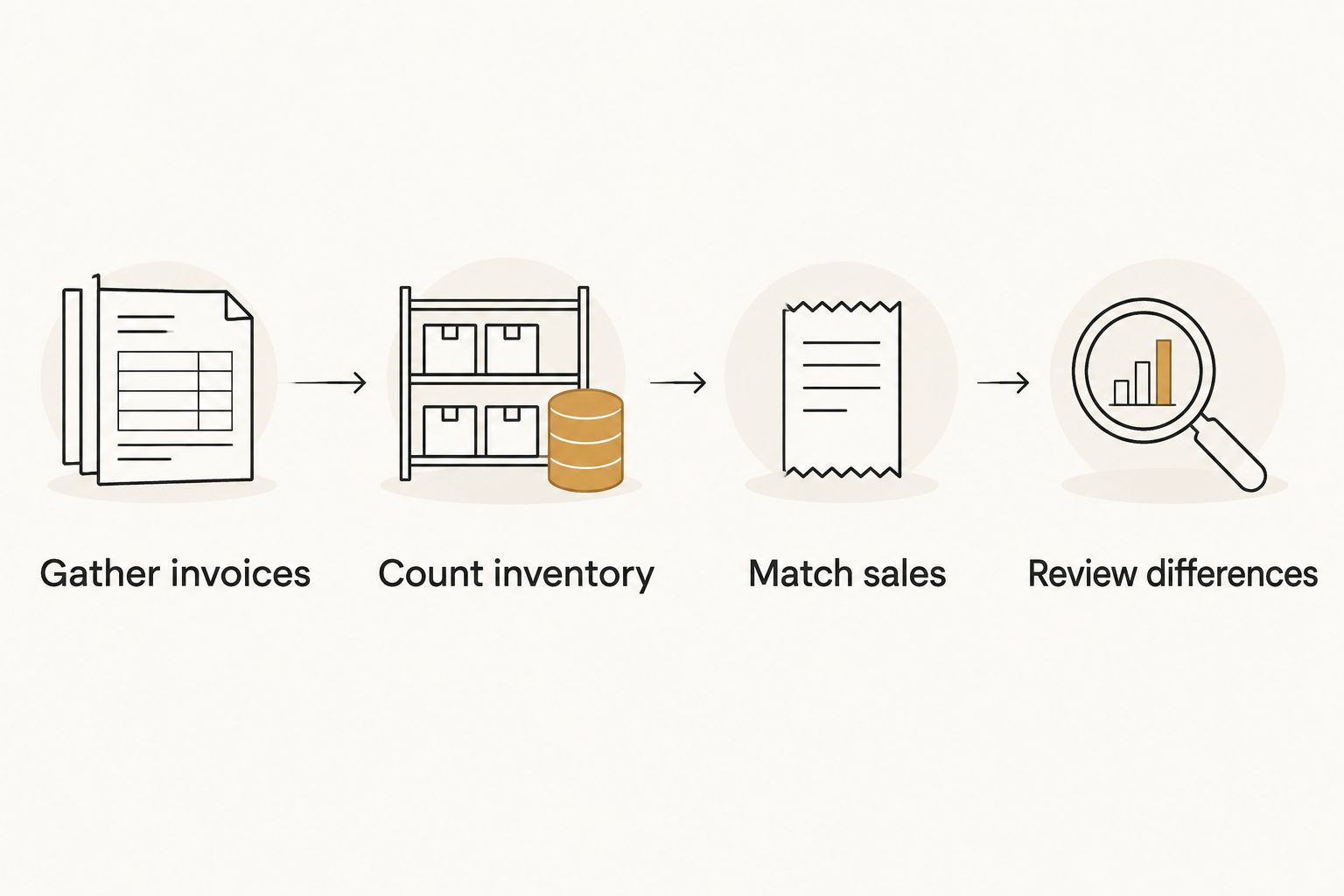
Gather invoices
Keep itemized supplier invoices, credits, and supporting receipts. A payment total cannot show whether you bought produce, disposable containers, or cleaning products on the same account.
Ask your bookkeeper how to submit corrected invoices and supplier credits. Without that process, the explanation can rest on an amount that no longer reflects the transaction.
Count inventory
Record food on hand at the reporting boundary using consistent units and valuation methods. Include the storage areas relevant to your restaurant, rather than counting only the walk-in because it is easiest to inspect.
For a comparison between 2 monthly periods, check that both periods use the same counting approach. A changed method can create a reporting difference that looks like an operating change.
Match sales
Provide sales reports that separate food from other revenue categories. Explain refunds, discounts, and reporting adjustments so the person reviewing the books understands the denominator used in your food-cost percentage.
Keep the reporting dates aligned. Comparing calendar-month purchases with a different sales window weakens the explanation before anyone begins reviewing the results.
Review differences
Compare unit costs, recorded inventory, food sales, and any waste or recipe records. Ask what the evidence establishes and what still needs a kitchen-level check.
End the review with an assigned action: correct a coding error, check an invoice, inspect portion practices, or adjust an order. A report becomes useful when you know what to investigate next.
What you can handle yourself—and when monthly help makes sense
You can keep control of daily records without doing every part of the accounting. Saving invoices, recording waste, checking deliveries, and organizing inventory counts all remain useful owner-managed tasks.
DIY bookkeeping is a reasonable choice when you can maintain the records, reconcile the accounts, and explain the reports consistently. The advantage is direct familiarity with the transactions. The trade-off is that the review still needs your attention during busy restaurant weeks.
Monthly help becomes useful when reconciliation falls behind, categories change from month to month, or you cannot explain a food-cost movement from the records you have. Hiring someone does not replace inventory counts or kitchen oversight. It changes who organizes, checks, and explains the financial information under the agreed scope.
Full Plate is best considered by Florida restaurant owners seeking ongoing monthly bookkeeping rather than a replacement for kitchen oversight. When discussing restaurant accounting services with Full Plate, ask which parts of that work the proposed arrangement includes.
The limitation matters as much as the benefit: even organized monthly books cannot reconstruct unrecorded waste or verify portions that nobody checked. Keep responsibility for those operating records explicit.
What should you ask before hiring a monthly bookkeeping service?
Use your food-cost concern as a practical hiring discussion. You are not asking for a promise to reduce spending. You are asking how the service will turn your records into an explanation you can use.
Will you report purchases or food used?
Ask whether monthly reports include inventory adjustments and how those adjustments are supported. If the arrangement reports purchases only, understand that limitation before treating the result as food consumed.
Neither report is useful when its label is unclear. Ask the provider to explain exactly what the food-cost line represents.
What will you need from the restaurant?
Request a written list covering invoices, credits, sales reports, inventory records, and any other required documents. Agree on who provides each record and how missing information gets flagged.
The handoff should fit your restaurant's routine. A process that depends on documents nobody collects will not answer your questions reliably.
How will you explain a change?
Ask for the proposed review process, not an unsupported savings claim. Will the provider distinguish an invoice increase from an inventory adjustment? Will unresolved questions be stated clearly?
Before choosing Full Plate or another provider in 2026, confirm who answers follow-up questions and whether that discussion is part of the monthly scope. Do not assume a delivered report includes an explanation meeting.
Where does bookkeeping stop?
Clarify responsibility for physical counts, recipe costing, menu decisions, and supplier negotiations. These tasks connect to food costs but are not interchangeable with bookkeeping.
Write down the boundary. It protects you from expecting operational work that was never included and gives the provider a clear basis for requesting information.
Discuss your monthly bookkeeping needs
Ask which records and food-cost reviews belong in your monthly scope.
Can a bookkeeper tell whether suppliers are charging more?
A bookkeeper can compare supplier unit costs when itemized invoices show comparable ingredients, quantities, and pack sizes. A higher total invoice alone does not prove an increase in ingredient prices.
Ask for a like-for-like comparison. If the product specification changed, settle that difference before using the comparison to negotiate with the supplier.
Do you need weekly records if you hire monthly help?
You still need records collected as the restaurant operates, even when the financial review is monthly. Invoices, credits, waste notes, and delivery discrepancies are easier to document when the event occurs.
Monthly bookkeeping describes the reporting arrangement; it does not mean you should postpone recordkeeping until the end of the month.
FAQ
Can restaurant accounting services explain rising food costs?
Restaurant accounting services can explain recorded food-cost changes when purchasing, inventory, and sales records align. Kitchen-level causes such as waste or inconsistent portions require operating records as well.
Why are food purchases higher when sales are flat?
Higher food purchases with flat sales can reflect changes in unit costs, quantities ordered, or inventory held. Compare itemized invoices and ending inventory before deciding which explanation applies.
Can I review restaurant food costs myself?
You can review food costs yourself if you maintain invoices, consistent inventory records, and comparable food-sales reports. Monthly professional help is useful when reconciliation or explanations become difficult to maintain.
Does monthly bookkeeping include inventory counting?
Inventory counting is not something you should assume is included in monthly bookkeeping. Confirm who performs physical counts, who values inventory, and who records the adjustment.
Will Full Plate take over purchasing decisions?
Confirm purchasing responsibilities directly with Full Plate before hiring. Define the bookkeeping scope separately from supplier selection, ordering, and kitchen management.
Should I increase menu prices when food costs rise?
A food-cost increase alone is not enough to justify a menu-price decision. First identify whether the change comes from ingredient costs, usage, inventory timing, sales mix, or a reporting correction.
What should I bring to a food-cost review?
Bring itemized invoices, supplier credits, beginning and ending inventory records, and food-sales reports for the same period. Include waste or recipe records when the question involves kitchen usage.
One last thing
Check what is still on the shelf before deciding what the kitchen used. A large delivery can make purchases look worse while increasing inventory rather than consumption.
For your next 2026 review, ask for 1 clear explanation of the largest food-cost change, the records supporting it, and the next action. That is a better hiring test than a promise to make every number improve.