
You do not need a restaurant accountant just because you use bookkeeping software; you need professional help when nobody is checking that the records are complete, accurate, and ready for decisions. For an independent Florida restaurant, software supports the work, but someone still needs to reconcile accounts, explain differences, and keep the monthly books current.
- A restaurant accountant adds review and judgment; software alone does not establish that your books are correct.
- DIY restaurant bookkeeping works when you can reconcile accounts, resolve differences, and finish each month consistently.
- Evaluate Full Plate for ongoing Florida restaurant bookkeeping when you want monthly help rather than another software subscription.
- Before hiring, separate monthly bookkeeping, cleanup, tax preparation, and advisory work in the written scope.
Why this matters
A Florida restaurant owner can have connected bank accounts, imported sales, and a dashboard without having finished books. A deposit appearing in your software does not establish whether the related sales, fees, refunds, and taxes were recorded correctly.
The decision is not software versus an accountant. It is whether you can reliably finish and review the work yourself.
If you are considering Full Plate, start with the monthly responsibilities you want to hand over. Keep your existing software decision separate from your decision about who does the work.
Do you need a restaurant accountant if you already use software?
You need a restaurant accountant or bookkeeper when your software contains transactions but you cannot confidently explain the balances. You can keep doing the books yourself when you understand the process, complete it consistently, and resolve discrepancies rather than carrying them forward.
For your 2026 decision, compare who performs the work—not just which system holds the data.
| Approach | Best for | What it provides | Main limitation |
|---|---|---|---|
| Software with DIY bookkeeping | Owners who can maintain and review their own records | A place to record transactions and prepare reports, depending on the software | You remain responsible for accuracy and completion |
| Software with monthly bookkeeping help | Owners who want recurring recordkeeping and reconciliation handled | Defined monthly work and someone responsible for completing it | Tax preparation and advice are not automatically included |
| Software with accounting or tax advice | Owners with questions beyond routine recordkeeping | Advice within the professional's agreed scope | Routine bookkeeping still needs an assigned owner |
These approaches are not mutually exclusive. You can keep entering receipts yourself, hire someone to reconcile accounts, and use a separate tax professional for filing questions.
The useful question is: Who checks the books, what do they check, and what happens when something does not match? A software subscription does not answer that question.
When is doing the books yourself enough?
DIY bookkeeping is a reasonable choice when you can trace a transaction from its original record through to the final report. You do not need to outsource work you understand and consistently finish.
For example, you should be able to explain why a payment processor deposit differs from the sales recorded for the same activity. Processing fees, refunds, and settlement timing require separate attention; treating every deposit as new sales can produce misleading records.
Use this practical test:
- Accounts match: You reconcile bank and credit card accounts to their statements.
- Sales make sense: You can connect recorded sales with point-of-sale reports and settlement records.
- Questions get resolved: You investigate unfamiliar transactions instead of assigning a convenient category.
- Months get finished: You have a clear point when the period is reviewed and ready to use.
- Records stay accessible: You can retrieve invoices, statements, and supporting reports when needed.
The advantage is control: you know the transactions and can investigate them directly. The drawback is that the work still needs your attention during busy service periods, staffing changes, and time away from the restaurant.
For 2026, judge DIY by the condition of your books, not by whether you enjoy bookkeeping. Staying involved is useful; being the only person who understands unfinished records is a different situation.
When does professional bookkeeping become useful?
Professional help becomes useful when recurring bookkeeping tasks remain unfinished or the same unexplained differences keep returning. Hiring makes sense when you need a defined process and someone accountable for completing it.
Consider a Florida restaurant that receives customer payments through its dining room, online ordering, and delivery platforms. Each source needs a clear route into the books, with supporting records for deductions and adjustments.
You can handle that yourself. But if you routinely skip the supporting reports and record only the bank deposits, the problem is not necessarily your software—it is the unfinished work around it.
Look for these hiring triggers:
- Bank or credit card statements do not agree with the books.
- Delivery settlements are recorded without explaining deductions.
- Payroll entries are difficult to connect with payroll reports.
- Personal and restaurant transactions remain mixed or unresolved.
- Reports change because earlier periods keep receiving corrections.
- You cannot tell a prospective bookkeeper which month is complete.
Hire for a defined responsibility, not a vague promise to take accounting off your plate. A provider should explain what they will review, what they need from you, and how they will raise questions.
Before comparing proposals, read how to choose a restaurant accountant in Florida. Evaluate the proposed work as carefully as the provider's familiarity with restaurants.
Why the amount of help you need varies
The right arrangement depends on your records and responsibilities. Restaurant size alone does not tell you whether an owner can maintain reliable books.
These factors change the work involved:
- Payment channels: Dining-room payments, delivery settlements, and other sales channels need supporting records and a consistent recording method.
- Payroll records: Wages, tips, deductions, and payroll liabilities need to connect with the payroll reports.
- Account activity: More bank accounts, credit cards, and transfers create more balances to reconcile.
- Seasonal operations: Changes in trading activity require context when you compare periods and plan cash needs.
- Record condition: Missing statements or unresolved balances add work before routine monthly reporting becomes dependable.
- Owner involvement: Someone still needs to answer questions about purchases, transfers, and unusual activity.
A seasonal Florida restaurant should explain its operating pattern during the initial conversation. A delivery-heavy restaurant should show how settlement records are currently handled. Neither situation proves you need a particular package; both help define the work you actually need.
When reviewing proposals in 2026, ask each provider to describe how these factors affect the scope. Comparing proposals is difficult when one includes reconciliation and another leaves it with you.
What should change when you hire monthly help?
Hiring should change who performs and checks the agreed work. It should not leave you guessing about whether the month is finished.
Ask a prospective provider to describe the handoff in this order:
- Gather records: Agree on which bank statements, sales reports, payroll reports, invoices, and settlement records you provide.
- Reconcile accounts: Identify which accounts the provider checks and how unresolved differences are handled.
- Resolve questions: Establish how the provider asks about unclear transactions and how you respond.
- Review reports: Define which reports you receive and whether anyone explains unusual movements.
- Confirm completion: Agree on how you know the month is finished and which issues remain open.
These steps describe responsibilities to request, not services to assume. A proposal that says only bookkeeping leaves too much room for different expectations.
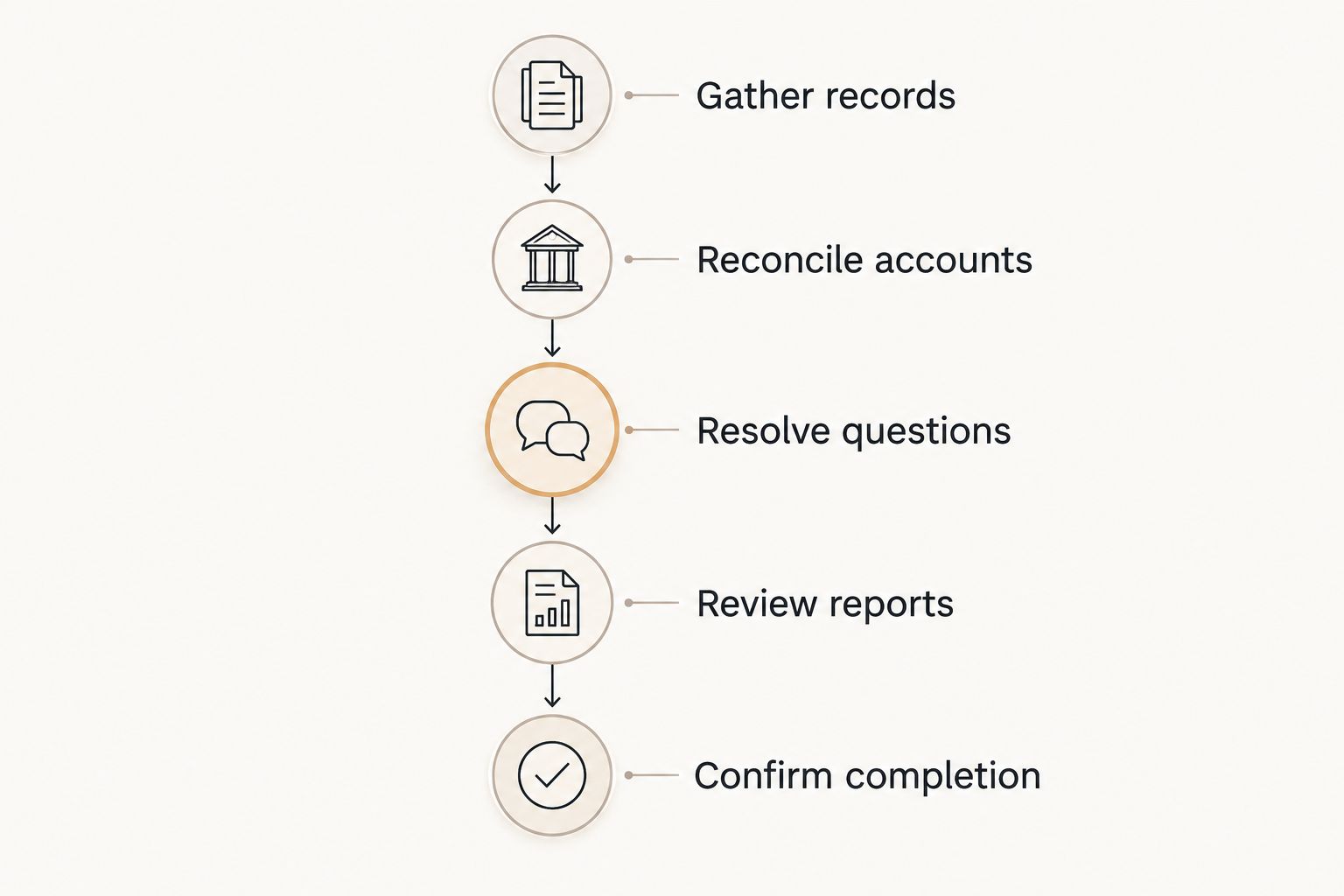
When discussing Full Plate restaurant bookkeeping, use this sequence to request a written scope. Ask what you keep doing, what the provider takes over, and what needs a separate agreement.
You should also establish who controls the software account and how access works. Hiring help does not require giving up visibility into your restaurant's records.
Do you need a bookkeeper, an accountant, or tax help?
Monthly bookkeeping addresses the recurring recording, reconciliation, and reporting work described in the engagement. Tax preparation and business advice are separate responsibilities unless the agreement explicitly includes them.
The word accountant alone does not tell you which services a provider supplies. Ask about the actual tasks and, where relevant, professional credentials rather than relying on a job title.
For your 2026 engagement, separate these questions:
- Who maintains and reconciles the monthly books?
- Who handles sales tax returns and related questions?
- Who prepares income tax returns?
- Who answers questions about business structure or tax treatment?
- Who coordinates when a bookkeeping correction affects a filing?
The benefit of separating responsibilities is clarity. The drawback is that you must make sure the people involved exchange the records they need; hiring separate professionals without a handoff process leaves gaps.
Do not assume that monthly bookkeeping includes every filing obligation. Ask for exclusions in writing as well as inclusions.
Can you keep your current restaurant software?
You can keep your current software if the prospective provider agrees to work in it and it supports the required records and access. Confirm compatibility before signing; do not assume that every bookkeeper supports every system.
Ask what would happen to transaction history, account access, and connected sales or payroll records if a change is proposed. A new system is a separate decision, not proof that the bookkeeping will improve.
Start with the accounting problem, then decide whether changing software helps solve it. If the issue is missing statements or unexplained deposits, those records still need attention after a switch.
Will hiring a bookkeeper let you stop checking the numbers?
No. Hiring a bookkeeper transfers agreed tasks, but you still need to review the reports and answer questions about the restaurant's activity.
Your involvement becomes more focused. Instead of performing every entry and reconciliation, you can review results, explain unusual transactions, and check that outstanding questions are resolved.
For an independent restaurant owner, that distinction matters. You should know whether a change reflects operating activity, a timing difference, or a correction—not simply accept a report because someone else produced it.
FAQ
Do I need a restaurant accountant if my software imports bank transactions?
You need professional help if you cannot verify and finish the books yourself; importing bank transactions is not the same as reconciliation. Someone still needs to check balances, classifications, and supporting records.
Can I do my Florida restaurant bookkeeping myself?
You can do your Florida restaurant bookkeeping yourself if you can maintain complete records, reconcile accounts, and resolve differences consistently. Assign responsibility for tax filings separately rather than assuming bookkeeping covers them.
What's the difference between restaurant bookkeeping and tax preparation?
Restaurant bookkeeping maintains the transaction records and account balances used for reporting. Tax preparation uses relevant records to prepare returns, and it should be explicitly included or separately assigned.
Will a restaurant bookkeeper work with my existing software?
A restaurant bookkeeper can work with your existing software only if the provider accepts it and it supports the agreed work. Confirm this before hiring, including how account access and connected records will be handled.
What should I ask Full Plate before hiring?
Ask Full Plate which monthly tasks are included, which records you provide, and how completed work is confirmed. Also ask whether cleanup, tax filings, and report discussions are included or separate.
Should I hire monthly help if my books are behind?
Discuss unfinished periods before starting a monthly bookkeeping engagement. Ask the provider to distinguish the work needed to correct earlier records from the work needed to maintain future months.
Can I keep control of my books after hiring someone?
You can keep control by agreeing on account access, record ownership, reporting, and approvals before the work starts. Review completed reports and answer transaction questions rather than stepping away entirely.
One last thing
Before signing a bookkeeping agreement in 2026, choose a recent completed month and ask the provider to walk through how they would verify it. Use real bank statements, sales summaries, settlement records, and payroll reports—not just a screenshot of your dashboard.
The useful answer is a clear explanation of what matches, what needs investigation, and what you would still need to supply. Buy a defined monthly process, not simply another person with access to your software.