
Hand over your Florida restaurant’s bookkeeping by delegating recordkeeping and reconciliation while keeping account ownership, payment approval, and report access. Put those boundaries in writing before work starts, then review the first monthly close together; hiring restaurant bookkeeping services does not require handing over control of your money.
- Restaurant bookkeeping services should handle preparation and reconciliation while you retain payment approval and account ownership.
- Florida owners considering Full Plate should agree on monthly bookkeeping responsibilities before granting access.
- Keep business-controlled logins, approve sensitive changes, and review unresolved transactions at each monthly close.
- Separate historical cleanup from ongoing bookkeeping so you know what the handover actually includes.
How do you hand over restaurant books without losing control?
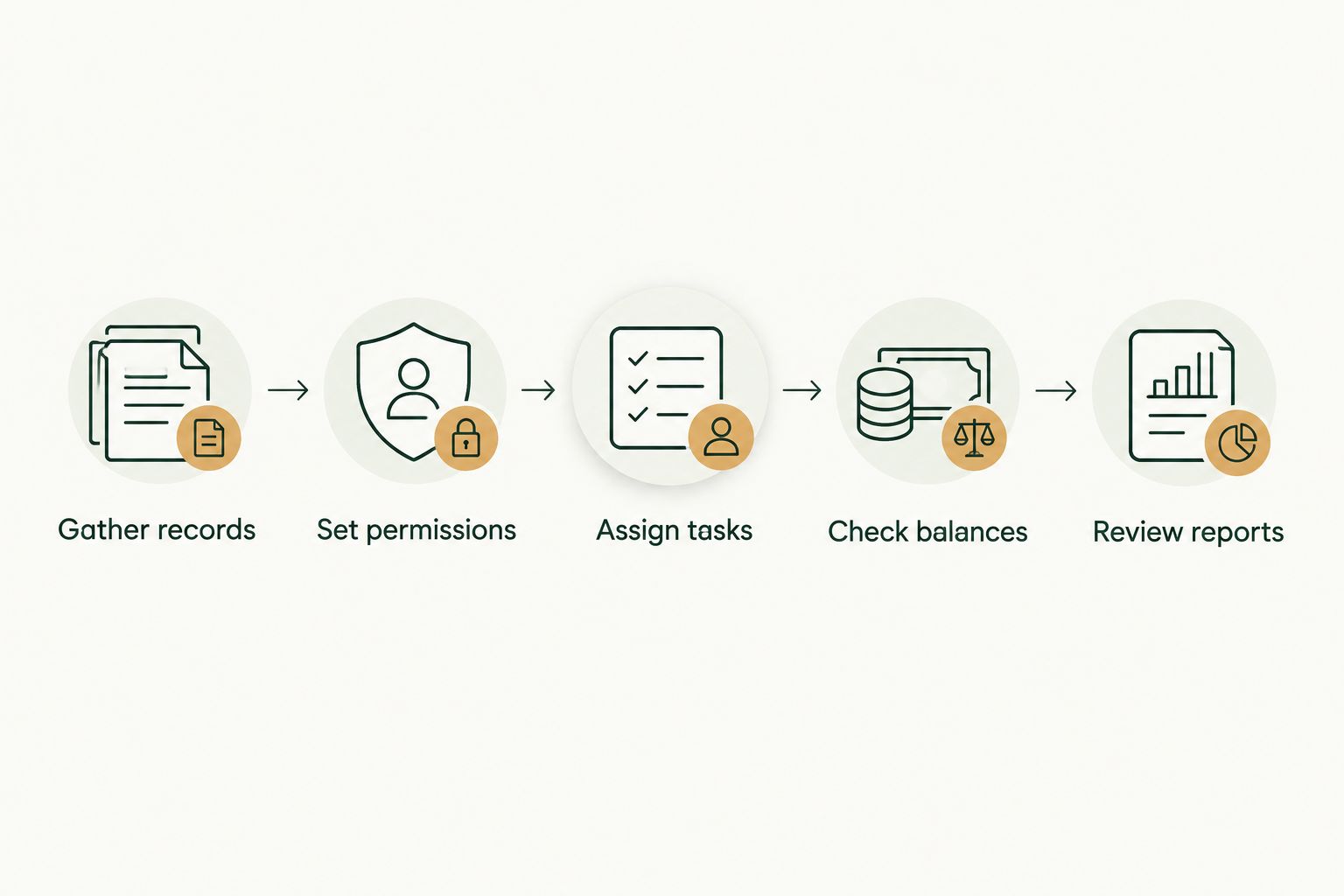
Transfer the work, not the authority to spend. Use the following handover checklist when discussing monthly bookkeeping with Full Plate or another provider. Ask the provider to document who prepares the books, who approves changes, and how you receive the finished reports.
Gather records
Create a shared list of the records your restaurant actually uses: bank statements, credit card statements, point-of-sale reports, payroll summaries, supplier bills, and delivery-platform statements. Include records of cash deposits, tips, refunds, and gift card activity where relevant.
For a 2026 handover, name the last month you consider complete and identify unfinished periods separately. Do not describe old books as finished simply because transactions appear in the accounting system. A completed period needs supporting records and reconciled balances.
Set permissions
Keep your restaurant as the account owner and use separate user access wherever the bank or software supports it. Select permissions that match the agreed job; a person reconciling transactions does not automatically need permission to move money.
Keep recovery details under business control. Never make a bookkeeper’s personal email address the only route back into your accounting records, and avoid sharing your owner login when separate access is available.
Assign tasks
Write down who collects documents, categorizes transactions, reconciles accounts, answers questions, and approves corrections. Add responsibility for payroll coordination and tax-related records if those tasks are part of the engagement.
Separate preparation from approval. For example, the bookkeeper can identify an unfamiliar supplier payment while you confirm whether the restaurant authorized it. Do not let an unanswered question become an undocumented guess.
Check balances
Agree on the opening balances before treating new monthly reports as reliable. Ask the provider to identify unreconciled accounts, unexplained differences, and missing records rather than quietly carrying them forward.
If historical cleanup is necessary, define it as separate work with its own completion standard. Otherwise, you cannot tell whether a current report reflects this month’s operations or corrections to an earlier period.
Review reports
Book a 30-minute review for each of the first 2 monthly closes. This is a suggested handover routine, not a promised service schedule; agree on the actual reporting date and meeting arrangements with your provider.
Review the profit and loss statement, balance sheet, reconciliations, and unresolved questions. Ask what changed, which entries need your approval, and what documents remain outstanding before accepting the close as complete.
Why this matters for a Florida restaurant owner
Your restaurant can have card sales, cash receipts, delivery-platform settlements, payroll, and supplier payments moving through different records. The bank statement alone does not explain every transaction. A deposit needs enough supporting detail to connect it to the activity behind it.
For your 2026 bookkeeping agreement, make that connection part of the job description. Ask how the provider will investigate a delivery-platform deposit that differs from reported sales, or a payroll withdrawal that you cannot match to the payroll summary.
Control comes from being able to inspect and question the records—not from personally entering every transaction. A useful handover leaves you with less preparation work and a clear approval role.
DIY bookkeeping or monthly support: what should you keep?
Doing your own books remains a reasonable choice when you keep records current, reconcile accounts, and understand the reports. Hiring help becomes useful when routine preparation repeatedly crowds out that review or leaves unresolved transactions accumulating.
Neither approach removes your responsibility to provide complete information. A service cannot explain an undocumented cash purchase simply because you have delegated bookkeeping.
| Approach | Best for | What you handle | Main advantage | Main limitation |
|---|---|---|---|---|
| Owner-managed bookkeeping | Owners who can maintain records and review them consistently | Preparation, reconciliation, questions, and approval | Direct familiarity with individual transactions | Routine work stays on your schedule |
| Monthly bookkeeping service | Owners ready to delegate preparation while retaining oversight | Document delivery, business explanations, approvals, and report review | Agreed bookkeeping tasks move to the provider | Results still depend on records, access, and timely answers |
Before hiring, write a 1-page responsibility sheet. Put each recurring task beside a named owner and a completion rule. Use that sheet to compare proposals instead of judging them by a broad promise to handle everything.
Ask Full Plate which restaurant bookkeeping services belong in the monthly scope and which remain your responsibility. A clear answer should distinguish recordkeeping from bill payment, payroll processing, tax preparation, and business decisions rather than treating them as interchangeable.
What should stay under your control?
Retain control of the decisions that commit your restaurant’s money or change its access. Your bookkeeper needs a workable process, but convenience is not a reason to remove approval boundaries.
- Account ownership: Keep the business in control of banking, accounting, payroll, and point-of-sale accounts.
- Payment approval: Decide who can authorize supplier payments, transfers, and other disbursements.
- Sensitive changes: Approve changes to payment instructions, account permissions, and recovery details.
- Business explanations: Confirm unusual purchases, owner withdrawals, and transactions without clear documentation.
- Report acceptance: Review completed work and ask for explanations before treating a period as closed.
If bill payment is included, document preparation and authorization separately. Someone can prepare a payment for review without receiving unrestricted authority to release it. Confirm what your bank and payment systems support before agreeing to the workflow.
Your 2026 access list should also identify anyone who no longer needs entry. Review former employees, prior providers, and unused logins during the handover rather than assuming that existing permissions are appropriate.
Why the bookkeeping handover varies
The right handover depends on your records and the agreed scope—not simply on whether your restaurant is busy. Ask the provider to explain how these factors change the work:
- Condition of existing books: Missing reconciliations and unexplained balances require attention before a clean starting point exists.
- Sales channels: Dining-room sales, takeout, and delivery platforms create different records that need to be matched.
- Cash activity: Cash sales, deposits, and purchases need a documented trail rather than an assumed connection.
- Payroll and tips: Agree on who supplies summaries, answers discrepancies, and handles corrections.
- System permissions: Available access settings determine how closely preparation and approval can be separated.
- Included responsibilities: Monthly bookkeeping, historical cleanup, bill payment, and tax preparation need distinct definitions.
Use actual restaurant records to discuss these factors. An anonymized delivery settlement or a recent supplier statement gives a prospective bookkeeper something concrete to explain without requiring unrestricted account access during the sales conversation.
What should a monthly bookkeeping agreement include?
Your agreement should describe deliverables, responsibilities, access, and the process for unresolved questions. A phrase such as monthly bookkeeping is not enough to tell you whether bank reconciliation, supplier balances, or a review meeting is included.
For a 2026 engagement, check these terms before signing:
- Coverage: The accounts, records, locations, and reporting periods included.
- Deliverables: The reports and reconciliations you receive, with an agreed delivery schedule.
- Owner duties: Documents, explanations, and approvals you must supply.
- Exceptions: How missing receipts, unexplained balances, and late records are reported.
- Corrections: Who approves material changes and how those changes are documented.
- Exit arrangements: How you obtain records, remove access, and transfer unfinished work.
Ask for a plain-language explanation of exclusions. If payroll processing or tax filing is outside the agreement, identify who handles it and how the bookkeeping records reach that person. Do not assume coordination means responsibility.
Discuss your bookkeeping handover
Use your responsibility sheet to discuss scope, access, and monthly reporting.
How do you check the first monthly close?
Check the first monthly close against source records, not just whether the profit looks plausible. A tidy report is not a substitute for reconciled accounts and explanations you understand.
Start with bank and credit card reconciliations. Ask whether differences remain, then trace selected sales settlements and payroll withdrawals to their supporting reports. Choose transactions from your actual restaurant activity rather than relying only on a prepared summary.
Next, review the questions that required your input. Were unclear purchases explained? Were missing documents listed? Did approved corrections reach the reports? Keep a short decision log so the same issue does not require a fresh explanation every month.
Finally, compare the delivered work with your responsibility sheet. If the provider needs different records or more access, resolve the request explicitly. Do not expand permissions simply to get an unfinished close off the list.
Can you keep paying suppliers yourself?
Yes, you can keep paying suppliers while delegating transaction recording and reconciliation. Put that division in writing so the provider knows which payment records to expect and does not assume responsibility for scheduling disbursements.
For example, you can approve and release a seafood supplier payment while the bookkeeper records it against the supporting bill. The handover succeeds when both sides know who handles the payment and who checks its accounting treatment.
What happens if you want to change bookkeepers later?
You keep control by agreeing on record access and transfer responsibilities before the engagement begins. Your exit process should cover accounting data, supporting documents, outstanding questions, and the status of unfinished periods.
Ask how exports and document access work in your actual systems. Keep business-controlled copies of essential records and remove the outgoing provider’s permissions when the agreed transfer is complete. Avoid an arrangement where changing providers also means losing access to your own history.
FAQ
Do restaurant bookkeeping services need my bank password?
Use separate bank access instead of sharing your owner password wherever your bank supports it. Give the provider permissions that match the agreed work, and keep account recovery under business control.
Can I hire a bookkeeper and still approve every payment?
Yes, you can retain payment approval while delegating recording and reconciliation. If payment preparation is included, document who prepares payments and who authorizes their release.
What should I ask Full Plate before handing over my books?
Ask Full Plate to define the monthly scope, required access, owner responsibilities, and reporting schedule. Confirm how historical cleanup, unresolved transactions, and an eventual transfer of records will be handled.
Should my old books be cleaned up before monthly bookkeeping starts?
Agree on the condition of the opening balances and the treatment of unfinished periods before relying on new monthly reports. Define any historical cleanup separately so you can distinguish corrections from current operations.
Can I keep doing part of my restaurant bookkeeping myself?
Yes, you can retain document collection, supplier payments, or other agreed tasks. Assign each task to one responsible person and define how completed work reaches the bookkeeper.
How often should I review reports during the handover?
Set a review for each of the first 2 monthly closes as a practical starting routine. Agree on the reporting date and use the meeting to review reconciliations, corrections, and unanswered questions.
Does monthly bookkeeping automatically include Florida tax filings?
Do not assume monthly bookkeeping includes Florida tax filings. The agreement should identify the specific filings included, the responsible preparer, and the records you must provide.
One last thing
Before granting access, ask the prospective provider to walk through an unresolved transaction with you. Use a real example: a delivery settlement, an unfamiliar supplier charge, or a cash deposit without a clear match.
Listen for a process that identifies the missing evidence, assigns the next action, and preserves your approval role. That conversation shows you what working together will require more clearly than a promise to take bookkeeping off your plate. In 2026, make a documented handover—not a shared password—the starting point for monthly support.