
For Florida restaurants with catering sales, restaurant accounting services organize dining-room and event activity into reliable books so owners can track obligations, review results, and plan cash. Catering needs extra attention because deposits, event dates, final payments, and supplier bills do not necessarily fall in the same month.
- Choose restaurant accounting services that connect catering deposits, event balances, and monthly bookkeeping—not just bank transactions.
- Keep DIY bookkeeping when you can match payments to events and finish a dependable monthly review.
- Consider Full Plate for ongoing bookkeeping discussions focused on your Florida restaurant and catering workflow.
- Before hiring, agree on deposit treatment, event records, reporting deadlines, and responsibility for missing information.
A conversation with Full Plate should start with how your restaurant takes catering orders and collects payments. Full Plate is a bookkeeping-service option for Florida restaurant owners considering help with their monthly books. Use the questions below to test whether the proposed service covers your catering work.
Why restaurant accounting services matter for catering restaurants
A restaurant owner can keep accurate books without outsourcing. Catering adds a separate tracking problem: the payment hitting your bank does not explain which event it belongs to, whether the event has happened, or what the customer still owes.
Consider a Florida restaurant serving lunch while preparing an off-site wedding order. A customer deposit, a rental invoice, and the final card payment each tell part of the story. Recording those transactions without connecting them leaves the owner to reconstruct the event later.
For your 2026 bookkeeping plan, the hiring question is not simply whether someone can categorize expenses. It is whether the monthly process preserves those connections and gives you clear answers about completed events, outstanding balances, and upcoming commitments.
Hire for a repeatable monthly process, not a promise to make the bank feed look tidy.
How to organize catering books and choose monthly support
1. Map how a catering order becomes a payment
Start with the manual approach: follow a recent catering job from the customer's request through the final payment. Write down where each record lives and who updates it. A spreadsheet and a consistent folder structure can handle this mapping without new software.
Capture 3 core records for each job: the accepted order, the payment history, and the final invoice. Keep changes to guest counts, menus, delivery arrangements, or cancellation terms with that same job rather than in separate message threads.
This exercise shows what you can maintain yourself and what a bookkeeper would need from you. It also prevents hiring around an incomplete description of the work. A bookkeeper cannot connect an unexplained transfer to an event whose paperwork never arrives.
- Give each catering job a consistent reference.
- Record the customer name and event date.
- Identify every payment collection method.
- Keep approved changes with the original order.
- Assign responsibility for updating the job record.
2. Separate deposits from completed-event activity
Track 2 dates separately: when you receive money and when you provide the catering service. Neither date substitutes for the other. Your accounting method and customer agreement determine how the transaction belongs in the books; confirm the treatment with the person responsible for your accounting.
The DIY approach is a deposit register showing the event reference, receipt date, amount received, event date, and remaining balance. Reconcile that register with your bookkeeping records rather than treating it as a separate list nobody checks.
Professional help becomes useful when deposits cross month-end, customers change orders, or refunds and credits make the register difficult to maintain. Ask Full Plate how a proposed monthly bookkeeping engagement would handle those situations. Request an explanation using your own paperwork, not an unrelated sample business.
- Distinguish payment dates from event dates.
- Track deposits by customer and event.
- Document refunds, cancellations, and credits.
- Match final payments to the remaining balance.
- Confirm who reviews deposit treatment at month-end.
3. Connect catering costs to the work they support
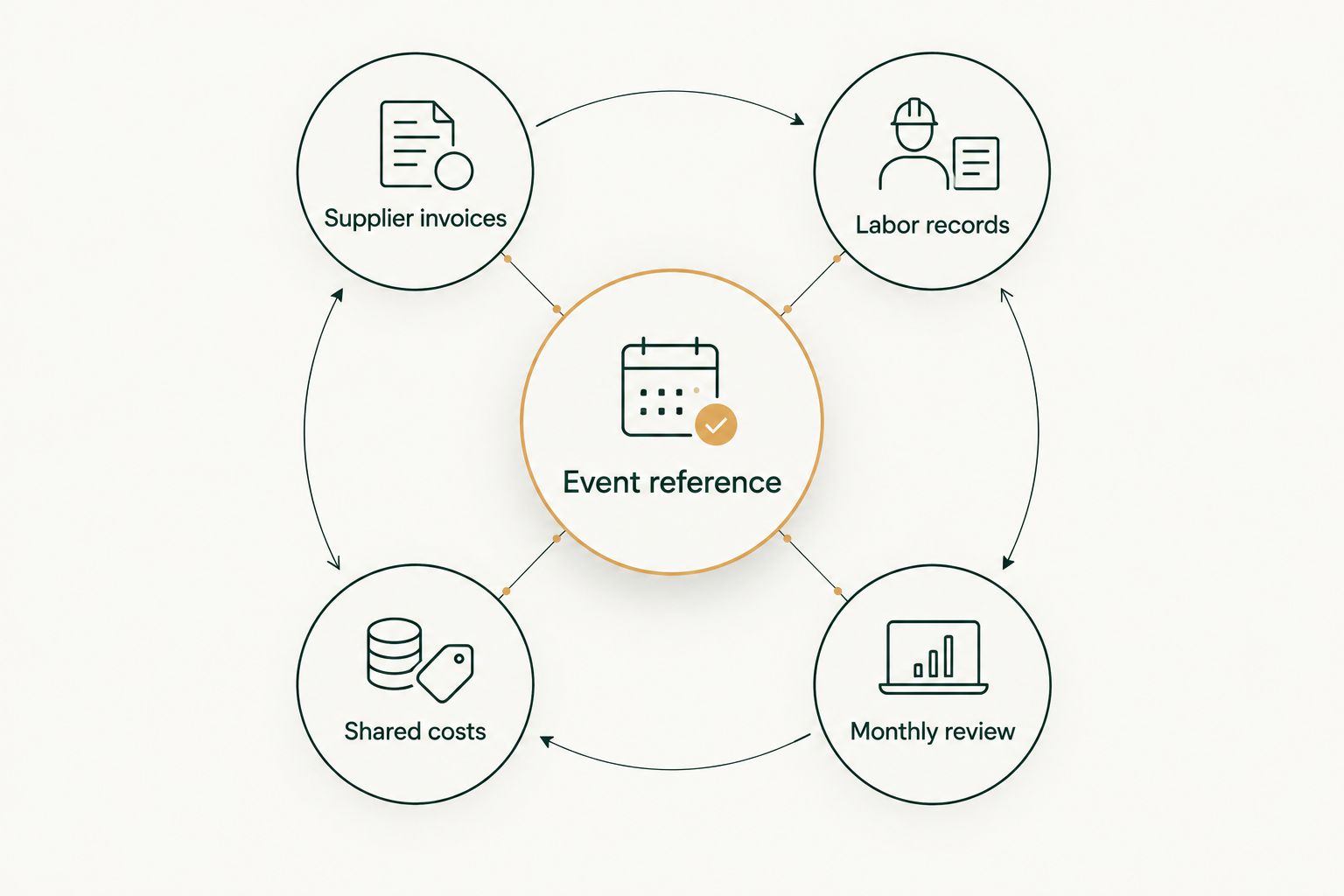
Start manually by marking supplier invoices and receipts with the relevant event reference. Identify costs you can directly trace to a job, such as a specific rental order or a delivery charge. Keep shared costs separate unless you have a consistent allocation method.
A combined food delivery might support both regular service and catering. Calling the entire invoice a catering expense would distort both activities. Ask how your bookkeeping provider would record the purchase and what additional information would be needed for an event-level estimate.
Monthly bookkeeping and event profitability reporting are different deliverables. If you want event-level results in 2026, put that requirement in the service discussion. Do not assume ordinary expense categorization includes a cost calculation for every catering job.
- Event reference: connect identifiable purchases to the job.
- Supplier invoices: retain the underlying purchase detail.
- Labor records: identify separately recorded catering work.
- Shared costs: use a documented allocation approach.
- Monthly review: resolve unclear classifications consistently.
These records work together; a bank withdrawal alone does not show which event used the purchase. Keep the event reference attached as the documents move through your monthly process.
4. Agree on a monthly handoff and review
Choose a handoff process you can actually maintain during restaurant service. You can collect documents yourself, label catering records, and send a monthly package. Outsourcing the bookkeeping does not remove the need to explain transactions only your team understands.
Ask each provider to describe the path from document submission to finished reports. Who asks about missing receipts? Who investigates an unmatched deposit? What happens when an event changes after you have already sent the paperwork?
Use what monthly restaurant bookkeeping services should include to frame the scope discussion. For your 2026 agreement, define the submission deadline and reporting timetable together, including how late records affect delivery. Avoid accepting a reporting promise without understanding what you must supply first.
- Name the person submitting restaurant records.
- Set the document submission deadline.
- Agree on a channel for bookkeeping questions.
- Define which accounts will be reconciled.
- Schedule the owner review of finished reports.
5. Compare providers using a catering example
Give each prospective bookkeeper the same example: an event booked in one month, a deposit collected before service, a supplier invoice received later, and a final payment after the event. Ask the provider to explain the proposed recordkeeping process from beginning to end.
You do not need an accounting lecture. You need to understand which documents the provider needs, what the reports will show, and which decisions remain yours. A clear explanation also makes it easier to spot gaps between your expectations and the written scope.
Ask Full Plate to distinguish monthly bookkeeping from cleanup, tax filing, payroll work, and event reporting in any proposal. Do not assume a service is included because it relates to accounting. Compare the stated responsibilities rather than the length of the service list.
- Ask how the sample deposit would be tracked.
- Confirm how outstanding customer balances are handled.
- Request a walkthrough of the proposed reports.
- Identify work excluded from the engagement.
- Confirm who communicates with your tax preparer.
6. Keep control of purchases after you hire
Hiring a bookkeeper should not make purchasing decisions less clear. Keep the manual control simple: name who can approve catering purchases, require a job reference, and retain the approval with the receipt. Review exceptions instead of assuming every recorded expense was authorized.
For your 2026 workflow, separate permission to spend from the later task of recording the expense. A correctly categorized rental charge can still be a purchase nobody approved. Conversely, an approved purchase still needs an invoice and a clear explanation of its business purpose.
When several people order supplies or rentals, expense approval software for restaurants addresses the authorization step; your bookkeeping process still needs the approved purchase linked to the correct event. Decide who owns each step before adding another system.
- Name an approver for catering purchases.
- Require an event reference on purchase requests.
- Keep approval records with supporting invoices.
- Explain unusual purchases before monthly review.
- Retain owner access to financial accounts.
Compare your bookkeeping options
Choose the smallest arrangement that reliably completes the work you need. DIY remains a valid option when you have the time, records, and confidence to maintain the process. Monthly support becomes relevant when the recurring work no longer fits your schedule or requires expertise you do not have.
| Option | Best for | Main advantage | Key limitation |
|---|---|---|---|
| Owner-managed bookkeeping | Owners who can maintain records and reconcile accounts consistently | Direct control over the process and restaurant context | The owner remains responsible for completion and resolving errors |
| Owner-managed books with periodic accountant review | Owners who maintain the records but need help with accounting questions | Outside review without transferring every recurring task | Problems can remain unresolved between reviews |
| Ongoing monthly bookkeeping | Owners who want defined recurring support | Assigns responsibility for agreed bookkeeping tasks | Still requires timely records and owner answers |
| Full Plate service discussion | Florida restaurant owners evaluating monthly bookkeeping | Lets you assess the proposed service against your actual restaurant workflow | Catering reporting, exclusions, and responsibilities must be confirmed in the proposal |
For a 2026 hiring decision, compare the same deliverables across proposals. Separate recurring bookkeeping from catch-up work, and ask whether event reporting requires additional recordkeeping by your team. A narrower scope can work well if everyone understands its boundaries.
Common mistakes catering restaurant owners make
Treating every incoming payment as a finished sale
A payment confirmation does not establish that the event has taken place. Keep the event date and the customer's balance visible, then confirm the accounting treatment. Otherwise, you risk losing the distinction between money received and work still owed.
Expecting bank records to explain catering jobs
A bank feed shows transactions, not the full order history. It will not explain a revised menu, a customer credit, or which wedding used a rental order. Preserve the supporting records before asking a bookkeeper to interpret the payment.
Requesting event margins without recording event costs
Event-level reporting needs event-level inputs. If kitchen labor and shared ingredients are not tracked separately, discuss what the resulting estimate can and cannot show. Do not treat a report built from partial costs as a complete event result.
Hiring without assigning the restaurant's responsibilities
Someone at the restaurant must answer questions about orders, purchases, and changes. Name that person and give them a backup. Outsourcing data entry while leaving every bookkeeping question unanswered does not create a workable monthly process.
FAQ
Do I need restaurant accounting services if I only cater occasionally?
Occasional catering alone does not require outsourcing your books. Keep the work yourself if you can track deposits, customer balances, and supporting records consistently, and get professional advice for accounting questions you cannot resolve.
How should my restaurant track catering deposits?
Track each deposit against a specific customer and event, with separate payment and event dates. Confirm the accounting treatment with your accountant based on your accounting method and customer agreement.
Can I keep doing some bookkeeping after hiring a service?
Yes, you can retain document collection, event tracking, or other agreed tasks. Put the division of responsibilities in writing so neither you nor the provider assumes the other person completed the work.
Will monthly bookkeeping show profit for every catering event?
Monthly bookkeeping does not automatically include event-level profit reporting. Ask for that deliverable explicitly and agree on how direct costs, shared ingredients, and labor will be recorded.
What should I ask Full Plate before hiring?
Ask Full Plate to explain the proposed monthly scope using a catering job from deposit through final payment. Confirm document requirements, reporting deadlines, exclusions, and responsibility for unresolved transactions.
Should the same provider handle bookkeeping and tax filing?
Bookkeeping and tax filing can be assigned together or separately. Confirm who handles each service and who resolves accounting questions that affect the records sent to your tax preparer.
What records should I prepare before changing bookkeepers?
Prepare account statements, existing bookkeeping records, unpaid customer invoices, catering deposit details, and supporting purchase documents. Include upcoming events with money already collected so the new provider can understand your outstanding commitments.
One last thing
Before signing, pick an upcoming catering event with a deposit already collected. Ask the prospective bookkeeper to show how the proposed process will keep that payment connected to the event through completion. That conversation tests the handoff more clearly than a general promise to keep accurate books.