With outsourced restaurant accounting, your restaurant’s owner or designated manager approves payments unless you explicitly give that authority to the accounting provider. For an independent Florida restaurant, the clearest arrangement separates preparing bills, approving spending, and releasing money; hiring a bookkeeper does not automatically transfer all three responsibilities.
- Outsourced restaurant accounting does not automatically give your bookkeeper payment approval authority.
- The restaurant owner should name who prepares, approves, and releases each payment.
- Bank access and bill payment belong in the written service agreement, not in assumptions.
- Keep vendor changes and urgent payments subject to separate verification.
Why this matters
A Florida restaurant owner can hand over bookkeeping without handing over spending decisions. Recording an invoice is different from deciding whether the restaurant received the order, whether a credit is missing, or whether a payment should leave the bank.
For Florida owners considering Full Plate for outsourced restaurant accounting, the best arrangement keeps payment approval with the owner unless authority is deliberately delegated. Put that expectation into your 2026 service discussions before granting access.
You do not need to stop doing every bookkeeping task. You need a clear boundary between the work you are hiring someone to handle and the decisions you still own.
Who approves payments with outsourced restaurant accounting?
The person your restaurant authorizes approves payments—not automatically the person who maintains the books. Name that person in writing, then make the permissions in your banking and payment systems match the decision.
A practical payment process separates these responsibilities:
| Responsibility | What the person does | Suggested owner of the task | Main limitation |
|---|---|---|---|
| Prepare | Collects invoices, checks supporting records, and assembles bills for review | Bookkeeper or designated employee | Preparation is not permission to spend |
| Approve | Confirms the purchase, amount, vendor, and timing | Owner or authorized manager | Approval requires knowledge of the purchase |
| Release | Sends the approved payment through the bank or payment system | Named authorized user | Access must match the agreed authority |
| Reconcile | Matches recorded payments to bank activity | Bookkeeper or assigned reviewer | Reconciliation does not replace approval |
These are suggested roles, not a description of any provider’s package. A monthly bookkeeping agreement should identify which tasks are included and which remain with your restaurant.
Before signing, ask the provider to walk through an actual invoice. Who receives it? Who checks it? Who authorizes it? Who sends the money?
Owner approval: best for keeping spending decisions close
Owner approval is best for a restaurant owner who wants to delegate bookkeeping but retain the final spending decision. A bookkeeper can prepare the information for review if that work is included in the agreement; you decide which bills proceed.
Consider a produce invoice with a disputed delivery. The invoice can be entered and tracked while you confirm the missing items with the kitchen manager. Preparing the bill should not erase that unresolved question.
The benefit is direct control. The drawback is dependence on your availability: an approval queue cannot move if you are the only approver and you do not review it.
For your 2026 process, choose a regular review window and a named backup. Keep responsibility explicit when you are away from the restaurant rather than asking someone to use your login.
Manager approval: best for purchases the manager can verify
Manager approval is best for routine operating purchases that an authorized manager can confirm firsthand. A manager who accepted a delivery can check whether the invoice matches what arrived.
The benefit is that the decision sits near the purchase. The limitation is scope: authority to approve a food delivery should not silently become authority to approve an equipment purchase or change a vendor’s bank details.
Write down the boundaries. Describe the permitted purchase categories, any spending limits you choose, and the circumstances that require owner approval.
If you have business partners, agree on those boundaries together. Your bookkeeper should not have to resolve disagreements about who is allowed to authorize restaurant spending.
Delegated payment release: best for an agreed administrative handoff
Delegating payment release is best for an owner who wants help executing already-approved payments and has confirmed that the service includes it. This is a proposed arrangement to discuss, not a standard feature of monthly bookkeeping.
The benefit is less payment administration for the owner. The drawback is the additional access and oversight required when someone outside the restaurant can move money.
Separate approval from release in the written instructions. Specify how approval is recorded, who can release funds, and what happens when a payment differs from the approved bill.
If a provider does not offer payment release, retain that step yourself. A clear boundary is better than an informal favor involving bank credentials.
Why payment approval arrangements vary
Payment authority should follow the restaurant’s responsibilities and the signed scope, not the label on the accounting package. During a 2026 hiring conversation, work through these factors:
- Service scope: Recording bills, preparing payments, releasing payments, and reconciling accounts are distinct tasks. Confirm which ones you are buying.
- Purchase knowledge: The person checking a delivery needs enough information to verify the invoice, including shortages and credits.
- Ownership structure: Partners need an agreed decision process before a provider receives conflicting instructions.
- System permissions: Banking access should reflect the approved role. Do not assume access to view transactions also permits payment activity.
- Owner availability: A seasonal closure, vacation, or busy service period needs an approval plan rather than an improvised exception.
- Payment type: Vendor bills, payroll, tax payments, and automatic withdrawals need explicit responsibility rather than one blanket instruction.
A Florida restaurant with seasonal operations should also identify who remains available during quieter periods. Fewer open hours do not answer who handles an outstanding vendor bill.
How do you set up payment approval before hiring?
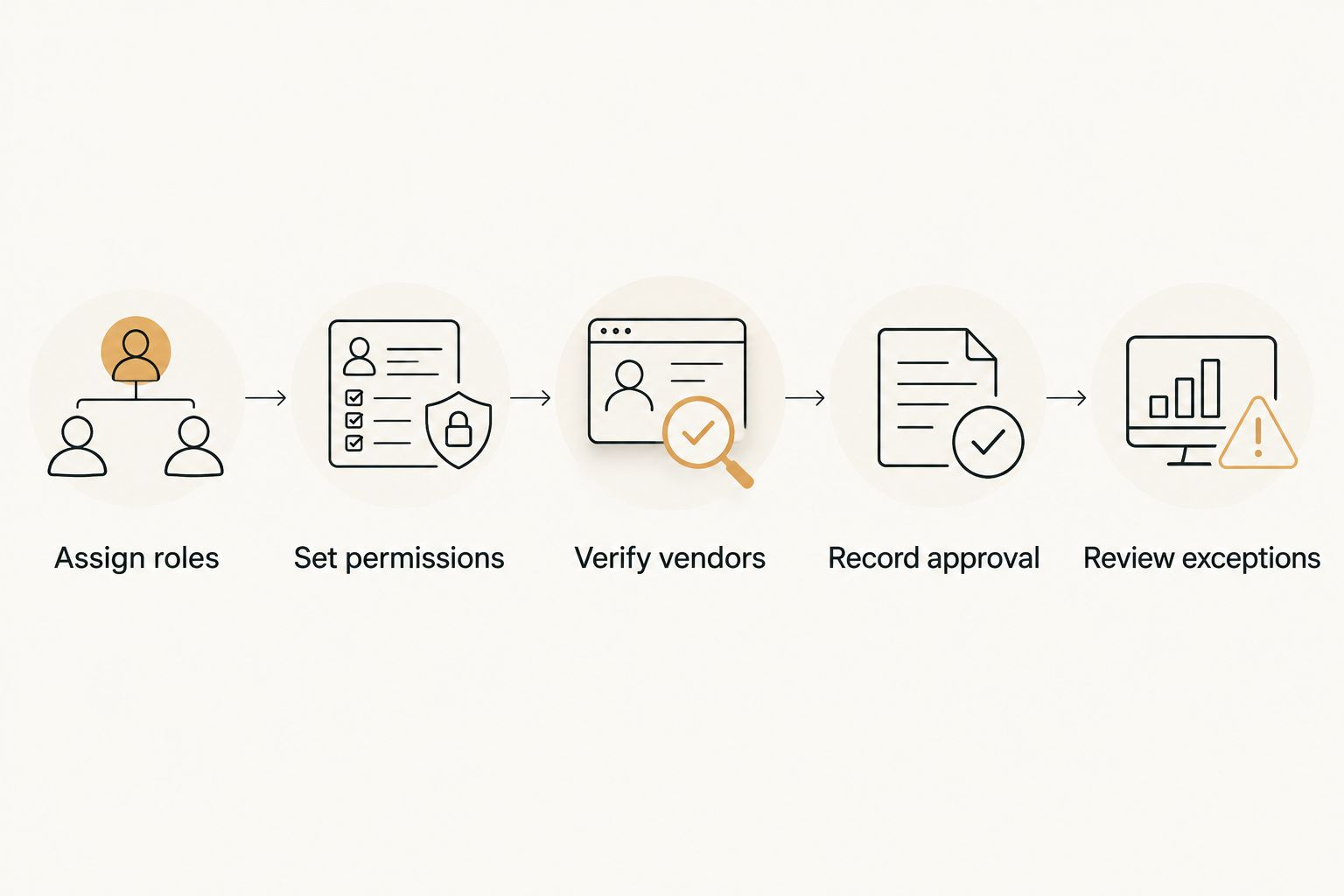
Build the handoff around the actual movement of a bill. For your 2026 onboarding, use these steps before the first payment is prepared.
- Assign roles. Name the person preparing bills, the person approving them, the person releasing funds, and the person reviewing bank activity. Where roles overlap, identify who checks the work.
- Set permissions. Use individual access where the systems support it. Match permissions to the assigned tasks rather than sharing the owner’s credentials.
- Verify vendors. Decide who confirms new vendors and changes to payment details. Use a known contact method rather than relying only on the message requesting the change.
- Record approval. Choose where the invoice, supporting records, approval, and payment confirmation will live. Keep the decision connected to the bill.
- Review exceptions. Define what happens with a disputed invoice, an absent approver, or an urgent request. Identify the person who can resolve each situation.
The goal is a process your manager can explain during a busy shift. If the instructions require guessing who has authority, simplify them before the handoff.
Use 3 sample bills to test the process: a routine supplier invoice, an invoice with a missing credit, and a request containing changed bank details. This is a recommended rehearsal, not a rule about how many invoices your provider must review.
Then name 1 backup approver and confirm how that person receives the records. For a vendor bank-detail change, require 2 separate checks: confirmation through a known vendor contact and approval from the person your restaurant designates.
What changes when you add another location?
Another restaurant adds a question before payment approval: which location received the goods or service? A bill addressed to the business does not establish which manager can verify the purchase.
For a Florida owner reviewing a second location in 2026, approval workflows for multi-location restaurants should identify both the location responsible for a purchase and the person authorized to approve it. A central payment queue still needs local confirmation that the order arrived or the work was completed.
Keep location-level review distinct from owner-level authorization. A kitchen manager can confirm a delivery without receiving unrestricted authority over the restaurant’s bank account.
The same principle applies to shared expenses. Decide who reviews an invoice covering both locations and who resolves disagreements before asking a bookkeeper to prepare it for payment.
What can you keep doing yourself?
DIY bookkeeping remains a reasonable choice when you can keep records current, check bills, and match payments to bank activity consistently. You already know which deliveries arrived, which equipment repairs were authorized, and which supplier credits are outstanding.
Its limitation is the work still needs to happen alongside running the restaurant. If bill review repeatedly waits until after a long service, separate the preparation task from the spending decision rather than assuming you must outsource both.
Professional help becomes useful when you want someone else responsible for the agreed bookkeeping work and a repeatable handoff. It does not remove your responsibility to provide records, answer questions, or exercise authority you have retained.
When discussing monthly bookkeeping with Full Plate, ask which preparation and review tasks would move off your plate and which approvals would stay with you. Have that conversation before access is granted, not after someone receives an unpaid invoice.
The practical test is whether you can explain how to hand over restaurant books without losing control in terms of named people, specific permissions, and documented decisions.
What should you ask before signing an agreement?
Ask a prospective provider to describe the boundary between bookkeeping and bill payment in plain language. A proposal that says only accounts payable leaves too much room for different expectations.
Use these questions in the hiring conversation:
- Does the scope include recording bills, preparing payments, releasing funds, or only some of those tasks?
- Who receives invoices, and who follows up on missing records?
- Where will I see bills awaiting approval?
- What evidence shows that I approved a payment?
- Who verifies a new vendor or changed payment details?
- What happens when I dispute an invoice or cannot respond?
- How do we remove access when the engagement ends?
For outsourced restaurant accounting with Full Plate, put the agreed answers into the engagement scope. Do not treat a verbal discussion as a substitute for written responsibilities.
Before making a decision, ask the provider to explain one ordinary bill and one exception from receipt through reconciliation. A process that works only when every invoice is correct is not enough for day-to-day restaurant operations.
FAQ
Do I still approve bills if I outsource restaurant accounting?
You still approve bills if you retain that authority in the service agreement. Outsourcing bookkeeping does not automatically authorize the provider to approve spending or release money.
Can my restaurant bookkeeper pay vendors for me?
A restaurant bookkeeper can pay vendors only if that work is included in the agreement and you provide the necessary authorization. Confirm preparation, approval, and payment release separately before granting access.
Should my restaurant manager approve supplier invoices?
Your restaurant manager can approve supplier invoices when you explicitly authorize that role and define its limits. Keep invoice verification separate from unrestricted permission to move money.
Do I have to give an outsourced bookkeeper my bank password?
Do not share your personal bank password as the handoff method. Ask your bank about individual user access and permissions suited to the agreed bookkeeping tasks.
What happens if I am unavailable to approve a restaurant payment?
A named backup approver should follow your written instructions when you are unavailable. Set that arrangement before an urgent bill arrives, including which decisions still require your approval.
Does monthly bookkeeping automatically include payroll and tax payment approval?
Monthly bookkeeping does not automatically establish authority over payroll or tax payments. Name the person responsible for preparing, approving, and submitting each type of payment in the agreed scope.
Can I outsource restaurant bookkeeping but keep control of payments?
You can outsource restaurant bookkeeping while retaining payment approval and release. Specify that boundary in writing and make account permissions match it.
One last thing
A payment approval rule is incomplete until it explains what happens when something goes wrong. Before signing, ask: who stops a payment if the invoice changes after approval?
Require a fresh approval for a changed payment rather than letting the original approval cover it. That gives your restaurant a clear decision point when the amount, recipient, or payment details no longer match what you authorized.