
Protect your Florida restaurant’s data when using outsourced restaurant accounting by giving each person a named login, limiting permissions, and keeping control of account ownership and payment approvals. Share records through an agreed secure channel rather than sending passwords or payroll files through ordinary email. Before hiring, get written answers about who can access your records, how access ends, and what happens after a suspected breach.
- Choose outsourced restaurant accounting with named logins, limited permissions, and owner-controlled approvals.
- Florida restaurant owners should separate bookkeeping access from authority to move money.
- Ask Full Plate to document data handling before sharing restaurant bookkeeping or payroll records.
- Keep business accounts, recovery methods, and access decisions under your restaurant’s control.
How do you protect data when outsourcing restaurant accounting?
Give your bookkeeper access to the records needed for the work, not unrestricted control of your restaurant’s accounts. Apply that rule to banking, point-of-sale reports, payroll, delivery platforms, and document storage.
When considering Full Plate for monthly restaurant bookkeeping, make data protection part of the hiring conversation—not an item to settle after sending records. Ask for the proposed access arrangement alongside the scope of work.
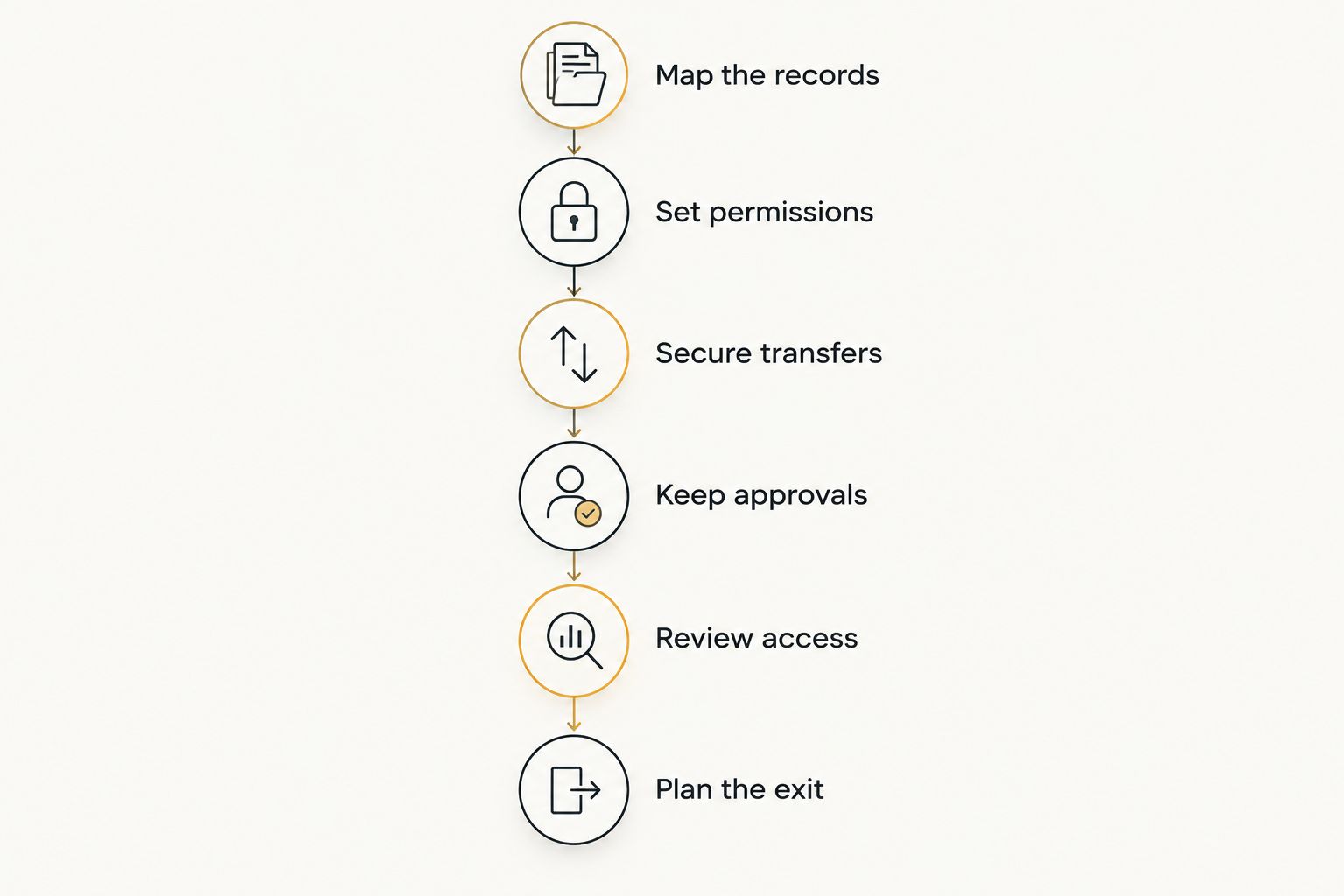
Use this sequence for your 2026 onboarding checklist:
- Map the records. List the systems and documents needed for monthly bookkeeping. Separate sales summaries and vendor invoices from employee identity records and payment credentials.
- Set permissions. Create 1 named login per person wherever the system supports it. Start with reporting or read-only access when that is enough.
- Secure transfers. Agree on a protected document-sharing method, account authentication, and who receives uploaded files.
- Keep approvals. Decide who approves payments, payroll changes, and new bank details. Recording a transaction should not automatically authorize it.
- Review access. Keep 1 current access list and update it when staff, providers, or responsibilities change.
- Plan the exit. Put record delivery, permission removal, and retained copies into the engagement terms before work begins.
This gives you a hiring checklist and a practical handoff plan. Ask the provider to demonstrate the proposed permissions before connecting accounts.
Why this matters for a Florida restaurant owner
Restaurant bookkeeping connects records that serve different purposes. Your bookkeeper needs sales and deposit information to reconcile activity, but that does not automatically create a need for employee identification documents or permission to change bank recipients.
For an independent Florida restaurant, the practical challenge is keeping that boundary clear during service, seasonal staffing changes, and manager turnover. Write the rules down so a busy owner or closing manager does not have to improvise a response to a request for sensitive information.
Outsourcing the books does not require outsourcing control of the business. You should know who has access, what that access allows, and how to remove it without losing your records.
Should you keep bookkeeping in-house or hire monthly help?
Doing the books yourself is a valid choice when you can maintain the records, reconcile accounts, and protect access consistently. Professional help becomes useful when the work no longer fits your schedule or you need a clearer monthly process.
Neither arrangement removes the need for security controls. Use this comparison when deciding who should handle your restaurant’s books in 2026.
| Arrangement | Best for | Practical benefit | Responsibility or limitation |
|---|---|---|---|
| Owner-managed bookkeeping | Owners who can maintain consistent records and reviews | You control access and handle questions directly | You also manage updates, secure storage, reconciliations, and recovery |
| Outsourced monthly bookkeeping | Owners who want to delegate recurring recordkeeping | You can assign bookkeeping work while retaining approvals | You must verify the provider’s practices and manage the access boundary |
Do not hire solely because a provider says its process is secure. Ask how the arrangement works in your actual systems, including any system that lacks separate user permissions.
Full Plate is best suited to a Florida owner’s shortlist when its proposed restaurant bookkeeping arrangement preserves owner control and clearly assigns data responsibilities. Treat that as a hiring condition, not a promise to assume.
What records should your bookkeeper receive?
Start with the work being performed. A monthly reconciliation needs evidence of sales, deposits, expenses, and balances; it does not justify sending every document your restaurant holds.
Sales and settlement records
Provide the reports needed to explain sales and deposits, including relevant point-of-sale summaries, delivery settlements, refunds, and gift card activity. Ask which report fields are necessary before exporting customer-level detail.
For a restaurant with catering sales, distinguish the records needed to account for a customer deposit from unrelated customer correspondence. Keep the information sent proportionate to the bookkeeping task.
Payroll and employee records
Ask whether payroll summaries meet the bookkeeping need before sharing employee-level files. Names, compensation details, tax identifiers, and bank information deserve separate handling decisions.
If payroll administration is also included, document that scope separately. Permission to post a payroll expense is not the same as permission to change an employee’s payment destination.
Vendor and banking records
Invoices, statements, and transaction histories support expense recording and reconciliation. Payment authority is a different responsibility and needs its own approval rules.
A bookkeeper reviewing a supplier invoice should not automatically gain authority to change that supplier’s bank details. Keep the verification step with a designated person at the restaurant.
Why data protection needs vary between restaurants
The right controls depend on the information and authority involved—not just whether the provider calls the service bookkeeping or accounting. These factors should shape your 2026 engagement terms:
- Scope of work: Recording expenses, preparing payroll, and initiating payments require different permissions. Specify each responsibility rather than granting broad access for convenience.
- Record sensitivity: Sales totals and employee bank details do not need identical sharing arrangements. Identify sensitive files before the first transfer.
- System permissions: Some platforms support separate reporting, editing, and payment roles. Check the actual settings rather than assuming those roles exist.
- People involved: Identify the provider’s staff and any subcontractors who will handle your records. Include staff changes in the notification process.
- Connected systems: Bank feeds, payroll connections, and document integrations create additional access points. Record who authorizes and maintains each connection.
- Business changes: A second location, ownership change, or new payroll responsibility changes the access discussion. Review permissions when the work changes.
Do not accept a generic security checklist as a substitute for these decisions. The useful document names your systems, the permitted tasks, and the person responsible for each approval.
What should you ask before signing?
Ask Full Plate—or any proposed restaurant bookkeeping provider—to walk through these questions using your accounts and records. Request written answers you can compare with the engagement terms.
Who will see the records?
Ask whether access is limited to assigned staff and whether subcontractors are involved. Establish how you will learn about changes to the people handling your information.
Get a clear answer about using restaurant records in other services or applications. Do not treat permission to maintain the books as blanket permission to reuse the data.
How are logins and files protected?
Ask about multifactor authentication, individual user accounts, encrypted file transfers, and recovery access. Where a platform supports separate invitations, invite the provider instead of handing over your own login.
If a system cannot support individual users, agree on a documented alternative. Avoid letting a shared credential become an undocumented exception that remains in place indefinitely.
What happens after a suspected incident?
Identify the contact person, notification process, containment responsibilities, and records the provider will preserve. Ask how you will communicate if the usual email account is compromised.
Keep security commitments separate from vague assurances. A useful answer explains who acts and what they do; it does not simply say your information is safe.
What happens when the engagement ends?
Specify how you receive usable records, how access is revoked, and what happens to retained copies. Ask which information the provider must retain and why, rather than requesting deletion without considering applicable obligations.
For the operational side of the transition, use this guide to handing over restaurant books without losing control.
How do you keep payment control without doing all the books?
Separate preparing, approving, and recording a payment wherever your staffing allows. You can delegate transaction entry and reconciliation while retaining the decision to release money.
For sensitive bank-detail changes, use 2 people when practical: one prepares the change and another verifies it through a previously established contact method. This is a recommended control, not a reason to give additional staff unrestricted account access.
A familiar supplier name on an email is not enough verification. Call a known contact using details you already hold—not the replacement phone number supplied in the change request.
Write this approval boundary into your 2026 bookkeeping agreement. If payment processing is outside the provider’s scope, say so explicitly; if it is included, define the limits and review process.
Can your bookkeeper work without your bank password?
Your bookkeeper can work without your personal bank password when your bank provides suitable delegated access or the task can use statements and exports. Check your bank’s available roles before onboarding.
Ask which tasks require a connection and which can use reports. Do not grant money-movement permissions merely because a broader user role is easier to configure.
Keep account recovery details under business control. The person reconciling transactions should not become the only person capable of restoring your access.
What should you check during the monthly review?
Use your 2026 monthly bookkeeping review to check both the numbers and unresolved access questions. A short discussion is more useful than letting exceptions accumulate without an owner.
Ask about unfamiliar transactions, missing records, new connections, and requests for broader permissions. Review unexplained items before approving changes simply to finish the month.
Keep the access list current between reviews, too. Remove access promptly when a staff member or provider no longer needs it, and check connected applications as well as user accounts.
The owner’s role changes when bookkeeping is outsourced: less transaction entry, but continued oversight of approvals, exceptions, and access. That is a workable division of responsibility—not a demand that you redo the bookkeeper’s work.
FAQ
Is outsourced restaurant accounting safe for a small Florida restaurant?
Outsourced restaurant accounting needs specific access controls, secure sharing, and clear responsibilities; outsourcing alone does not establish safety. Evaluate the proposed arrangement before providing sensitive records.
Should I give a restaurant bookkeeper my bank password?
Use a separate delegated login instead of sharing your bank password when your bank supports suitable access. Ask whether reporting access or statements are sufficient for the assigned work.
Does my bookkeeper need every employee’s personal information?
Your bookkeeper should receive only the employee information needed for the agreed work. Monthly expense recording and payroll administration have different information requirements.
Can I approve payments while someone else does the bookkeeping?
You can retain payment approval while delegating bookkeeping. Define who prepares, approves, releases, and records payments before the provider starts.
What should I ask Full Plate about data protection?
Ask Full Plate who will access your restaurant records, how files are shared, and what permissions the proposed work requires. Request written incident-response and offboarding procedures before sharing sensitive information.
What happens to my accounting records if I change providers?
Your engagement terms should explain record delivery, access removal, and retained copies when you change providers. Confirm the format of the records and keep ownership of your business accounts.
Can I keep doing my restaurant’s books myself?
You can keep doing your restaurant’s books yourself if you can maintain the records and security process consistently. Monthly help becomes useful when recurring work crowds out operations or unresolved bookkeeping tasks accumulate.
One last thing
Test the exit before you approve the entrance. Before onboarding a bookkeeping provider, confirm that you can access your own records, identify every permission granted, and remove the provider without closing your business accounts.
Put that test on your 2026 onboarding checklist. A clear exit process protects your control even while the working relationship is going well.