For an independent Florida restaurant, restaurant accounting services should close the year with reconciled accounts, supported balances, complete financial statements, and an organized handoff to the tax preparer. For the 2026 close, that means checking restaurant-specific items such as delivery settlements, tips, gift cards, and catering deposits—not just matching the bank balance; tax preparation and overdue cleanup need a separate scope agreement.
- Restaurant accounting services should deliver reconciled books, supported year-end balances, and a documented tax handoff.
- Florida restaurant owners can organize records themselves; unresolved payroll, sales, and liability differences need closer review.
- Ask Full Plate to define monthly bookkeeping, year-end responsibilities, and tax-preparer coordination before signing.
What should restaurant accounting services do at year-end?
The year-end deliverable is a set of books you and your tax preparer can trace back to records. A profit-and-loss report alone does not establish that the accounts are complete.
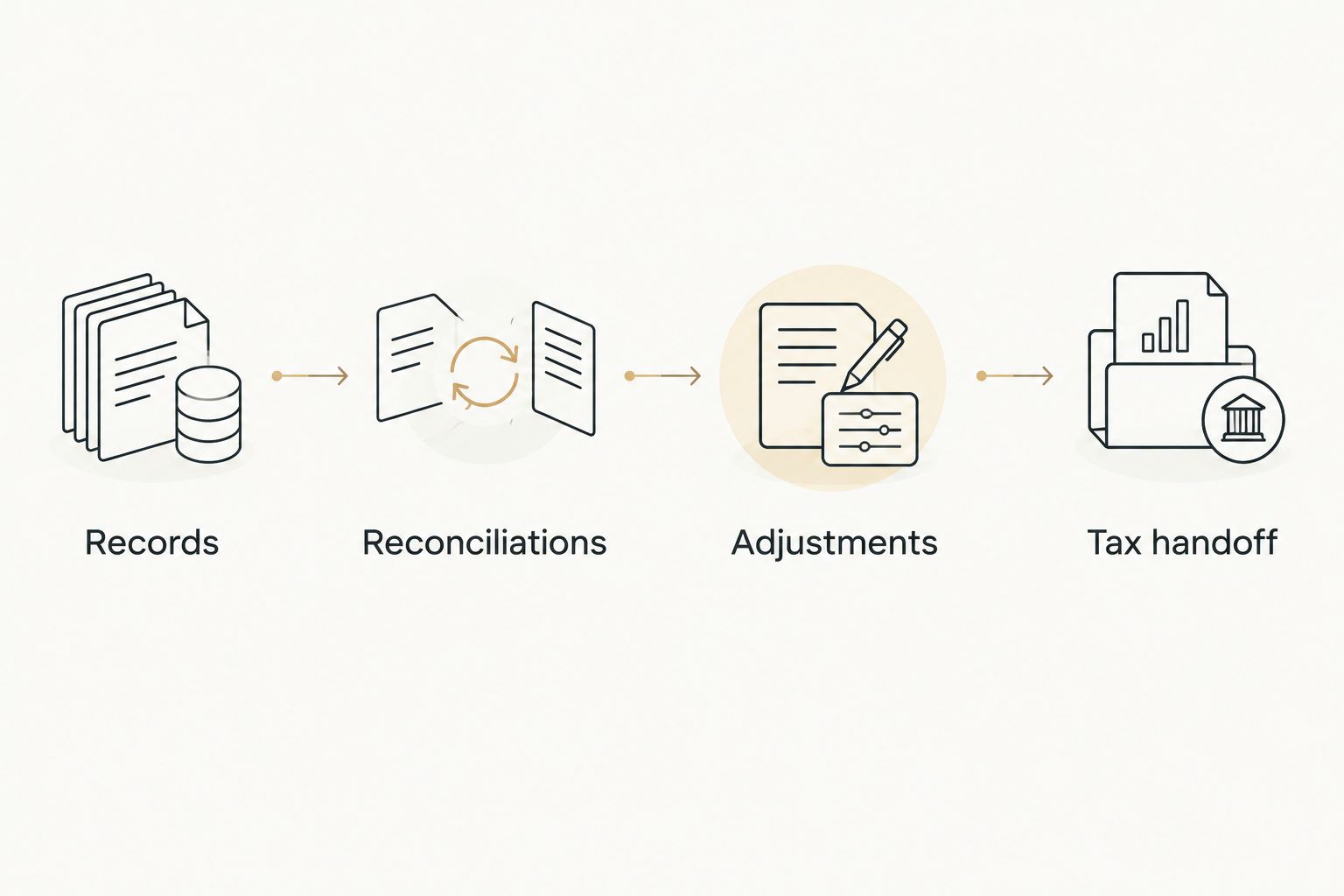
Your monthly restaurant bookkeeping scope should explain which checks happen throughout the year and which require additional year-end work. Ask for these steps in writing:
- Records: Collect the statements, sales reports, payroll reports, invoices, and supporting documents needed to complete the year. Identify missing records before calling the books finished.
- Reconciliations: Match bank and credit-card accounts to statements. Explain outstanding transactions and check payment-processor clearing accounts rather than treating every deposit as sales.
- Sales review: Compare recorded sales with point-of-sale reports, delivery-platform statements, refunds, discounts, and settlement activity. Separate restaurant revenue from amounts collected for other purposes, such as sales tax.
- Liability review: Check unpaid bills, loans, payroll liabilities, gift-card balances, and customer deposits. Each balance needs an explanation and supporting records.
- Adjustments: Review inventory, equipment purchases, owner transactions, and entries that depend on the accounting method. Coordinate tax-sensitive decisions with the tax preparer.
- Financial statements: Deliver a profit-and-loss statement and balance sheet, with explanations of material unresolved issues. Compare the full year with monthly results so unusual entries are visible.
- Tax handoff: Provide the final reports and supporting schedules requested by the tax preparer. Record who will answer follow-up questions and post approved tax-related adjustments.
These steps describe the work to agree on, not a promise that every bookkeeping engagement includes every task. For the 2026 close, assign responsibility before documents start moving between the owner, bookkeeper, payroll provider, and tax preparer.
Why this matters for a Florida restaurant owner
A busy dining room does not tell you whether the books are ready for tax preparation. Neither does a healthy checking balance. Your bank account reflects cash movement, while your books also need to explain obligations, transfers, and transactions that settle later.
Consider a Florida restaurant collecting a catering deposit in December for an event after year-end. The bookkeeper needs the event date and agreement to review how the deposit belongs in the records. A bank-feed description alone does not provide that context.
The same issue appears with holiday gift cards and delivery payouts. Year-end work should explain what a balance represents, not merely make the reports look tidy. That gives you a clearer starting point for the next operating period and gives your tax preparer records they can use.
What should the cash and sales review cover?
Start with all 12 monthly bank statements for the 2026 calendar year, along with credit-card and relevant processor statements. Reconciliation means matching the accounting records to those statements and explaining differences—not changing entries until the totals agree.
Restaurant deposits deserve particular attention because a payout is not necessarily gross sales. Delivery platforms and card processors can deduct fees or combine activity from different dates. Refunds and chargebacks also need a place in the records.
Ask the service to document:
- Which accounts were reconciled and through what date.
- Which deposits remain unmatched to sales or settlement reports.
- Whether transfers between your accounts were kept out of revenue.
- Which outstanding checks or withdrawals need your explanation.
For December 31, 2026, a settlement received after the reporting date needs review under the restaurant's accounting method. Do not assume the deposit date settles every year-end question.
What should happen to payroll, tips, and sales tax?
The bookkeeping records should agree with payroll reports, with differences investigated rather than buried in a general expense account. Employee reimbursements, owner payments, payroll withdrawals, and payroll liabilities need distinct treatment.
Tips require a clear trail between the point-of-sale system, payroll records, and amounts paid or still owed. A bookkeeper should identify discrepancies and coordinate with the payroll provider where corrections belong. Bookkeeping review does not replace payroll filing responsibilities.
For a Florida restaurant, ask how the service compares recorded taxable activity, sales-tax liabilities, filed returns, and payments. Do not assume monthly bookkeeping includes preparing or filing Florida sales-tax returns. The engagement should name the responsible party and explain how filing records reach the bookkeeper.
You can gather reports yourself. Professional help becomes useful when those reports disagree and the difference cannot be explained from the underlying transactions.
What should happen to inventory, equipment, and owner transactions?
If inventory is part of your year-end accounting, agree on the count date and method before the final service of the year. Keep the count sheets and valuation support. The bookkeeper should know whether the figures cover food, beverages, or other stock rather than receiving an unexplained total.
Equipment purchases also need supporting invoices and descriptions. A replacement refrigerator, repairs to existing equipment, and small operating supplies should not be treated as interchangeable simply because the same vendor supplied them. Tax treatment belongs with the appropriate tax professional.
Owner transactions need equal attention. Money transferred into the restaurant is not automatically sales, and money transferred out is not automatically an operating expense. Label contributions, distributions, reimbursements, and loans with enough detail for review.
For the 2026 close, compare opening balances with the approved records as of January 1, 2026. An unexplained opening balance can carry an old mistake through otherwise careful monthly work.
Should you do the year-end books yourself or hire help?
DIY bookkeeping is a reasonable choice when you can maintain the records, complete reconciliations, and explain the balances. Hiring becomes useful when unresolved differences consume your attention or require accounting judgment beyond the work you want to handle.
| Approach | Best for | Main advantage | Main limitation |
|---|---|---|---|
| Owner-managed bookkeeping | Owners with orderly records and time for regular review | Direct knowledge of purchases, deposits, and operating decisions | The owner must investigate differences and maintain supporting records |
| Ongoing monthly bookkeeping | Owners who want recurring help keeping accounts current | Questions can be addressed during the year instead of collected at year-end | The owner still supplies records and explains unusual transactions |
| Year-end cleanup | Owners with incomplete or unreconciled books | Focused attention on bringing records into a usable condition | Missing evidence still requires owner involvement; cleanup does not create a monthly process |
The choice is about responsibility, not whether you are capable of understanding your restaurant's finances. You can retain payment approval, bank access, and oversight while assigning reconciliation and reporting work to a service.
A tax appointment is not a substitute for that decision. Ask whether the books need cleanup before the tax preparer receives them, and who is responsible for completing it.
Why year-end bookkeeping work varies
The amount of year-end work depends on what happened in the restaurant and how consistently the records were maintained. These factors change the scope you should discuss:
- Record completeness: Missing statements, receipts, or payroll reports create gaps that someone must resolve.
- Sales channels: Dining-room sales, delivery settlements, and catering deposits require different supporting records.
- Monthly reconciliation: Accounts checked throughout the year leave fewer accumulated differences to investigate at the close.
- Payroll complexity: Tip activity, corrections, and unresolved payroll liabilities require coordination with payroll records.
- Business changes: New equipment, financing, ownership transactions, or another location introduce balances that need separate support.
- Accounting responsibilities: Inventory adjustments, tax-related entries, and return preparation depend on the agreed division of work.
When comparing services in 2026, describe these conditions directly. A proposal based only on the restaurant's bank-account count can miss the records and coordination your year-end actually requires.
What should you ask before hiring Full Plate?
Full Plate's restaurant bookkeeping focus fits independent Florida owners considering ongoing monthly help. Before hiring Full Plate, ask for a written explanation of what the monthly engagement includes at year-end and what remains your responsibility.
Use these questions to make the discussion concrete:
- Who reconciles bank, credit-card, and payment-clearing accounts?
- Who reviews gift cards, catering deposits, payroll liabilities, and outstanding bills?
- Which reports and supporting schedules reach the tax preparer?
- Who investigates missing records or differences from earlier periods?
- Who posts approved adjustments after the tax preparer finishes reviewing the books?
- How will you know the year is closed rather than still under review?
When you hire a monthly bookkeeper, the change should be an explicit transfer of tasks—not a loss of visibility. Keep a short owner checklist for submitting documents, answering questions, and reviewing reports.
Ongoing help also has limits: a bookkeeper cannot supply an undocumented explanation for your cash withdrawal or approve a business decision on your behalf. Agree on communication and access before the handoff.
Discuss your year-end bookkeeping scope
Ask Full Plate which monthly tasks, closing work, and tax-preparer handoffs belong in your engagement.
Does year-end bookkeeping include filing the restaurant's taxes?
Year-end bookkeeping does not automatically include tax filing. Reconciled accounts and financial statements prepare the records for tax work; preparing and filing returns is a separate responsibility unless the engagement explicitly includes it.
Ask who handles business returns, payroll filings, information returns, and Florida sales-tax filings. Get named responsibilities rather than a general assurance that taxes are covered.
Can you hire a bookkeeper before every missing record is found?
You can discuss an engagement before all missing records are found. Give the prospective bookkeeper an honest list of gaps so the proposed work distinguishes cleanup from ongoing monthly bookkeeping.
Do not expect missing documents to disappear as an issue after hiring. Agree on who requests replacements, what alternative evidence is acceptable, and which unresolved items prevent the books from being finalized.
FAQ
What should restaurant accounting services give me at year-end?
Restaurant accounting services should give you reconciled books, a profit-and-loss statement, a balance sheet, and the supporting records agreed for your tax handoff. Ask for a written list of unresolved items rather than assuming every report is final.
Can I close my restaurant's books myself?
You can close your restaurant's books yourself if you can reconcile the accounts, support the balances, and coordinate any required adjustments with your tax preparer. Get help with differences you cannot explain rather than forcing the accounts to match.
Should my bookkeeper check gift cards at year-end?
Your bookkeeper should review gift-card activity and the supported outstanding balance as part of the agreed close. Sales, redemptions, refunds, and adjustments need records; tax treatment should be coordinated with the tax preparer.
Does monthly restaurant bookkeeping include year-end cleanup?
Monthly restaurant bookkeeping does not automatically include cleanup of incomplete periods. Ask the service to distinguish routine closing work from missing-record reconstruction and corrections to earlier books.
What should I send my restaurant bookkeeper for the 2026 close?
Send the records requested for the 2026 close, including bank and credit-card statements, sales and settlement reports, payroll records, and support for loans, purchases, and deposits. Include explanations of unusual owner transactions and any inventory records used in your accounting.
Who should correct a payroll difference at year-end?
The bookkeeper and payroll provider should identify where a payroll difference originates and assign the correction to the responsible party. An accounting entry alone does not correct an inaccurate payroll filing.
How do I know my restaurant's year-end books are finished?
Your year-end books are finished when the agreed reconciliations, reviews, adjustments, and reports are complete and unresolved issues have been addressed or explicitly documented. Ask who can change the closed period and how approved later adjustments will be recorded.
One last thing
Ask for the unresolved-items list before asking whether the books are finished. A report can look complete while an unidentified deposit, unsupported loan balance, or missing payroll adjustment remains underneath it.
For each open item, request the explanation needed, the person responsible, and the next action. That small document gives you a practical way to judge progress without taking back every bookkeeping task yourself.