
Your Florida restaurant accountant should handle both bookkeeping and tax filing only if the agreement clearly covers both jobs and names who is responsible for each. In 2026, monthly bookkeeping with a separate tax preparer is also a sound arrangement when they agree on the records, handoff, and questions each will handle. Choose clear responsibility over the convenience of a single provider.
- Your restaurant accountant can handle books and taxes, but both services need explicit scope and responsibility.
- Separate bookkeeping and tax providers work when records, deadlines, and follow-up duties are agreed in advance.
- Full Plate is a restaurant bookkeeping option for Florida owners; confirm tax filing separately.
- DIY bookkeeping remains reasonable when you reconcile accounts consistently and can explain the records to your tax preparer.
Should your restaurant accountant handle both books and tax filing?
Yes, if the provider takes explicit responsibility for both; otherwise, separate the jobs and require a documented handoff. Monthly bookkeeping keeps your records current. Tax preparation uses those records, along with tax-specific information, to prepare returns.
If you're considering Full Plate for restaurant bookkeeping, ask about monthly work and tax filing separately. Treat them as distinct hiring decisions, even when you discuss them in the same conversation.
| Arrangement | Best for | Main advantage | Main limitation | Confirm before hiring |
|---|---|---|---|---|
| One provider handles books and taxes | Owners who want a single point of responsibility | Fewer handoffs between firms | One agreement can still leave tasks excluded | Who prepares returns, who reviews them, and which filings are included |
| Monthly bookkeeper plus separate tax preparer | Owners who want ongoing bookkeeping while keeping their tax relationship | Each provider has a defined role | Someone must manage questions and record transfers | Required reports, delivery dates, and who resolves discrepancies |
| Owner handles books; professional prepares taxes | Owners who can maintain accurate records consistently | Direct control over everyday records | The owner carries the reconciliation and documentation workload | What the preparer expects and how bookkeeping questions get resolved |
The distinction matters more than the job title. An accountant's involvement does not automatically mean that every return, notice, payroll task, or bookkeeping correction is included.
Why this matters for Florida restaurant owners
A bank deposit does not always equal restaurant sales. Card processing fees, delivery-platform deductions, refunds, and timing differences can separate what customers paid from what reached your bank account.
Those differences need explanations in your books, not guesses during tax preparation. Florida sales tax reporting also belongs in the scope conversation; do not assume that an agreement covering income tax preparation includes sales tax returns.
For your 2026 service agreement, separate 3 responsibilities: maintaining the books, reviewing tax questions, and preparing returns. One person can perform several roles, but each role still needs an owner.
What can you keep doing yourself?
You can collect supplier invoices, save receipts, review daily sales summaries, and explain unusual transactions. You can also maintain the books yourself if you consistently reconcile accounts and understand how transactions should be recorded.
DIY bookkeeping is not a failure to delegate. It becomes a hiring issue when unfinished reconciliations, missing documents, or unanswered questions prevent you from producing records your tax preparer can use.
What should change when you hire help?
Hiring a monthly bookkeeper should transfer the agreed recordkeeping tasks, not your responsibility to understand the business. You still need to approve access, supply records, and review questions that require your knowledge.
When discussing an engagement with Full Plate, ask which tasks would leave your desk and which would stay. Request a walkthrough using a normal restaurant month rather than relying on a broad description such as full-service accounting.
One provider: best for a single point of responsibility
Using one provider for bookkeeping and taxes reduces the number of outside relationships you manage. Questions about an expense or account balance can stay within the same engagement rather than moving between separate firms.
That convenience has limits. Different people within the same firm can still use separate workflows, and tax preparation can still be outside the monthly bookkeeping agreement.
Before choosing this arrangement, ask:
- Who does the work? Identify the bookkeeping contact and the person responsible for preparing returns.
- Which filings are included? Separate income tax, sales tax, and payroll-related work in the discussion.
- How do questions move? Find out who handles an unexplained balance or a transaction requiring tax judgment.
- What happens outside routine work? Ask how prior-period corrections and tax notices are handled.
Choose one provider when the combined responsibility is documented, not simply implied by the title restaurant accountant. A single contact is useful only when that contact can tell you who owns the next task.
Separate providers: best for keeping an existing tax relationship
A monthly bookkeeper and a separate tax preparer can serve different needs without duplicating the entire job. The bookkeeper maintains the records within the agreed scope; the tax preparer identifies the information needed to prepare returns.
The disadvantage is coordination. Without a shared process, you become the messenger for questions neither provider has agreed to resolve.
Keep your tax preparer involved before choosing the bookkeeping arrangement. Ask what reports, account details, and supporting documents the preparer needs, then confirm that the proposed monthly service can supply them.
Do not assume that two professionals will communicate automatically because they both work for you. Obtain permission for direct communication and decide whether either provider needs your approval before making changes.
Choose separate providers when their responsibilities meet cleanly at the handoff. Keeping an established tax relationship is reasonable; keeping an undefined handoff is not.
Why the right arrangement varies
The decision depends on your workload and the responsibilities you want to keep. Use these factors to compare proposals rather than choosing by job title alone.
- Condition of the books: Current, reconciled records create a different assignment from missing statements and unexplained balances. Separate catch-up work from ongoing bookkeeping.
- Your available attention: If you can maintain records consistently, DIY remains an option. If bookkeeping repeatedly loses its place behind staffing and service, define what outside help would take over.
- Sales channels: Dining-room sales, delivery-platform settlements, and refunds need records that explain the movement from sales to deposits.
- Existing tax relationship: A preparer who already understands your ownership and filing history can remain part of the arrangement, provided the bookkeeping handoff is clear.
- Business changes: Opening another location or changing ownership creates questions beyond ordinary transaction entry. Establish who receives those questions.
- Scope of filings: Income tax preparation, Florida sales tax reporting, and payroll-related responsibilities should be discussed separately rather than grouped under taxes.
There is no need to replace a working arrangement simply to put every task with one firm. Change the arrangement when responsibility, capacity, or communication no longer meets your restaurant's needs.
How do you divide bookkeeping and tax responsibilities?
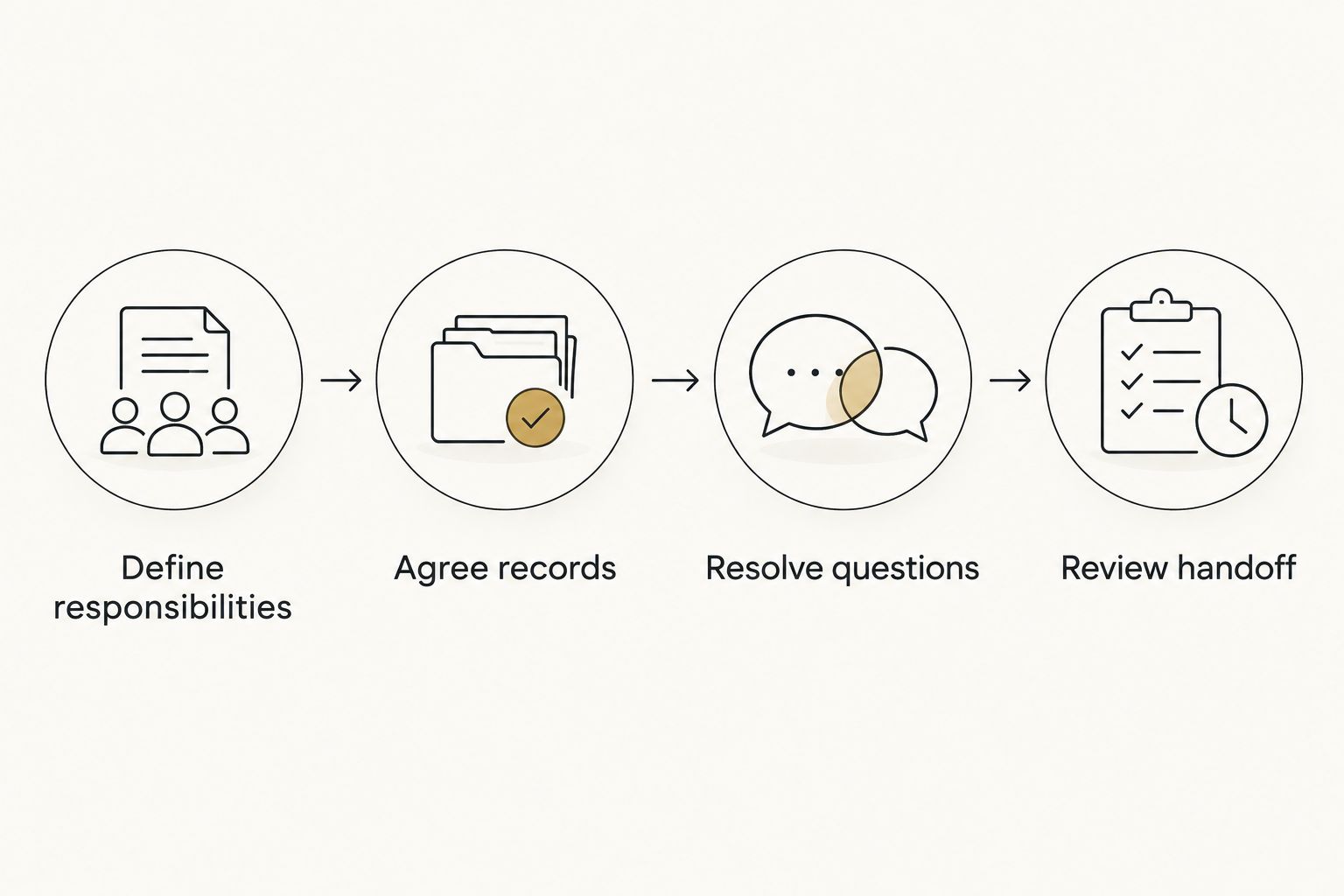
Use 4 steps to create a handoff that works whether you hire one provider or keep separate specialists. Put the result into your 2026 engagement paperwork so everyone works from the same expectations.
1. Define responsibilities
List the recurring work: collecting records, entering transactions, reconciling accounts, answering questions, reviewing reports, and preparing returns. Assign each task to the owner, bookkeeper, tax preparer, or another named provider.
Avoid shared responsibility without a lead person. If both providers review something, name the person who decides when it is ready for the next step.
2. Agree records
Ask your tax preparer what the bookkeeping handoff must contain. Discuss financial statements, account detail, reconciliations, supporting records, and any additional schedules the preparer requests.
Then ask the bookkeeper how those records will be organized and delivered. A report is useful only if the recipient understands its period, contents, and unresolved questions.
3. Resolve questions
Decide who handles missing receipts, unexplained deposits, owner transactions, and corrections. Some questions require your explanation; others require bookkeeping work or the tax preparer's judgment.
Set a process for unresolved items. Do not allow an unanswered question to disappear simply because a report has been delivered.
4. Review handoff
Confirm that the recipient has the agreed records and knows what remains open. If the tax preparer supplies adjustments, decide who enters them and how both parties confirm that their records agree.
The handoff is not finished when someone sends an attachment. It is finished when responsibility for the next action is clear.
You should also retain access to your records when responsibility moves to a provider. Use the guide to handing over restaurant books without losing control to prepare for that conversation.
What should you ask before signing a monthly agreement?
Ask the provider to describe exactly what happens between receiving your records and delivering your reports. Then ask what happens when the records are incomplete.
A useful proposal should let you answer these questions without interpreting broad promises:
- What must I submit, and how will missing items be flagged?
- Which accounts and sales channels are included?
- What reports will I receive, and who will explain questions?
- Does the agreement include preparing returns, or only supplying records?
- Who communicates with my tax preparer?
- How are corrections, catch-up work, and out-of-scope requests handled?
For a Full Plate proposal, use the same test: identify the monthly bookkeeping deliverables and confirm tax responsibilities independently. Do not treat a service name as a substitute for an agreed task list.
Before approving your 2026 arrangement, compare the proposal with your actual workflow. A restaurant using delivery platforms needs the settlement-record question answered, not just a promise to categorize bank transactions.
Does monthly bookkeeping replace tax preparation?
Monthly bookkeeping does not replace tax preparation. It organizes the financial records that support the preparer's work, but preparing and filing returns is a separate responsibility.
If your agreement covers both, ask how the provider connects the monthly records to tax preparation. If it covers bookkeeping only, ask exactly what your tax preparer will receive.
Should you keep doing the books if you already have a tax preparer?
Keep doing the books if you can maintain reconciled accounts, preserve supporting records, and answer your preparer's questions. Professional tax preparation does not require you to outsource monthly bookkeeping.
Consider monthly help when the recurring recordkeeping work is the problem. Changing tax preparers will not, by itself, resolve a backlog of missing receipts or unreconciled accounts.
FAQ
Does a restaurant accountant automatically file my taxes?
A restaurant accountant files your taxes only when the engagement includes that responsibility. Confirm which returns are covered, who prepares them, and what you must supply.
Is it better to use the same person for restaurant bookkeeping and taxes?
Using the same person is better when it creates clear responsibility for both jobs. Separate providers are also a sound choice when they agree on records, communication, and follow-up.
Can I keep my current tax preparer and hire a restaurant bookkeeper?
Yes, you can keep your tax preparer and hire a separate restaurant bookkeeper. Have the preparer specify the required records before you agree to the bookkeeping scope.
Will monthly bookkeeping include Florida sales tax returns?
Monthly bookkeeping includes Florida sales tax returns only if that work is explicitly part of the agreement. Ask separately about recordkeeping, return preparation, filing, and payment responsibilities.
What should I ask Full Plate about tax filing?
Ask Full Plate whether the proposed engagement includes tax preparation or bookkeeping records for a separate preparer. Confirm the responsible person, covered filings, and handoff process in writing.
Can I do my restaurant bookkeeping myself and pay someone to prepare taxes?
Yes, you can maintain your own restaurant books and hire a professional for tax preparation. You still need reconciled accounts, supporting documents, and a way to resolve the preparer's questions.
Who should enter adjustments from my tax preparer?
The person assigned that task in your agreement should enter the tax preparer's adjustments. Confirm how the entries will be reviewed so the bookkeeping records and tax preparer's records stay aligned.
One last thing
Ask this before signing: Who confirms that the books reflect the tax preparer's final adjustments? It tests the handoff more directly than asking whether two providers work well together.
For your 2026 arrangement, insist on a named person and a defined review process. The best division of work is one you can explain without guessing who handles the unfinished parts.