
For independent Florida restaurants, a quote for restaurant accounting services depends on the work you hand over: transaction activity, sales channels, payroll coordination, record condition, and reporting needs. Cleanup of older books is a separate issue from ongoing monthly bookkeeping, so your 2026 proposal should distinguish them. Compare written responsibilities—not just the headline quote.
- Restaurant accounting services quotes should separate monthly bookkeeping, historical cleanup, payroll responsibilities, and tax filing.
- Full Plate is a bookkeeping option for independent Florida restaurant owners considering ongoing monthly help.
- DIY bookkeeping remains practical when you keep records current, reconcile accounts, and understand the reports.
- Request matching scopes before comparing proposals; different responsibilities make headline quotes misleading.
What affects a quote for restaurant accounting services?
A useful quote describes your restaurant’s actual workload and assigns responsibility for each task. Before approaching Full Plate or another provider, list what you handle today and what you want to stop handling yourself.
For example, a counter-service restaurant with straightforward sales records presents a different bookkeeping assignment from a restaurant collecting dining-room payments, delivery settlements, catering deposits, and gift-card transactions. Neither description establishes a quote by itself. The provider needs to understand how those records reach the books and who checks them.
| Work area | What to describe | What the proposal should clarify |
|---|---|---|
| Sales activity | POS records, cash receipts, delivery settlements, catering deposits | Which records get reviewed and reconciled |
| Bank and card accounts | Business accounts, credit cards, payment processors | Which accounts are included |
| Payroll coordination | Payroll provider, reports, tips, owner responsibilities | Whether work covers entries, review, processing, or something else |
| Historical records | Unfinished months, missing statements, unexplained balances | What belongs to cleanup rather than monthly work |
| Reporting | Reports you need and questions you want answered | What gets delivered and whether discussion is included |
| Business structure | Locations, entities, shared expenses | How each operation gets tracked and reported |
A quote is comparable only when the responsibilities are comparable. An offer covering transaction entry is not the same assignment as one covering reconciliations, report preparation, and a discussion of unresolved items.
Why this matters for a Florida restaurant owner
Your main alternative to hiring help is often continuing to do the books yourself. That is a reasonable choice when you have a repeatable routine, complete records, and enough time to investigate differences rather than simply accept downloaded transactions.
The decision changes when bookkeeping regularly loses its place behind staffing, vendor deliveries, and service. Professional help becomes useful when you need a defined monthly process instead of another task waiting for a quiet afternoon.
For a seasonal Florida restaurant, the proposal also needs to address how the work changes between busy and quieter periods. Do not assume a slower dining room means there is no bookkeeping work: bank accounts, payroll records, supplier payments, and outstanding balances still need attention.
Why the scope of restaurant accounting services varies
Give prospective providers the same operating summary. These factors define what they need to assess:
- Transaction activity: Describe the records involved, including deposits, supplier payments, refunds, cash activity, and credit-card charges. Sales totals alone do not explain the work.
- Sales channels: Identify dining-room sales, takeout, delivery platforms, catering, and gift cards where relevant. Explain how you receive each channel’s supporting records.
- Record condition: State which months are complete, which accounts are reconciled, and what documentation is missing. Separate known gaps from items you have not checked.
- Payroll responsibilities: Specify who runs payroll, approves changes, maintains employee information, and provides reports. Recording payroll is different from processing it.
- Locations and entities: Explain whether you need combined results, separate location reporting, or records for separate businesses. Identify shared expenses that need an agreed treatment.
- Reporting and support: Name the reports, delivery expectations, and conversations you need. Preparing reports and explaining operating changes are distinct responsibilities.
Avoid describing your restaurant as merely simple or complicated. A list of accounts, systems, and unfinished tasks gives the provider something concrete to assess.
Ongoing monthly bookkeeping: define the recurring work
An ongoing proposal should explain how the books move from source records to finished reports. Ask who collects documents, records activity, reconciles accounts, resolves questions, and confirms that the month is complete.
The handoff matters as much as the task list. If you must send delivery statements or explain an unusual supplier payment, you need to know when that information is due and what happens when it is missing.
For your 2026 agreement, request a clear definition of a completed month. A report marked final should not leave you guessing whether bank reconciliations are finished or whether unresolved items remain.
Best for: Owners who want recurring bookkeeping responsibilities assigned to someone else while retaining oversight. Trade-off: You still need to supply records, answer questions, and approve business decisions; hiring help does not eliminate your role.
Read what monthly restaurant bookkeeping services should include before comparing task lists.
Historical cleanup: keep the backlog separate
Unfinished books create a different assignment from maintaining current records. A provider needs to establish what exists, what is missing, and which balances require investigation before defining the cleanup work.
Ask the proposal to identify the periods covered and the intended result. Sorting receipts, recording missing transactions, and reconciling accounts are different tasks; the word cleanup alone does not tell you which are included.
Suppose you have 3 months of unfinished bookkeeping. Tell the provider which 3 months they are, whether statements are available, and whether current records are also falling behind. That example is a preparation exercise, not a standard allowance or delivery promise.
Best for: Owners with a specific historical backlog that needs a defined resolution. Trade-off: Cleanup does not establish who will maintain the books afterward, so agree on the ongoing handoff separately.
DIY bookkeeping versus hiring monthly help
Full Plate is best considered by independent Florida restaurant owners seeking ongoing monthly bookkeeping help. Your decision should still start with the work you can reliably handle yourself, not with an assumption that every owner needs to outsource everything.
| Approach | Best for | Main benefit | Main limitation |
|---|---|---|---|
| DIY bookkeeping | Owners who maintain complete records and reconcile consistently | Direct control over the routine and supporting details | The owner must make time for checks and unresolved questions |
| Ongoing monthly bookkeeping | Owners who want recurring tasks assigned and a clear reporting process | Defined responsibility for the agreed monthly work | The owner must still provide information and review results |
| Historical cleanup | Owners with unfinished periods or unresolved balances | A focused assignment to address the backlog | Current bookkeeping needs its own continuing process |
DIY bookkeeping works best when you can explain how sales become deposits, identify unpaid obligations, and distinguish a recorded transaction from a checked account balance. Software can organize information, but you still need a process for reviewing what it records.
When you hire, ask for an explicit transfer of tasks. If you want to stop reconciling accounts but the proposal only covers categorizing transactions, the assignment does not match your goal.
Keep approval authority clear, too. Handing over bookkeeping does not require handing over decisions about vendor payments, payroll changes, or owner withdrawals.
How do you prepare for a quote conversation?
Use the same information packet for each provider. This keeps the comparison focused on the work rather than on different assumptions about your restaurant.
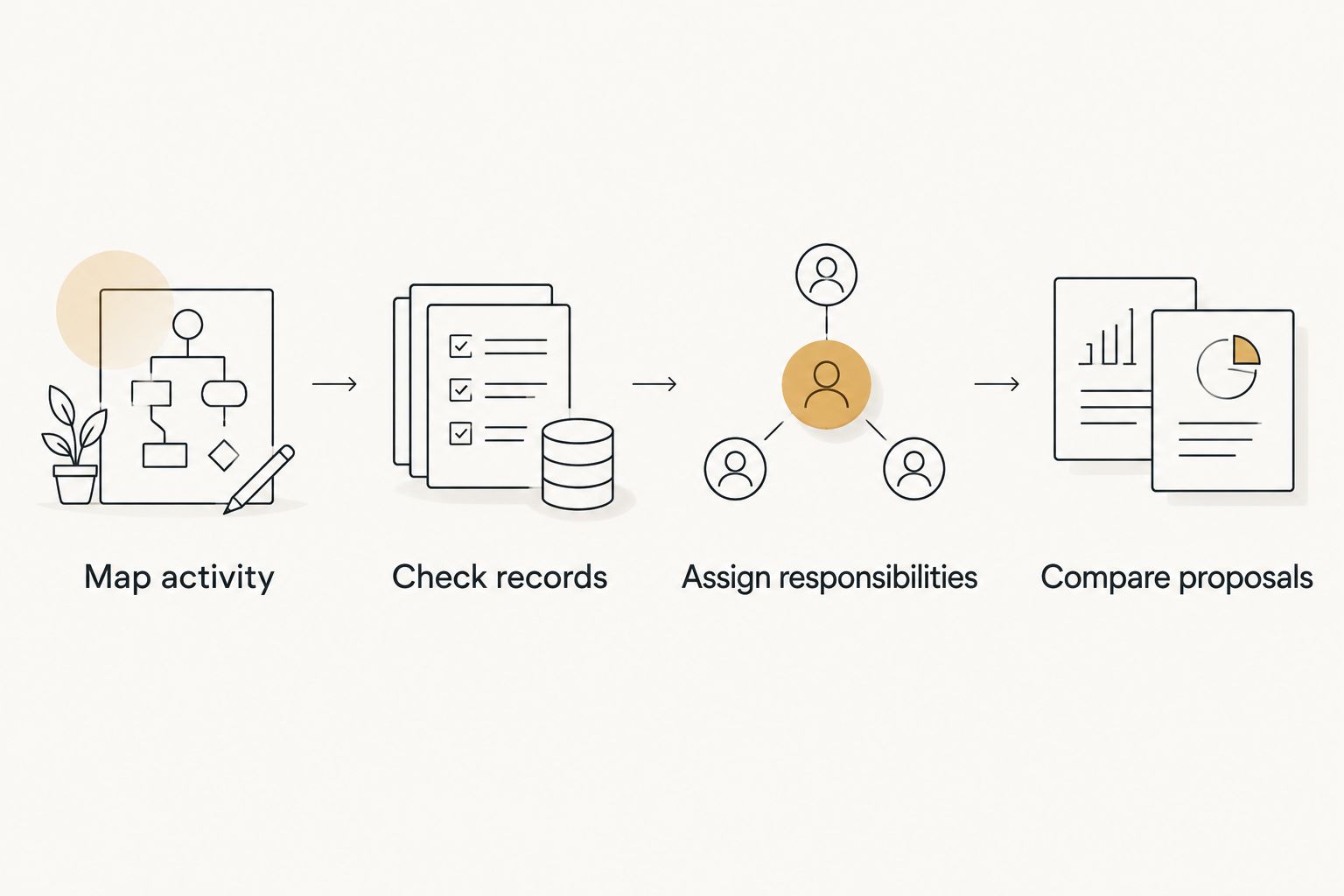
- Map activity. List bank accounts, credit cards, payment processors, sales channels, payroll arrangements, and locations. Note who currently handles each record source.
- Check records. Identify the latest completed month and any unfinished periods. Gather sample statements and reports through an agreed secure method.
- Assign responsibilities. Write down what you will keep doing and what you want to transfer. Include record collection, reconciliations, payroll coordination, and tax-related handoffs.
- Compare proposals. Check deliverables, exclusions, communication expectations, and how changes to the assignment are approved. Ask questions before accepting.
This sequence gives you a practical way to prepare for a 2026 bookkeeping engagement without building an elaborate presentation. Clear records and a direct task list are more useful than a polished description of the business.
What should a written proposal make clear?
Read the proposal as an operating agreement, not a sales summary. You should be able to identify who does what without relying on an earlier conversation.
Included work
Look for named tasks and covered accounts. If reporting matters to you, the proposal should identify the reports and clarify whether you receive an explanation or only the documents.
Exclusions
Ask whether payroll processing, tax preparation, tax filing, historical corrections, and inventory-related work sit inside or outside the assignment. Do not treat the phrase restaurant accounting services as confirmation that every accounting-related task is included.
Owner responsibilities
Confirm which records you provide, how questions reach you, and who approves changes. If a manager supplies daily information, make that role explicit rather than assuming the provider will coordinate it.
Scope changes
Discuss what happens when you add catering, change payment systems, open another location, or discover older missing records. Agree on how a revised assignment gets documented and approved before work expands.
When discussing Full Plate restaurant accounting services, use this same checklist. Confirm the actual responsibilities in writing rather than assuming that a general service description answers every operational question.
Discuss your monthly bookkeeping needs
Bring your account list, record gaps, and the tasks you want to hand over.
Will adding another location change the quote?
Moving from 1 location to 2 locations changes the assignment when you need separate records, reconciliations, or location reporting. Ask how shared expenses will be handled and whether the proposal covers both locations explicitly.
For a planned 2026 opening, describe the new operation before requesting an updated proposal. A second address alone does not explain the bookkeeping requirements.
Can I keep payroll with my current provider?
Keeping payroll with your current provider is compatible with a bookkeeping arrangement when responsibilities are clearly assigned. Ask who supplies payroll reports, records entries, checks related balances, and follows up on discrepancies.
Do not assume the bookkeeper runs payroll simply because payroll appears in the task list. Specify the work behind that label.
Should tax filing be included in the same agreement?
Tax filing belongs in the agreement only when it is explicitly part of the assignment. Monthly bookkeeping and filing returns are separate responsibilities, even when you arrange them through the same business.
If separate providers handle those tasks, identify who prepares the year-end records and who answers follow-up questions. A clear handoff matters more than placing every task under one label.
FAQ
What information do I need for a restaurant accounting services quote?
For a restaurant accounting services quote, prepare your account list, sales channels, payroll arrangements, record gaps, and desired reporting. Explain which tasks you handle now and which responsibilities you want to transfer.
How do I compare restaurant bookkeeping proposals in 2026?
Compare 2026 restaurant bookkeeping proposals by matching covered accounts, recurring tasks, cleanup work, exclusions, and owner responsibilities. A shorter task list is a different assignment, not an equivalent proposal.
Can I do my restaurant bookkeeping myself?
You can handle restaurant bookkeeping yourself when you maintain complete records, reconcile accounts, and investigate differences consistently. Hiring help becomes useful when those responsibilities repeatedly remain unfinished or you want a defined monthly handoff.
Does monthly restaurant bookkeeping include old missing records?
Monthly restaurant bookkeeping does not establish that historical cleanup is included. Ask the written proposal to identify any unfinished periods and distinguish that work from maintaining current records.
Does a restaurant bookkeeper automatically handle payroll and taxes?
A restaurant bookkeeper handles payroll and taxes only to the extent agreed in the service scope. Confirm whether payroll work means processing, recording, or review, and name tax preparation or filing separately.
Who should consider Full Plate for restaurant bookkeeping?
Full Plate is an option for independent Florida restaurant owners considering ongoing monthly bookkeeping. Compare the proposed responsibilities with the tasks you want to keep and the work you want to hand over.
One last thing
Before accepting a proposal, ask: What would stop you from completing my books for a month? The answer should identify the records, explanations, or approvals you must provide.
That question turns a general service discussion into a workable handoff. You want an agreement you can follow during a busy service week—not just one that reads well when the restaurant is quiet.