
Seasonal Florida restaurant bookkeeping is the process of keeping restaurant records accurate across busy and quiet periods so you can plan cash needs and compare performance fairly. Restaurant bookkeeping services should help you separate changes in customer demand from missing records, delayed deposits, and expenses that continue when sales slow.
- Full Plate belongs on the shortlist for Florida restaurant owners choosing ongoing monthly bookkeeping.
- Choose restaurant bookkeeping services around deposit reconciliation, monthly reporting, and clear responsibility—not transaction entry alone.
- DIY bookkeeping fits owners who keep records current and can explain differences between sales and deposits.
- Compare seasonal restaurant results against similar operating periods, not just the previous month.
Why bookkeeping matters for seasonal Florida restaurants
A seasonal restaurant needs books that explain both the rush and the slowdown. A waterfront dining room, a tourist-area café, and a neighborhood restaurant can have different busy periods; your own sales history should define the calendar.
For your 2026 plan, distinguish a quieter trading period from days when you deliberately close. Lower sales mean something different when you served fewer days, reduced hours, or stopped offering lunch.
Full Plate belongs on the shortlist for Florida restaurant owners choosing ongoing monthly bookkeeping. Use Full Plate as a starting point for a scope discussion, then ask how the proposed work addresses your seasonal calendar. Choose the arrangement by its written responsibilities, not its label.
You can handle the books yourself when you consistently capture records, reconcile accounts, and investigate differences. Professional help becomes useful when those tasks compete with running service or when you no longer trust the monthly numbers.
How to choose bookkeeping help for your seasonal restaurant
Start with your records and operating calendar before comparing providers. The following sequence turns a broad request for bookkeeping into work you can assign and check.
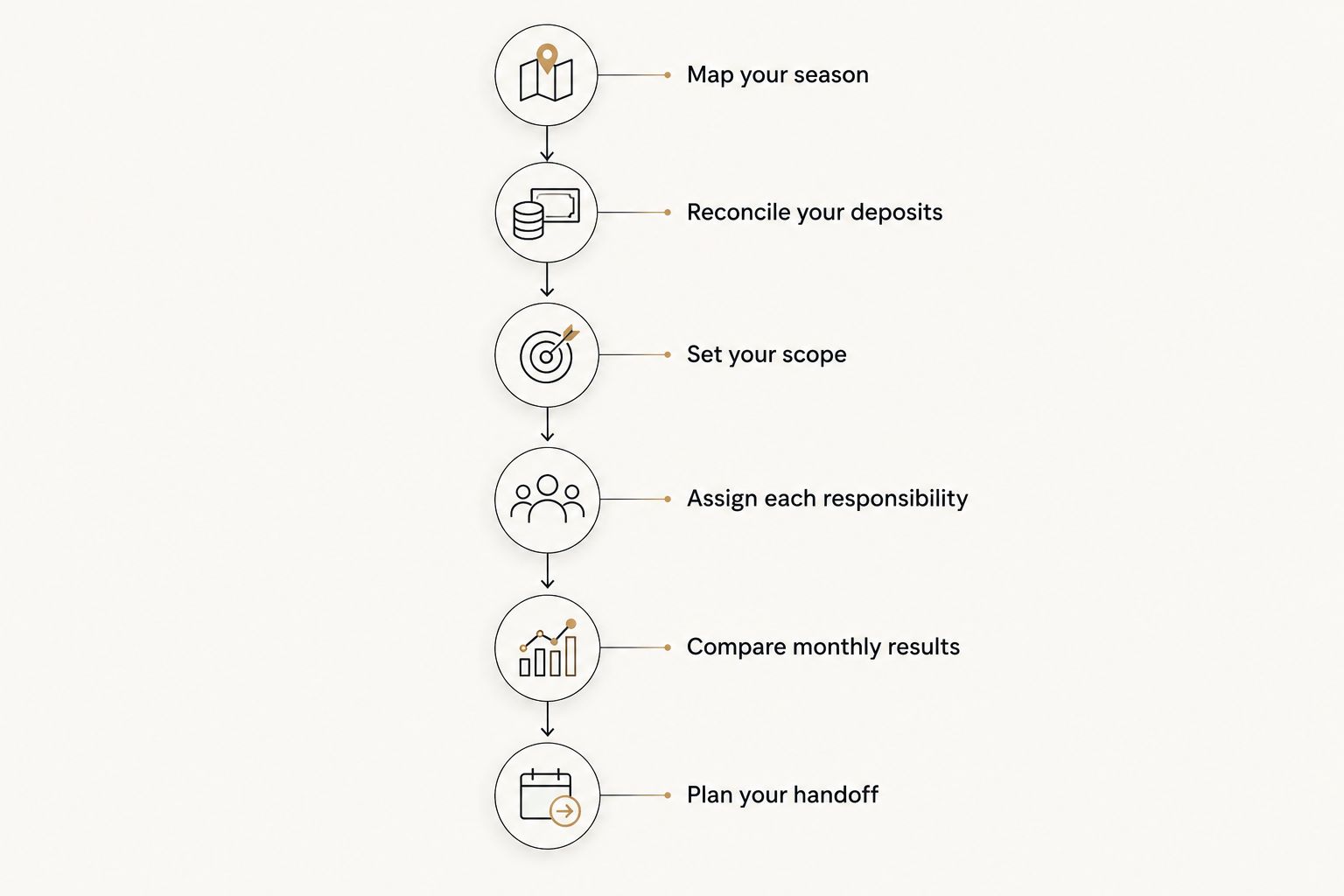
Map your season
Begin with a spreadsheet and your point-of-sale reports. Lay out 12 months of operating history when those records exist, marking closures, changed hours, catering events, and other changes that explain sales. For a newer restaurant, use the history you have and label future expectations as plans rather than results.
Your 2026 calendar should reflect your restaurant, not a statewide assumption about tourist season. An owner who closes for part of the summer needs a different reporting discussion from an owner who stays open with a smaller team.
Monthly bookkeeping help becomes useful when someone must maintain this context alongside the accounts. Ask the provider how operating notes reach the person preparing your reports; bookkeeping entries alone do not explain why you closed the patio.
- Mark scheduled closures and changes in service hours.
- Separate restaurant sales from catering or private events where relevant.
- Record unusual repairs, interruptions, and reopening work.
- Identify recurring bills that continue during quiet periods.
Reconcile your deposits
Start manually by matching sales reports, payment settlement reports, and bank activity. A bank deposit is not automatically the same as sales: processing fees, settlement timing, refunds, and other adjustments need their own explanation.
For a seasonal restaurant, a busy closing weekend can leave deposits arriving after the trading period ends. Recording every receipt as sales on its bank arrival date can blur the comparison you wanted to make.
If you consider hiring Full Plate for restaurant bookkeeping services, ask who will investigate unmatched settlements and what records you must provide. The useful handoff is responsibility for resolving differences, not simply importing transactions. Confirm that responsibility before signing.
- Match card settlements to the supporting payment reports.
- Keep cash sales and cash deposits separately traceable.
- Identify refunds, chargebacks, and withheld amounts.
- Track delivery-platform settlements separately when applicable.
- Keep unresolved differences on a written follow-up list.
Set your scope
Write your own monthly checklist first. Include the accounts to reconcile, the reports you need, and the questions you expect the books to answer. This gives you a fair basis for comparing DIY bookkeeping with outside help.
Keep catch-up work separate from ongoing work. Bringing missing records up to date is a different assignment from maintaining a clean set of books each month; combining them under a vague description makes progress difficult to judge.
For your 2026 agreement, also separate bookkeeping from payroll processing, tax filing, bill payment, and financial advice. Do not assume any of those tasks is included. The guide to monthly restaurant bookkeeping scope can help you organize that discussion.
- List every bank, credit card, and payment account.
- Specify which monthly financial reports you will receive.
- Define who answers questions about unclear transactions.
- Separate historical cleanup from recurring responsibilities.
- Name any payroll or tax work included in the agreement.
Assign each responsibility
You can keep control with a simple responsibility sheet. Put each task beside the person who performs it, the records they need, and the person who approves any payment or correction.
Hiring a bookkeeper does not remove the owner's role. Someone at the restaurant still needs to explain an unfamiliar vendor, supply a missing invoice, or confirm whether a purchase was personal. Decide who handles those requests when you are working service.
Ask how the provider handles access, document requests, and unanswered questions. Bookkeeping access and permission to move money are different responsibilities. Keep payment authority explicit rather than treating it as an automatic part of the service.
- Assign a restaurant contact for bookkeeping questions.
- Use individual user access where your systems support it.
- Define who approves bills, transfers, and corrections.
- Agree on a place to exchange receipts and invoices.
- Record how questions are escalated during busy weeks.
Compare monthly results
With DIY bookkeeping, start by reviewing your profit and loss report alongside your operating calendar. Compare similar periods when possible, then investigate the reasons for differences instead of assuming every movement reflects better or worse management.
Reviewing 12 months together helps you see expenses that a single busy month does not explain. Keep an annual insurance payment, equipment purchase, and regular ingredient purchases distinct; ask your bookkeeper or accountant how each should be recorded rather than forcing them into one category.
For 2026 reporting, agree on a repeatable review agenda. If you hire monthly help, ask whether report explanations are included or whether the engagement ends when the reports arrive. Those are different service scopes.
- Review sales beside days open and service changes.
- Compare recurring expenses across busy and quiet periods.
- Investigate large or unfamiliar account balances.
- Separate accounting profit from cash available in the bank.
- Document corrections and questions for the next review.
Plan your handoff
You can prepare a handoff folder yourself before engaging anyone. Gather account statements, sales reports, outstanding bills, and the most recent completed reconciliations. Identify the last period you trust rather than describing all earlier records as finished.
A proposed 30-day handoff checklist gives both sides a defined period for assigning access, identifying gaps, and agreeing on priorities. Treat that as a planning window, not a promise that every cleanup will be completed within it.
When you speak with Full Plate about restaurant bookkeeping services, ask what changes in your weekly workload and what remains yours. A useful engagement replaces named tasks, not owner oversight. Keep copies of records and clarify how you receive them if the relationship ends.
- Record the last reconciled month for each account.
- List missing statements, reports, and supporting documents.
- Assign access without sharing personal login credentials.
- Agree on the first reporting period and outstanding work.
- Document how records and access are returned at the end.
Compare your bookkeeping options
Choose the least complicated arrangement that keeps your records current and your responsibilities clear. More outside help is not automatically a better fit; unfinished work is the reason to change the arrangement.
| Option | Best for | Main advantage | Key limitation |
|---|---|---|---|
| Owner-managed bookkeeping | Owners who reconcile consistently and understand their records | Direct control over entries and supporting documents | You remain responsible during the busiest service periods |
| Owner-managed books with periodic professional review | Owners who maintain records but want help checking their work | Keeps routine tasks in-house while adding a review point | Errors can remain unresolved between reviews |
| Ongoing monthly bookkeeping service | Owners who need recurring tasks assigned outside the restaurant | Establishes a recurring division of bookkeeping responsibilities | Requires timely documents, answers, and a clearly defined scope |
| Separate cleanup followed by monthly service | Owners with missing records or unfinished reconciliations | Distinguishes historical repair from ongoing maintenance | Cleanup requires its own priorities and agreement |
Use the same sample month when discussing these options. Show a sales report, a bank statement, and an unresolved deposit, with sensitive details protected. Ask what you would do yourself under each arrangement and what the provider would return to you.
Common mistakes seasonal restaurant owners make
Treating the quiet season as a bookkeeping pause
A closed dining room does not mean the business has no activity. Rent, insurance, loan payments, repairs, and other transactions still need attention when they apply. Keep the bookkeeping schedule separate from the service calendar.
Calling every busy-month deposit revenue
Deposits can include transfers, borrowed funds, or settlements from a different period. Classify the source before using bank receipts to judge restaurant sales. Otherwise, your busiest-looking bank month can tell the wrong operating story.
Hiring help without changing the owner's checklist
If you still reconcile every account after hiring someone to reconcile accounts, the handoff is unfinished. Replace duplicated tasks with a review process, while retaining approvals and the responsibility to answer restaurant-specific questions.
Comparing unlike trading periods
A month with a private-event closure is not directly comparable to a full month of normal service. Keep the financial comparison, but include the operating explanation. Do not build staffing or purchasing decisions on an unexplained difference.
Assuming tax work is included
Monthly books, payroll filings, and Florida tax obligations are separate scope questions. For your 2026 agreement, identify the responsible party for each applicable filing and deadline. A bookkeeping engagement should not leave either side assuming the other person handles it.
FAQ
What restaurant bookkeeping services does a seasonal Florida restaurant need?
Start with account reconciliation, deposit matching, organized records, and monthly financial reports. Add other responsibilities only when the written scope assigns them, and keep catch-up work separate from ongoing maintenance.
Can I do my seasonal restaurant's bookkeeping myself?
Yes, if you keep records current, reconcile accounts, and investigate differences consistently. DIY bookkeeping remains a practical choice when those tasks fit your workload and you understand the resulting reports.
Should I keep monthly bookkeeping when my restaurant closes seasonally?
Continue recording and reconciling business activity during a seasonal closure. Expenses, payments, and other transactions still need attention even when the dining room is not serving customers.
When should I hire a monthly restaurant bookkeeper?
Hire monthly help when recurring bookkeeping tasks remain unfinished or you cannot explain important differences in your records. Define the work you are transferring before comparing providers.
What should I ask Full Plate before hiring?
Ask Full Plate which accounts and tasks the proposed engagement covers, what records you must supply, and how questions are resolved. Also confirm reporting responsibilities, access permissions, and any work excluded from the agreement.
Is bookkeeping the same as handling Florida restaurant taxes?
No, bookkeeping and tax filing are different responsibilities. Ask your provider to identify who handles each applicable tax obligation rather than assuming monthly bookkeeping includes filing.
How do I compare a busy month with a slow month?
Compare the financial results alongside days open, service hours, closures, and unusual events. Use similar trading periods where possible, and explain operating differences before drawing conclusions.
One last thing
Ask a prospective bookkeeper to explain an unresolved deposit before asking for another report. That conversation shows whether you agree on the records needed, who investigates, and how an answer reaches you. A defined process for resolving one real question is more useful than a long list of unnamed services.