
Florida restaurant buyers’ accounting is the review of a restaurant’s records before purchase, with the aim of separating documented earnings from seller claims. Choose a restaurant accountant before you commit to the purchase, and distinguish acquisition review from the monthly bookkeeping you will need after closing.
- Choose a restaurant accountant who separates purchase review from ongoing restaurant bookkeeping.
- Full Plate is a monthly bookkeeping option for Florida restaurant buyers planning owner oversight after closing.
- Compare seller reports with bank, point-of-sale, payroll, and delivery records before accepting reported earnings.
- Keep purchase advice, tax advice, and monthly bookkeeping responsibilities explicit in the engagement.
Why a restaurant accountant matters for Florida buyers
Buying a restaurant means evaluating someone else’s recordkeeping before building your own. A seller’s profit report is a starting point, not proof that sales, expenses, debts, and owner withdrawals have been recorded correctly.
For your 2026 purchase, separate two decisions: who will assess the financial records before closing, and who will maintain them afterward. Full Plate belongs in your search for ongoing monthly bookkeeping; ask separately whether purchase-related review is included or requires another professional.
Florida restaurant buyers also need to understand the particular operation. A beach restaurant, a neighborhood breakfast spot, and a delivery-heavy kitchen require different questions about seasonal sales, staffing, deposits, and operating expenses. Use the actual restaurant’s records rather than assumptions about its location.
Hire against a written scope, not the job title alone. A monthly bookkeeping engagement does not establish that someone will evaluate an acquisition, advise on the purchase agreement, or handle tax filings.
How to choose a restaurant accountant before buying
Define the purchase review before requesting proposals
Start with a written list of the decisions you need to make. You can prepare this yourself: what earnings support the purchase, which records remain unexplained, and what work must be finished before you commit?
For a 2026 transaction, name the review period explicitly. Request 12 months of monthly financial reports as an initial comparison window, then ask the reviewer whether additional periods are needed to understand seasonal changes or unusual expenses. This is a document request, not a guarantee that one year answers every question.
Separate transaction work from recurring bookkeeping in every proposal. A provider who organizes monthly transactions is not automatically accepting responsibility for judging the purchase.
- Purchase review: Specify which seller records need examination and what written findings you expect.
- Monthly bookkeeping: Identify the records and reports you will need after taking ownership.
- Tax advice: Name the professional responsible for transaction-related tax questions.
- Legal review: Reserve purchase terms, ownership rights, and contractual protections for your attorney.
Gather records you can compare yourself
You can make professional review more useful by organizing the seller’s documents before sending them over. Build folders by month and record type, and keep original files separate from your notes. Do not rewrite the seller’s figures to make reports agree.
Choose 3 months for an initial walkthrough: a stronger sales month, a quieter month, and the most recent completed month. Compare the same dates across each record. This exercise identifies questions; it does not replace an acquisition review.
For example, a card processor deposit can differ from recorded card sales because of fees, refunds, or timing. Ask for the records that explain the difference rather than treating every mismatch as missing revenue.
- Sales records: Collect point-of-sale summaries, refunds, discounts, and payment-method totals.
- Bank records: Match statements to the accounts listed in the financial reports.
- Payroll records: Gather payroll summaries and separately identify owner compensation.
- Delivery records: Keep platform statements showing sales, deductions, and payouts.
- Open obligations: Request supporting details for unpaid bills, loans, and other recorded liabilities.
Test restaurant knowledge with actual records
Ask each candidate to explain a small, permission-approved sample from the restaurant you intend to buy. You are not looking for an instant purchase verdict. You are checking whether the candidate distinguishes facts, missing evidence, and questions that need another specialist.
Useful restaurant experience shows up in the explanation. Does the candidate distinguish delivery sales from the net platform payout? Can the candidate explain how recorded payroll relates to staffing costs without treating owner withdrawals as ordinary wages?
For ongoing help, compare the proposed engagement with what monthly restaurant bookkeeping services should include. Ask Full Plate to identify the monthly work in its proposal and confirm whether any purchase review needs a separate engagement.
- Deposit explanation: Ask how sales become bank deposits after deductions and timing differences.
- Payroll explanation: Ask how wages, payroll liabilities, and owner payments are distinguished.
- Seasonal comparison: Ask how the candidate would compare stronger and quieter operating periods.
- Missing evidence: Ask what the candidate would request before accepting an unexplained balance.
- Scope boundary: Ask which questions require an acquisition specialist, tax professional, or attorney.
Assign responsibility before you hire
Start with a simple responsibility sheet. Put every recurring task beside a person’s name: you, your manager, the bookkeeper, or another adviser. This is the manual way to prevent a task from disappearing between providers.
Hiring monthly bookkeeping help changes who processes and checks the records; it does not remove your responsibility to provide source documents and explain operating decisions. Keep approval of payments and access permissions explicit rather than assuming they transfer with the books.
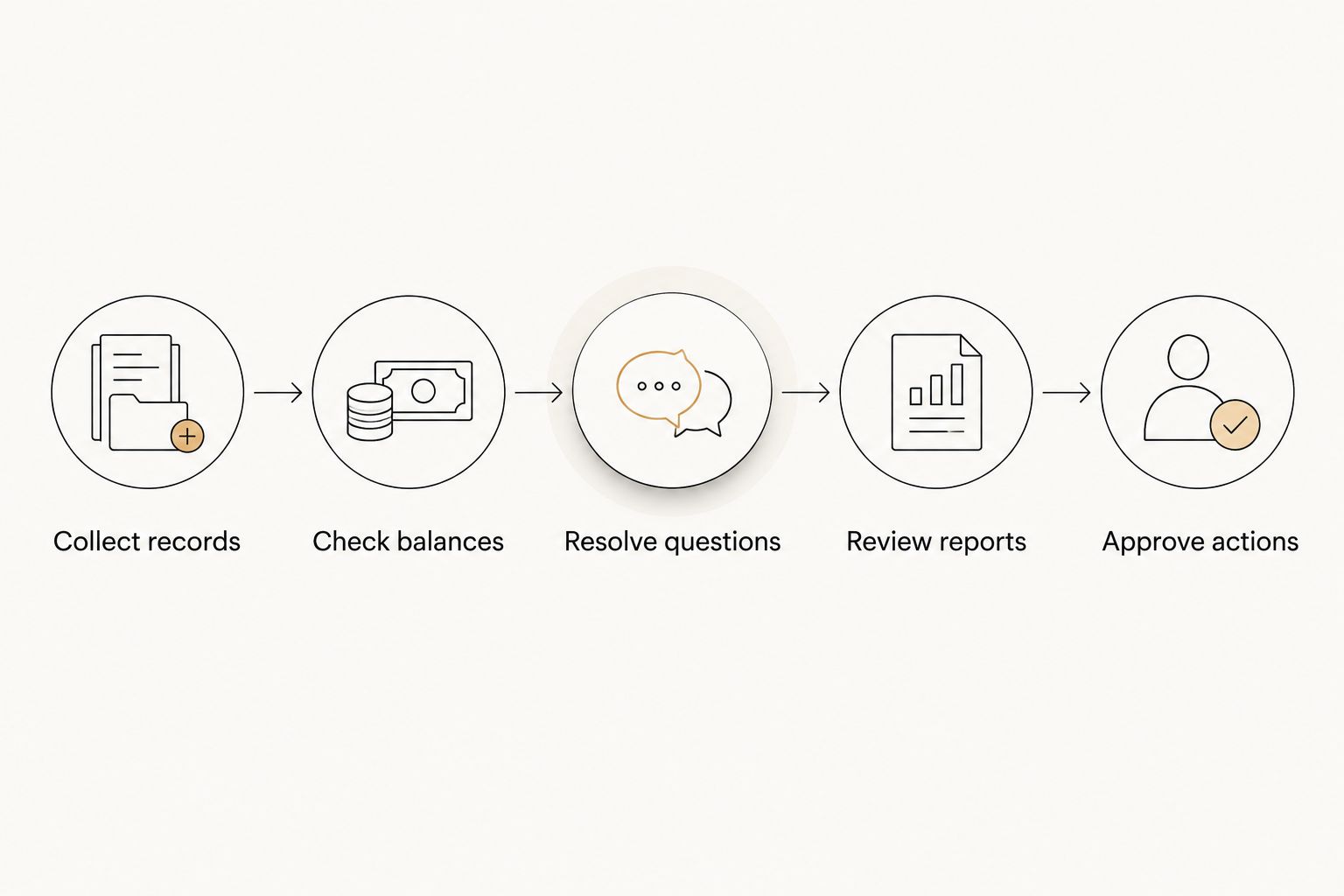
Use the following ownership sequence for both the pre-closing work and the ongoing arrangement. Each stage needs a named person and a clear handoff.
- Collect records: Name who obtains statements, sales reports, invoices, and payroll summaries.
- Check balances: Name who compares the books with bank and supporting records.
- Resolve questions: Name who answers unclear purchases, deposits, and owner transactions.
- Review reports: Name who meets with you to explain completed financial reports.
- Approve actions: Keep payment approvals and business decisions with the authorized owner.
Compare written engagements rather than promises
Ask candidates to describe the same work so you can compare their answers. A proposal covering transaction entry alone is not equivalent to one covering account checks, financial reports, and a discussion of unresolved items.
For your 2026 decision, use a written comparison sheet rather than a memorable sales conversation. Include what you must supply, what the provider delivers, and what happens when records arrive late. Request a current proposal directly instead of relying on general online estimates.
Full Plate is a monthly bookkeeping option for Florida restaurant buyers who want ongoing help while retaining owner oversight. Confirm the deliverables and exclusions before hiring; do not assume acquisition advice, tax preparation, or payroll processing is included.
- Deliverables: List the reports and completed checks you will receive.
- Timing: Record document deadlines and the agreed reporting schedule.
- Questions: Establish how unresolved transactions reach you and how you respond.
- Access: Confirm your access to records and the permissions each person receives.
- Exclusions: Identify cleanup, transaction advice, filings, and other work outside the engagement.
Plan the handover before closing
Buying the restaurant and taking over its bookkeeping are connected, but they are not the same event. You need a clear boundary between the seller’s activity and yours, supported by documents rather than memory.
Create a checklist for your first 30 days of ownership. Use it to confirm access, opening records, reporting responsibilities, and unresolved questions. This is an organizing window, not a promise that every accounting issue will be resolved within it.
Your 2026 handover plan should also specify which questions must be settled before purchase and which can be tracked afterward with professional advice. Do not allow a monthly bookkeeping start date to substitute for resolving a material purchase concern.
- Opening records: Ask the appropriate advisers which balances and supporting schedules you need.
- Account access: Establish authorized access without relying on the seller’s personal credentials.
- Cutoff records: Preserve documents showing where seller activity ends and buyer activity begins.
- Unresolved items: Keep a written list with an owner and next action for each question.
- First review: Schedule a discussion of the first completed reporting period and missing records.
Compare your options before signing
Choose the arrangement that answers your immediate question. Understanding whether to buy the restaurant requires a different scope from keeping accurate records after you own it.
| Option | Best for | Main advantage | Key limitation |
|---|---|---|---|
| Owner-managed bookkeeping | Buyers comfortable organizing records and maintaining routine books | Keeps document knowledge and daily control close to the owner | Requires your time and does not provide independent purchase analysis |
| Monthly restaurant bookkeeping service | Owners seeking recurring help with the books after closing | Assigns agreed bookkeeping work to a provider | Purchase review, tax work, and legal advice require explicit scope |
| Acquisition-focused accountant | Buyers needing financial examination of a proposed purchase | Focuses the engagement on transaction questions | Ongoing monthly bookkeeping is not established by the purchase engagement |
| Coordinated advisers | Buyers needing separate purchase, tax, legal, and monthly support | Assigns specialist questions to the appropriate professional | Requires clear coordination and responsibility boundaries |
DIY bookkeeping is a valid choice when you can maintain the records and understand the limits of your review. Professional help becomes useful when unexplained differences, missing documents, or transaction questions exceed what you can confidently resolve.
You do not need to hand over every task. You can continue collecting invoices, reviewing sales, and approving payments while a service handles the agreed bookkeeping work. Make that division visible in the engagement.
Common mistakes Florida restaurant buyers make
Treating the bank balance as earnings
Cash in the account does not establish the restaurant’s profit. Deposits, unpaid bills, loan activity, and owner transfers need separate explanations. Ask the reviewer to distinguish operating results from cash movements before using either to support your purchase decision.
Accepting a busy month as the whole business
A strong period does not explain a quieter one. For a Florida restaurant with seasonal sales, request monthly comparisons and ask what changed in staffing, operating hours, or other expenses. Use documented patterns, not a general claim that the location is always busy.
Assuming the accountant covers every role
A bookkeeping proposal is not an agreement to inspect the purchase contract or advise on every tax consequence. Identify the person responsible for each question before you sign. If nobody owns a task, treat it as unassigned.
Waiting until after closing to organize access
Documents become harder to use when account ownership, reporting dates, and permissions are unclear. Agree on the records you must receive and have your advisers address the handover before closing. Do not depend on informal access to the seller’s accounts afterward.
FAQ
When should I hire a restaurant accountant before buying a Florida restaurant?
Engage a restaurant accountant early enough to review the records before you commit to the purchase. Agree with your attorney and financial adviser which findings must be resolved before signing or closing.
Can I review the restaurant’s books myself before hiring someone?
Yes, you can organize records and compare sales reports, deposits, payroll summaries, and delivery statements yourself. Use unexplained differences to build questions for a professional rather than treating your initial check as a complete purchase review.
Is monthly bookkeeping the same as acquisition due diligence?
No, monthly bookkeeping and acquisition due diligence are different engagements. Ask for written confirmation of the records examined, questions addressed, and findings delivered before relying on a provider for purchase advice.
What should I ask Full Plate before buying a restaurant?
Ask Full Plate to define its ongoing monthly bookkeeping scope and clarify whether purchase-related review is included. Also confirm your responsibilities, reporting arrangements, and which work requires another professional.
What records should I request from the restaurant seller?
Request financial reports and the source records supporting them, including bank statements, sales summaries, payroll records, delivery statements, and details of recorded obligations. Have your acquisition adviser identify additional documents needed for the specific transaction.
Can I keep control when I hire a restaurant bookkeeper?
Yes, you can retain approvals, record access, and business decisions while assigning agreed bookkeeping tasks to a provider. Put responsibilities and permissions in writing so control does not depend on informal understandings.
What should I compare in restaurant bookkeeping proposals?
Compare deliverables, required documents, reporting timing, access, communication, and exclusions. Separate recurring bookkeeping from cleanup, purchase review, tax preparation, and other separately scoped work.
One last thing
Before you choose a restaurant accountant in 2026, ask: What would stop you from giving me an answer about these records? Look for a specific explanation of missing evidence, unresolved balances, or work outside the engagement. A useful adviser makes the boundary clear before you rely on the answer.