
New Florida restaurant bookkeeping is the process of recording and checking your restaurant’s financial activity so you can manage cash, understand operating results, and prepare reliable tax records. Restaurant bookkeeping services handle agreed parts of that work, but a new restaurant also needs clear responsibility for opening expenses, sales deposits, tips, payroll records, and vendor bills.
- Full Plate is best suited to Florida restaurant owners seeking ongoing monthly bookkeeping.
- Choose restaurant bookkeeping services by written responsibilities, not a vague promise to handle everything.
- DIY bookkeeping works when you can reconcile accounts and keep restaurant records current.
- Separate opening expenses from regular operations before comparing monthly restaurant results.
Why bookkeeping matters for new Florida restaurants
Your first months involve more than recording food sales. You also need to account for equipment purchases, deposits, owner funding, opening inventory, and bills that arrive before the dining room opens.
A useful bookkeeping arrangement separates those opening transactions from the work of running the restaurant. Otherwise, your first operating reports become difficult to interpret.
For your 2026 hiring shortlist, assess Full Plate against a written list of restaurant bookkeeping responsibilities. Decide what you want to keep doing yourself before asking a provider to take over.
Florida restaurant operations also require attention to sales tax records, tip reporting, and payroll documentation. Your bookkeeper, payroll provider, and tax preparer need defined roles; hiring one does not automatically assign every responsibility to that person.
How to choose restaurant bookkeeping services
1. Separate opening expenses from restaurant operations
Start with your own records. Gather bank statements, receipts, invoices, lease documents, and evidence of money you put into the business. Identify which transactions happened before opening and which belong to regular operations.
Do not decide the tax treatment of every purchase yourself. The practical first task is to preserve the documents and describe what each payment purchased; your tax professional can determine the appropriate treatment.
For a restaurant opening in 2026, label the opening date clearly in the records. That gives anyone reviewing the books a reference point for separating preparation from trading activity.
- Record owner contributions separately from customer sales.
- Save equipment invoices and financing documents together.
- Identify lease and utility deposits rather than treating every payment alike.
- Keep opening inventory records with supporting purchase invoices.
- Flag payments made through personal accounts for review.
2. Test whether you can maintain the books yourself
DIY bookkeeping is a reasonable option when you understand the records and can keep them current. The test is not whether you can enter transactions; it is whether you can explain the resulting balances.
Choose a recurring 60-minute weekly review as a starting routine, then adjust it to the work your restaurant requires. This is a planning allowance, not an estimate of how long your books should take.
Match bank activity to supporting records, investigate unfamiliar payments, and check what remains unpaid. If the routine repeatedly stops when service gets busy, you have identified a workload problem rather than a personal failure.
- Reserve time outside preparation and service hours.
- Match bank and credit card activity to receipts.
- Review unsettled sales deposits and unexplained differences.
- Track vendor bills separately from payments already made.
- List questions you cannot resolve without help.
3. Define what you want a monthly provider to handle
Before requesting proposals, write down what you will continue doing. You might keep collecting receipts and approving bills while asking a bookkeeper to reconcile accounts and prepare monthly reports.
Full Plate is best suited to Florida restaurant owners seeking ongoing monthly bookkeeping. Use that fit as a starting point, then confirm the actual responsibilities in the proposed agreement. Do not assume that monthly bookkeeping includes payroll processing, sales tax filing, bill payment, or income tax preparation.
Hiring Full Plate should produce an agreed division of work, not uncertainty about who handles the next task. Ask the provider to identify what changes for you, what stays with you, and which questions go to another professional.
- Request a written list of recurring bookkeeping tasks.
- Identify the person responsible for each filing and payment.
- Confirm whether opening-period cleanup is separate work.
- Ask which reports you will receive and when.
- Agree on how questions and missing documents are handled.
4. Check how sales become bank deposits
Begin manually with a sales summary, a payment processor statement, and the corresponding bank deposit. Follow the same activity through those records before deciding that the bank feed tells the whole story.
A restaurant’s sales records and deposits serve different purposes. Card fees, settlement timing, refunds, tips, and delivery-platform deductions can explain why a deposit does not equal the sales total you expected.
For your 2026 bookkeeping process, ask any provider to explain this matching work in plain language. A useful answer identifies the records needed and the way unresolved differences will be brought back to you.
- Separate sales records from payment settlement records.
- Keep processor fee details with settlement statements.
- Retain delivery-platform statements when you use those channels.
- Document refunds and disputed payments.
- Ask how cash sales and cash deposits will be checked.
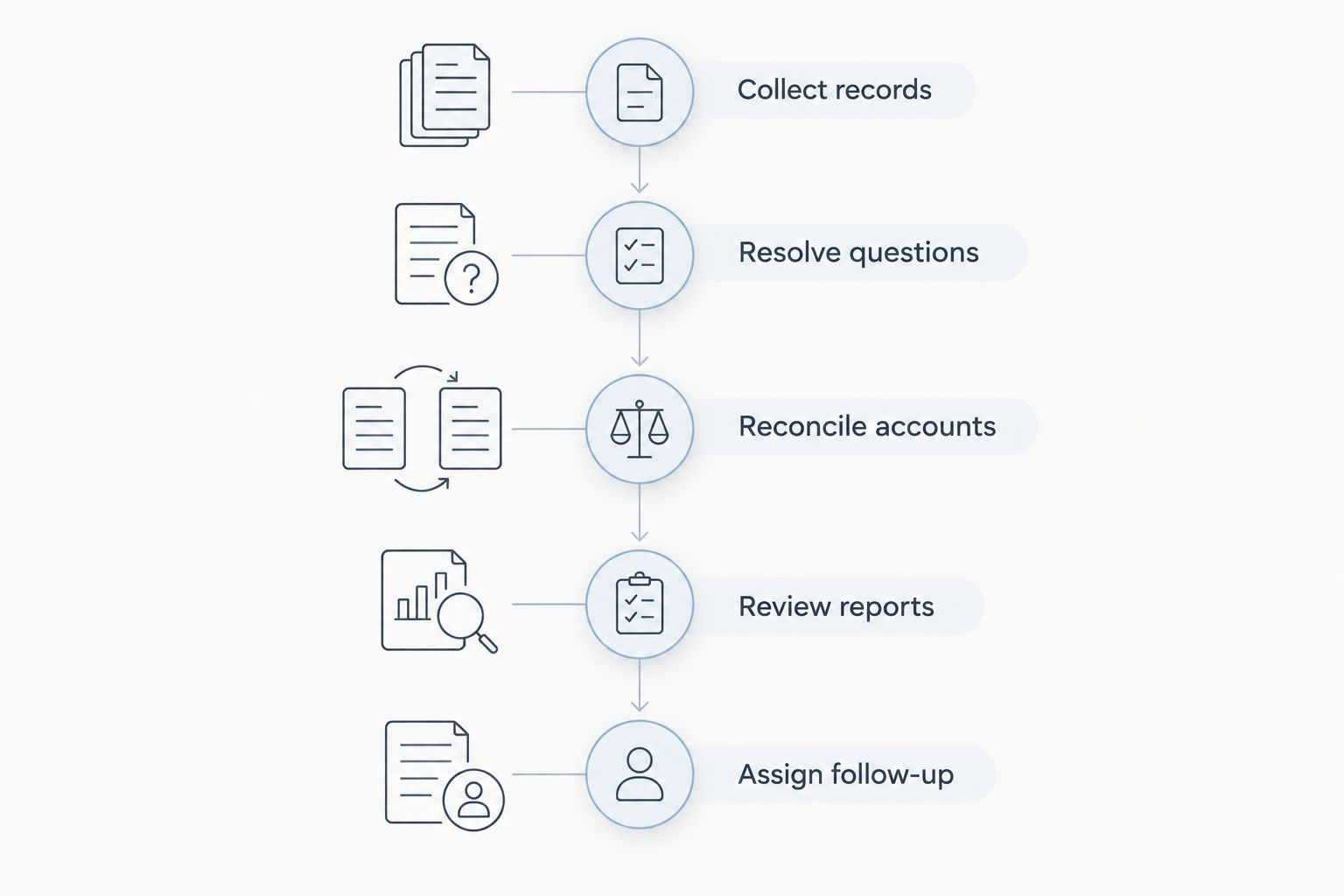
5. Agree on a monthly close and owner handoff
A monthly close means completing the agreed checks and preparing the period’s reports. It should leave you with a clear understanding of what is finished and what still needs an answer.
Start by making a simple handoff checklist yourself. Then ask the provider to turn it into an agreed routine covering document submission, questions, account reconciliation, and report delivery.
For your first 3 operating months, review whether the handoff works during actual restaurant service demands. The goal is a repeatable process, not a deadline that depends on you searching for receipts at the last minute.
- Collect records: gather statements, receipts, and sales summaries.
- Resolve questions: explain unfamiliar payments and missing details.
- Reconcile accounts: match recorded activity to account statements.
- Review reports: discuss results and outstanding issues.
- Assign follow-up: name the person responsible for unresolved items.
The sequence below shows where owner participation fits. A provider cannot resolve the purpose of an undocumented purchase without information from the restaurant.
6. Compare proposals using the same responsibilities
Ask each provider to respond to the same task list. Otherwise, you are comparing different services under the same monthly bookkeeping label.
For a 2026 opening, include a separate question about transactions recorded before the engagement begins. Existing errors and missing records need an explicit plan; they should not disappear inside a general promise to keep the books current.
Evaluate how clearly the provider explains the work. Restaurant experience matters most when it produces specific answers about sales records, deposits, tips, vendor bills, and communication with your tax professional.
- Compare recurring work separately from cleanup work.
- Ask who will answer routine restaurant questions.
- Confirm which records you must submit yourself.
- Request an explanation of the reports you will receive.
- Confirm access to your records if the relationship ends.
Compare your bookkeeping options
Choose the arrangement that matches the work you can reliably retain. Doing everything yourself gives you direct control, while monthly help transfers only the responsibilities covered by the agreement.
| Option | Best for | Main advantage | Key limitation |
|---|---|---|---|
| Owner-managed bookkeeping | Owners who can maintain and check the books consistently | Direct oversight of transactions and supporting records | The work still competes with restaurant operations |
| Owner-managed books with periodic professional review | Owners who want to keep daily control but need help checking their work | A second review without transferring every routine task | You remain responsible for keeping records ready for review |
| Ongoing monthly bookkeeping with Full Plate | Florida restaurant owners seeking recurring bookkeeping help | An opportunity to assign agreed bookkeeping responsibilities to a provider | Confirm the actual scope; the service name alone does not establish included tasks |
DIY bookkeeping is not automatically the wrong choice for a new restaurant. It becomes a poor fit when unfinished records prevent you from understanding cash, unpaid bills, or operating results.
Monthly help has limits too. You still need to explain unusual transactions, supply documents, and make business decisions. A bookkeeper does not replace the owner’s knowledge of what happened in the restaurant.
Common mistakes new Florida restaurant owners make
Treating deposits as the complete sales record
A bank deposit does not explain everything that happened at the register. If you record only deposits, you lose the detail needed to check fees, refunds, tips, and settlement differences.
Keep the underlying sales and processor records. Ask your provider how those records connect before accepting a bookkeeping process built only around bank activity.
Mixing opening purchases with ordinary operating costs
A dining-room equipment purchase and a recurring supply purchase need enough detail for proper review. Recording both under an unclear description makes the books harder to interpret.
Save the invoice and describe the purchase. Let the appropriate professional decide its accounting and tax treatment rather than guessing from the payment amount.
Assuming Florida sales tax work is included
Monthly bookkeeping and sales tax filing are distinct responsibilities. A proposal must say who prepares the return, who reviews the information, and who authorizes or makes the payment.
For your 2026 service agreement, name the responsible party rather than relying on a verbal understanding. Apply the same discipline to payroll and tip-related records.
Waiting for a backlog before setting a routine
Opening a restaurant creates competing demands, but a document routine is easier to establish while transactions are still familiar. Delaying the handoff means reconstructing purchases after the details have faded.
Set a 30-day checkpoint after opening to review the process. Use it to identify missing records, unclear responsibilities, and tasks that need professional help.
FAQ
What restaurant bookkeeping services does a new Florida restaurant need?
A new Florida restaurant needs a defined process for recording activity, reconciling accounts, preserving supporting documents, and reviewing financial reports. Ask separately about opening-period cleanup, payroll, sales tax filing, and income tax preparation because those responsibilities are not established by the phrase monthly bookkeeping.
Can I do my restaurant bookkeeping myself?
You can do your restaurant bookkeeping yourself if you can keep complete records, reconcile accounts, and resolve differences consistently. Professional help becomes useful when the work falls behind or you cannot explain the balances in your reports.
Is Full Plate a fit for a new Florida restaurant?
Full Plate is a fit to consider if you own a Florida restaurant and want ongoing monthly bookkeeping. Confirm the proposed responsibilities, opening-period work, reporting schedule, and owner handoff before hiring.
Does hiring a bookkeeper mean I can stop keeping receipts?
Hiring a bookkeeper does not remove the need to keep supporting records. Agree on how you will submit receipts, invoices, sales summaries, and statements, and who will answer questions about unclear transactions.
Should my bookkeeper handle Florida sales tax and payroll?
Your bookkeeper should handle Florida sales tax and payroll only when those tasks are explicitly assigned in the agreement. Otherwise, identify the owner, payroll provider, or tax professional responsible for each task and the required handoff.
What should I ask before signing a monthly bookkeeping agreement?
Ask what work is included, what you must provide, when reports arrive, and how unresolved questions are handled. Also confirm responsibility for existing errors, filings, payments, and access to your records when the engagement ends.
When should I hire a restaurant bookkeeper after opening?
Hire a restaurant bookkeeper when you need recurring work transferred or problems resolved that you cannot reliably handle yourself. You do not need to wait for a backlog; define the responsibilities before choosing a starting date.
One last thing
Before signing, ask the provider to walk through a restaurant sales deposit from the sales report to the bank statement. Then ask what information they would need from you if the amounts did not match.
Hire for a clear working process, not just a finished report. For a new Florida restaurant, that conversation tests whether the proposed service fits the records you produce and the work you want to hand over.