Restaurant payroll services should record each employee’s reported tips, calculate the required payroll taxes, distinguish tips already received from amounts still owed, and carry the correct totals into payroll filings and year-end wage statements. For a Florida restaurant, the service should also check how tips affect wage compliance; importing a point-of-sale report does not complete that job.
- Restaurant payroll services should tax reported tips without paying employees the same tips twice.
- IRS rules distinguish voluntary tips from mandatory service charges; payroll should keep them separate.
- Florida owners should assign tip reporting, payroll approval, and monthly reconciliation before hiring a provider.
- Ask Full Plate how monthly bookkeeping would connect tip records, payroll reports, and bank activity.
Why this matters for Florida restaurant owners
A server can receive cash directly, collect card tips through payroll, and share tips with other employees. Those movements need different records even when they relate to the same shift. A payroll total alone does not explain who received the money or whether the restaurant still owes it.
The goal is to tax tips correctly, pay them once, and leave a record you can follow. When considering Full Plate for monthly restaurant bookkeeping, ask who would connect payroll reports to the books and who would resolve differences. Do not assume bookkeeping and payroll processing include the same responsibilities.
For 2026, use the current IRS employer guidance and Florida wage requirements when reviewing that division of work. A provider’s software settings are not a substitute for a written process.
What should restaurant payroll services do with reported tips?
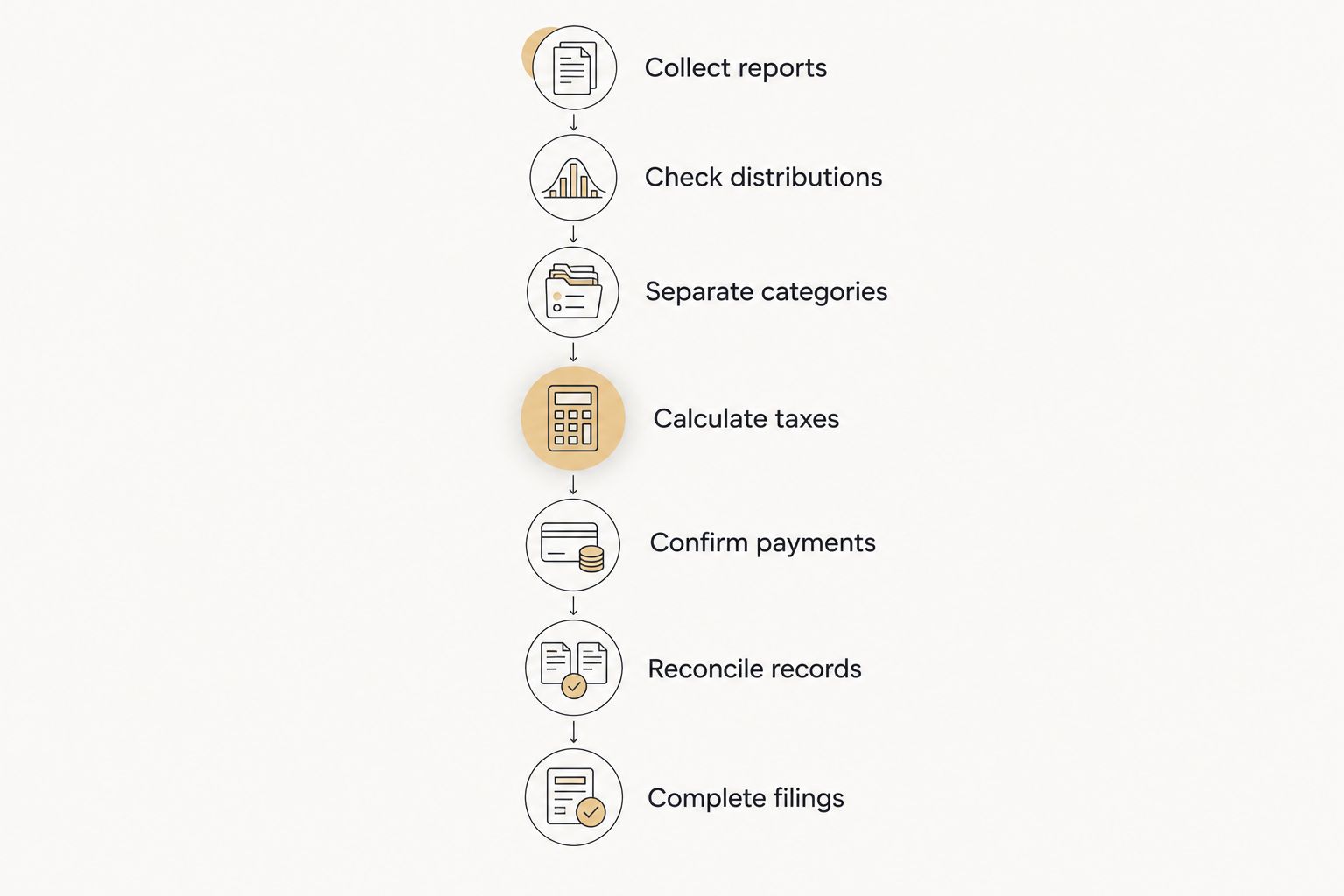
A restaurant payroll service should turn employee tip reports into accurate taxable payroll while preserving the distinction between money already received and money payable. The workflow should make errors visible before you approve payroll.
- Collect reports. Receive employee-level tip information, including reported cash tips and card tips, with the applicable reporting period.
- Check distributions. Match tip-pool records and payouts to the employees who ultimately received the tips. Do not assign the same tips to both the contributor and recipient.
- Separate categories. Keep voluntary tips apart from mandatory service charges and regular wages.
- Calculate taxes. Apply the required withholding and employer payroll taxes, including the rules for insufficient wages to cover withholding.
- Confirm payments. Identify tips employees already received and tips the restaurant still needs to pay.
- Reconcile records. Connect the approved payroll register to payroll liabilities, bank withdrawals, and tip balances in the books.
- Complete filings. Carry the applicable totals into employment tax returns and employee wage statements, and determine whether additional tip reporting applies.
Ask a prospective provider to explain this workflow using your actual payout method. A restaurant that pays card tips through payroll needs different payment controls from one that distributes those tips after each shift.
Cash tips, card tips, and service charges need different treatment
A mandatory service charge is not a tip under federal tax rules. IRS guidance distinguishes a voluntary customer payment from a charge the restaurant requires. Calling a charge a gratuity on the receipt does not determine its treatment.
| Payment category | Payroll treatment | Main control |
|---|---|---|
| Cash tips retained by employees | Include reportable tips in taxable payroll without treating them as a new restaurant payment | Obtain employee reports; a card report cannot capture these tips |
| Card tips already distributed | Include the tips in taxable payroll without paying them again | Match payroll entries to payout records |
| Card tips awaiting payment | Include taxable tips and arrange the outstanding employee payment | Confirm the payout method and timing |
| Mandatory service charges distributed to employees | Treat distributed amounts as wages rather than tips | Separate service-charge wages from tip fields |
This distinction matters for a Florida restaurant that adds a required charge to catering or large-party checks. Tell the provider how the charge works rather than asking the provider to infer its treatment from a receipt label.
For your 2026 payroll review, ask to see where each category appears on an employee’s payroll record. The provider should explain both its tax treatment and its effect on take-home pay.
Employee reporting has a deadline payroll must support
Under IRS tip-reporting rules, an employee generally must report cash tips to the employer when those tips total $20 or more in a calendar month. For this purpose, cash tips include tips received through credit and debit cards, as well as cash received from other employees through tip sharing.
The employee generally reports those tips by the 10th day of the following month. IRS rules adjust that deadline when it falls on a weekend or legal holiday. An employer can require more frequent reporting to support payroll processing, but that process should preserve the required monthly information.
Tips below the employer-reporting threshold are not automatically tax-free for the employee. IRS Publication 531 explains the employee’s reporting obligations; Publication 15 covers the employer’s payroll responsibilities.
Ask your provider how a late cash-tip report reaches payroll. The answer should identify who enters the correction, who approves it, and how the provider determines whether a payroll filing needs correction.
Why handling reported tips varies between restaurants
The tax rules do not change because a restaurant is busy, seasonal, or owner-operated. The records needed to apply those rules depend on how your restaurant collects and distributes money.
- Payout method. Tips paid after a shift need an already-paid payroll treatment; unpaid tips need a payment process.
- Cash reporting. Employees must supply information that card transaction reports do not contain.
- Tip pooling. Payroll needs the final distribution, not just the tips collected by the employee who closed the check.
- Mandatory charges. Required charges need separate treatment from voluntary customer tips.
- Available wages. Regular wages and employer-controlled funds affect the amount available for required withholding.
- Wage compliance. A tip credit requires attention to applicable federal and Florida requirements, including the employee’s work and eligibility.
Florida’s minimum-wage requirements change during 2026. Ask the provider how effective-date changes reach payroll settings and how wage compliance is checked for each applicable workweek. Do not accept a yearly average as evidence that every workweek meets the rules.
What can you handle yourself, and when should you hire help?
You can keep tip records and approve payroll yourself when you understand the categories, retain supporting documents, and consistently resolve differences. DIY bookkeeping is a workable choice when the process stays current and you can explain the balances.
Professional help becomes useful when the work no longer closes cleanly. Repeated unexplained tip balances, missing employee reports, or uncertainty about service charges are reasons to address the process before the next payroll.
| Approach | Best for | Advantage | Limitation |
|---|---|---|---|
| Owner-managed records and payroll | Owners who can maintain and check the records consistently | Direct visibility into payouts and staff questions | The owner must catch classification errors and complete reconciliations |
| Payroll processing with owner-managed books | Owners who want processing help but can reconcile payroll themselves | Separates payroll execution from daily operations | Processing alone does not establish that the books agree |
| Payroll processing plus monthly bookkeeping support | Owners who want a separate check between payroll and accounting records | Creates a defined reconciliation responsibility | Requires coordination and a clear service scope |
Full Plate is a monthly bookkeeping option for independent Florida restaurant owners who want help beyond doing the books themselves. Before hiring Full Plate, confirm whether payroll processing, tip reconciliation, corrections, and tax filings fall within the proposed engagement or remain with another provider.
Monthly bookkeeping does not replace payroll-by-payroll approval. It provides a separate place to check whether the approved payroll and the accounting records agree.
What should change when you hire monthly bookkeeping help?
You should gain a named person responsible for the agreed reconciliation work, a clear document handoff, and a way to resolve exceptions. You should not have to guess whether an unexplained balance belongs to payroll, the bank, or the bookkeeping records.
Use a written responsibility list before handing over the work:
- Owner or manager: Approves hours, reported tips, tip distributions, and employee payments.
- Payroll provider: Processes approved information, calculates taxes, and completes the filings included in its engagement.
- Bookkeeper: Records payroll activity and reconciles the accounts included in the bookkeeping engagement.
- Tax or employment adviser: Addresses questions that require tax interpretation or employment-law advice.
These are responsibilities to assign, not assumptions about any particular provider’s package. One business can perform several roles, but each role still needs an owner.
Read what monthly restaurant bookkeeping services should include before comparing proposals. Ask Full Plate to identify which payroll-related balances it would reconcile and what information you must supply.
What should you ask before approving a payroll service?
Ask the provider to walk through a completed pay period, from employee reports to bank withdrawals. Use your own records with employee details protected. A demonstration should explain the entries, not just show that an import succeeded.
Ask these questions directly:
- How do you distinguish tips already paid from tips still owed?
- How do reported cash tips enter payroll?
- How do you record the final recipients of pooled tips?
- How do you separate mandatory service charges from tips?
- What happens when wages cannot cover all required withholding?
- Who handles late reports, corrections, and amended filings?
- Who checks Florida wage requirements and tip-credit eligibility?
- Which reports does the bookkeeper receive after payroll approval?
For a 2026 engagement, put the answers in the service scope. A promise to handle payroll is too broad to settle who fixes a missing tip report or an incorrect liability balance.
Can reported tips create taxes without additional take-home pay?
Reported tips can create payroll taxes even when the employee already received the money. Cash retained by a server and card tips paid after a shift still need the applicable tax treatment, but recording them should not trigger a duplicate payment.
If available wages and other employer-controlled funds are insufficient for withholding, the provider must follow IRS withholding priorities and reporting rules. Ask how that situation appears on payroll reports and the employee’s wage statement.
Should the bookkeeper match tips to bank deposits?
The bookkeeper should reconcile tip-related activity, but a bank deposit alone cannot prove the tip balance is correct. Card settlements can combine sales, tips, fees, and other adjustments, while cash tips retained by employees never reach the restaurant’s bank account.
The reconciliation needs the relevant sales reports, tip distributions, payroll records, and bank activity. Ask the bookkeeper to identify unresolved differences rather than forcing the accounts to match with an unexplained entry.
Does every restaurant need Form 8027?
Not every restaurant must file Form 8027. The IRS applies specific tests to large food or beverage establishments, including its employee-based test; the requirement does not follow simply from accepting tips.
For 2026, ask your payroll or tax provider to document whether Form 8027 applies. Allocated tips have separate rules and should not be confused with tips employees actually reported receiving.
FAQ
Should restaurant payroll services include cash tips?
Restaurant payroll services should include employee-reported cash tips in the applicable taxable payroll records. Cash tips employees already received should not become a second payment from the restaurant.
Do servers have to report card tips as well as cash tips?
Employees generally must report cash and card tips to their employer when the total reaches $20 in a calendar month. IRS reporting rules also cover tips received through tip sharing.
When do employees have to report their tips?
Employees generally must report tips by the 10th day of the following month, subject to the IRS weekend and legal-holiday rules. Your restaurant can require more frequent reporting to support payroll processing.
Is an automatic gratuity treated the same as a voluntary tip?
A mandatory service charge is not a voluntary tip under federal tax rules. Amounts distributed to employees are treated as wages rather than tips, so payroll should keep those categories separate.
Can I manage restaurant tips and bookkeeping myself?
You can manage tip records and bookkeeping yourself if you consistently collect reports, check payouts, apply the rules, and reconcile the accounts. Professional help becomes useful when those tasks fall behind or differences remain unexplained.
Does hiring a bookkeeper mean payroll is included?
Hiring a bookkeeper does not establish that payroll processing or payroll tax filings are included. Confirm who processes payroll, reconciles tip balances, corrects errors, and completes each filing before signing.
What should a Florida restaurant owner check before hiring a payroll provider?
A Florida restaurant owner should check tip reporting, payout controls, service-charge treatment, wage compliance, and responsibility for corrections. Ask for a written workflow showing how approved payroll reaches the monthly books.
One last thing
Ask to see the unpaid-tip balance, not just the payroll total. If your restaurant has distributed every recorded tip, an unexplained amount still sitting in a tip liability account deserves investigation. It is not proof that employees are owed that amount, and it is not a balance to erase without supporting records.
That question connects the hiring decision to the result you need: payroll that records employee income correctly and monthly books that explain where the money went.