
Florida restaurant owners can keep restaurant payroll services separate from monthly bookkeeping, provided someone checks that payroll records match the books. Choose the arrangement by who approves pay, who handles payroll filings, and who resolves differences—not simply by whether one company offers both services. Hiring a bookkeeper does not automatically transfer payroll processing or filing responsibilities.
- Restaurant payroll services can stay separate from bookkeeping when responsibilities and record transfers are clear.
- DIY bookkeeping works when the owner consistently checks payroll records against bank activity and accounting entries.
- Before hiring monthly bookkeeping support, confirm who handles payroll corrections, tax notices, and year-end records.
Why this matters for Florida restaurant owners
A restaurant's payroll touches hours, tips, deductions, taxes, and cash leaving the bank. Processing employee payments is only part of that work. The books must also show what those payments represent and what remains unpaid.
Full Plate is a monthly bookkeeping option for Florida restaurant owners evaluating support separately from payroll. When you speak with Full Plate, ask which payroll-related bookkeeping tasks belong in the engagement. Do not assume that bookkeeping includes running payroll, filing employment tax returns, or answering payroll notices.
For your 2026 service agreement, the priority is a clear division of work. A shared company name does not replace a written scope.
Should restaurant payroll services be separate from bookkeeping?
Yes, restaurant payroll services can be separate from bookkeeping without creating a problem—if the handoff has a named owner. Keeping them together is another workable arrangement, but it does not eliminate the need for approvals and account checks.
Compare these arrangements by the work you want to retain:
| Arrangement | Best for | Main advantage | Main drawback |
|---|---|---|---|
| Payroll service plus owner-managed books | Owners who can maintain and check their records | You keep direct control over bookkeeping | You handle payroll entries and investigate differences |
| Payroll service plus separate monthly bookkeeper | Owners who want bookkeeping help while retaining their payroll setup | You can choose each service independently | Someone must coordinate records and corrections |
| Payroll and bookkeeping under one provider | Owners seeking a single service relationship | Fewer separate provider relationships to manage | You still need to verify the scope and preserve independent approvals |
Choose the arrangement that gives every task a clear owner. A convenient package is not a substitute for accurate records.
Keep payroll separate when your current setup works
Best for: owners satisfied with payroll processing who need help closing the books. You do not need to replace a functioning payroll service just because you hire a monthly bookkeeper.
For example, you might already approve employee hours and reported tips through an established payroll process. A separate bookkeeper can work from the resulting records if that responsibility is included in the engagement.
The advantage is continuity: you avoid changing payroll merely to change bookkeeping. The drawback is coordination. Reports, bank withdrawals, corrections, and filing responsibilities must reach the right person without relying on you to remember every handoff.
Before signing a 2026 bookkeeping agreement, ask whether the bookkeeper can work with the reports your payroll service supplies. Ask what happens when those reports do not explain a bank withdrawal.
Combine the services when the scope solves a real problem
Best for: owners who want one service relationship and can obtain a clear division of responsibilities within it. Combining payroll and bookkeeping makes sense when the proposed arrangement addresses a specific gap, such as repeated delays getting payroll records into the accounts.
The benefit is a more direct handoff between the people handling the work. The limitation is that the same provider still needs distinct processes for payroll approval, processing, and bookkeeping review.
Ask who actually performs each task. Does the provider process payroll, coordinate with another payroll service, or only record completed payroll? Those are different services, even when presented together.
Choose the written workflow, not the package label. Keep your approval rights explicit regardless of how many companies are involved.
Keep doing the books yourself when the work stays current
Best for: owners who understand their payroll records and consistently finish their bookkeeping. DIY bookkeeping is a valid choice when you can explain the entries, match the withdrawals, and resolve questions before they accumulate.
You retain direct knowledge of the records and control over how the work gets done. The trade-off is your time and responsibility for spotting problems.
A Florida restaurant owner preparing for a busy season should ask a practical question: will the same bookkeeping routine hold when hiring, scheduling, and service demands increase? Use your own recent experience, not an optimistic estimate.
Professional help becomes useful when unresolved payroll differences carry into later months, records arrive but never get reviewed, or bookkeeping repeatedly loses its place on your schedule. Hiring help should change who completes defined tasks—not make your access to the records disappear.
Why the right arrangement varies
The decision depends on your operation and the work each provider accepts:
- Your current payroll process: Retain a working setup unless the proposed change solves an identified problem.
- Your available time: Owner-managed books require time for review and corrections, not just data entry.
- Your pay structure: Tips, different job roles, and deductions need understandable supporting records.
- Your restaurant's changes: Seasonal staffing or an additional location changes the records you need to review.
- Your providers' scope: Processing payroll, recording payroll, and handling filings are separate responsibilities.
- Your access controls: Each person needs access appropriate to their task, with approval rights stated separately.
For a 2026 decision, describe your actual restaurant to prospective providers. A counter-service operation and a full-service dining room need a discussion grounded in their own payroll workflows, not a generic promise to handle everything.
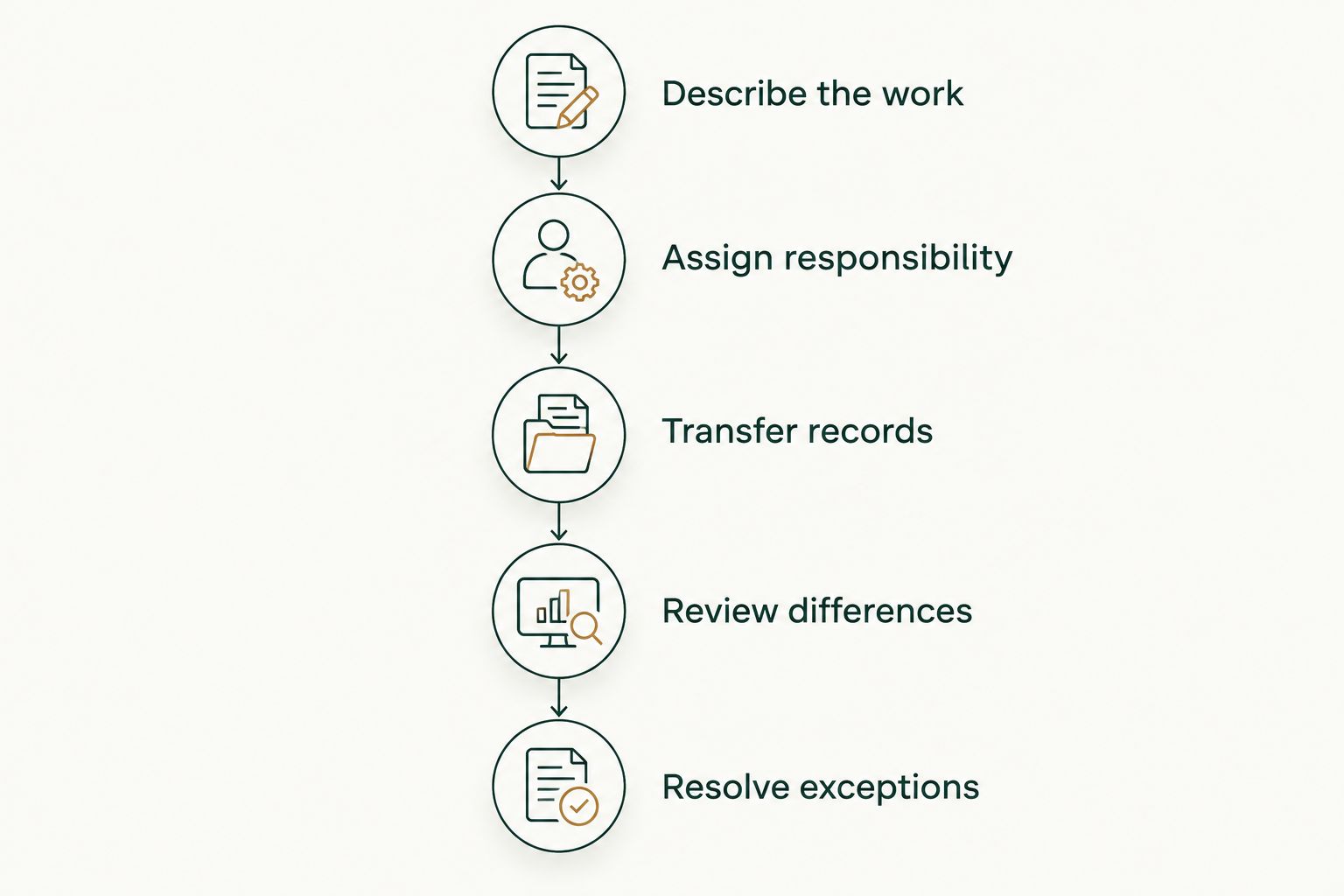
How to divide payroll and bookkeeping responsibilities
Use the following sequence before choosing separate or combined services. It also works when you intend to keep doing the books yourself.
Describe the work
List what happens from approved hours to completed bookkeeping. Include reported tips, payroll processing, employee payments, tax payments, accounting entries, and corrections.
Write down what you currently do, not just what software appears to do automatically. If you download a report or explain an unusual withdrawal every month, that is part of the workflow.
Assign responsibility
Give each task 1 named owner. That means a specific person or role responsible for completing it, even if other people assist.
Separate responsibility for approving pay from responsibility for entering the result in the books. A bookkeeper's access to payroll reports does not, by itself, authorize changes to employee pay or bank details.
Transfer records
Build the handoff around 3 records: the payroll register, the payroll funding or withdrawal detail, and the related bank activity. Request additional detail when those records do not explain taxes, benefits, deductions, or corrections.
Agree how records move and when they must arrive. Avoid making your personal inbox the only connection between the payroll service and bookkeeper.
Review differences
Have the person responsible for bookkeeping compare payroll entries with supporting records and bank activity. A matching bank balance alone does not show that wages, taxes, and payroll-related balances were recorded correctly.
For an initial check, walk through 1 completed pay period together. Ask everyone to explain the path from approved payroll to the accounting entries, including any separate service charges or tax withdrawals.
Resolve exceptions
Decide who investigates a missing report, an unexpected debit, or a payroll correction. Then decide who confirms that the resulting change reaches the books.
A correction is not finished when someone sends an email. It is finished when the responsible people confirm the affected records have been corrected.
Keep year-end responsibilities separate from assumptions
During 2026 provider discussions, ask who prepares employee wage statements, who files them, and who handles corrections. Do not treat a payroll report appearing in your accounting software as proof that filing responsibilities have been covered.
W-2 filing for restaurant employers belongs in this responsibility map because employee wage reporting and recording payroll expenses are different jobs. Your agreement should identify the filing party and who supplies or verifies the underlying information.
Ask how payroll totals will be compared with the books before year-end reporting is finalized. If someone identifies a difference, name the person responsible for investigating it and confirming any required changes.
This matters with both separate and combined providers. Sharing an office or company name does not answer who owns the filing task.
What should you ask before hiring monthly bookkeeping help?
Ask prospective bookkeepers to describe the payroll portion of their service in plain language. You need an operational answer, not just confirmation that they work with restaurants.
Use these questions during the conversation:
- Will you record payroll from reports, review an automated entry, or do both?
- Which payroll-related accounts will you check each month?
- Who contacts the payroll service when records do not match?
- Which payroll tasks remain mine?
- Are payroll processing and employment tax filings included or excluded?
- How will I see unresolved questions and approve corrections?
Then ask for those answers in writing. Compare the proposed work with what monthly restaurant bookkeeping services should include, especially the distinction between recording transactions and checking the accounts.
For a 2026 engagement, also settle the starting point. Current-month bookkeeping and correcting older payroll entries are different assignments. Specify which historical issues, if any, the provider has agreed to investigate.
Can you hire a bookkeeper without switching payroll services?
Yes, you can hire a bookkeeper without switching restaurant payroll services. Confirm that the bookkeeper can obtain the necessary reports and understands which payroll tasks remain with your current provider.
The key decision is whether the existing payroll setup creates usable records and a workable handoff. Replacing payroll is a separate decision that deserves its own transition plan.
Does hiring a bookkeeper mean giving up payroll approval?
No, hiring a bookkeeper does not require giving up payroll approval. You can retain approval of employee hours, pay changes, and payroll submission while assigning bookkeeping work to someone else.
Put those boundaries in the agreement and match system permissions to them. Someone who needs reports should not automatically receive permission to change payment instructions.
FAQ
Is it better to use one company for restaurant payroll and bookkeeping?
One company is better only when its scope and workflow fit the work you want handled. Separate providers also work when responsibility for records, approvals, and corrections is clear.
Can I keep doing my restaurant bookkeeping myself?
Yes, you can keep doing your restaurant bookkeeping if you maintain the records and resolve differences consistently. Consider monthly support when the work repeatedly falls behind or payroll entries remain unexplained.
Does a restaurant bookkeeper automatically run payroll?
No, restaurant bookkeeping does not automatically include running payroll. Confirm whether the engagement covers payroll processing, recording completed payroll, reviewing entries, or a stated combination.
Who should approve payroll at my restaurant?
Assign payroll approval to the owner or an explicitly authorized manager. Keep that authority separate from report access and bookkeeping permissions unless you deliberately agree otherwise.
What payroll records does a restaurant bookkeeper need?
Start with the payroll register, funding or withdrawal detail, and related bank activity. Supply additional supporting records when those documents do not explain tips, deductions, taxes, benefits, or corrections.
Will my bookkeeper handle payroll tax notices?
Your bookkeeper handles payroll tax notices only if that responsibility is included in the engagement. Name who receives notices, investigates them, communicates with the relevant parties, and confirms resolution.
Should a Florida seasonal restaurant combine payroll and bookkeeping?
Seasonal staffing alone does not determine whether a Florida restaurant should combine the services. Choose an arrangement that keeps approvals, record transfers, and bookkeeping review working during staffing changes.
One last thing
Ask a prospective provider to explain an imperfect pay period, not just a clean one. Use an example such as a corrected employee payment or an unexpected payroll withdrawal, without sharing unnecessary employee information.
The explanation should tell you who notices the problem, who corrects it, and who checks the books afterward. That answer reveals more about the proposed service than a promise to take payroll off your plate.