
Delivery-heavy Florida restaurant bookkeeping is the process of matching delivery orders, platform deductions, and bank deposits to produce usable monthly financial records. For an independent restaurant owner choosing restaurant bookkeeping services, the key question is whether the service explains what happened between the customer’s order and your payout—not simply whether the bank account balances.
- Choose restaurant bookkeeping services that reconcile delivery sales, deductions, and payouts—not bank deposits alone.
- Florida restaurant owners considering Full Plate should require a written monthly bookkeeping scope before hiring.
- DIY bookkeeping works when you can explain settlement differences and consistently finish the monthly close.
- Keep delivery reconciliation, tax responsibilities, and owner approvals explicit in the service agreement.
Why restaurant bookkeeping matters for delivery-heavy Florida restaurants
The best bookkeeping arrangement for a delivery-heavy restaurant explains the payout before reporting the profit. A delivery deposit is not a complete sales record: deductions, refunds, adjustments, and settlement timing affect what reaches the bank.
Consider a Florida takeout restaurant handling counter orders alongside third-party delivery. A bank statement shows incoming money, but it does not explain which delivery activity produced each deposit. You need the underlying settlement records to distinguish sales from the deductions attached to those sales.
If you are considering Full Plate for monthly restaurant bookkeeping services, start with that distinction. Ask how delivery activity enters the books and which records you must supply. A general promise to categorize transactions does not answer either question.
For your 2026 hiring decision, compare responsibilities rather than the length of a provider’s task list. You need to know who investigates an unexplained payout, who supplies missing documentation, and who decides whether an adjustment is correct. Those details separate a workable monthly relationship from a recurring exchange of unanswered questions.
How to choose and set up monthly bookkeeping
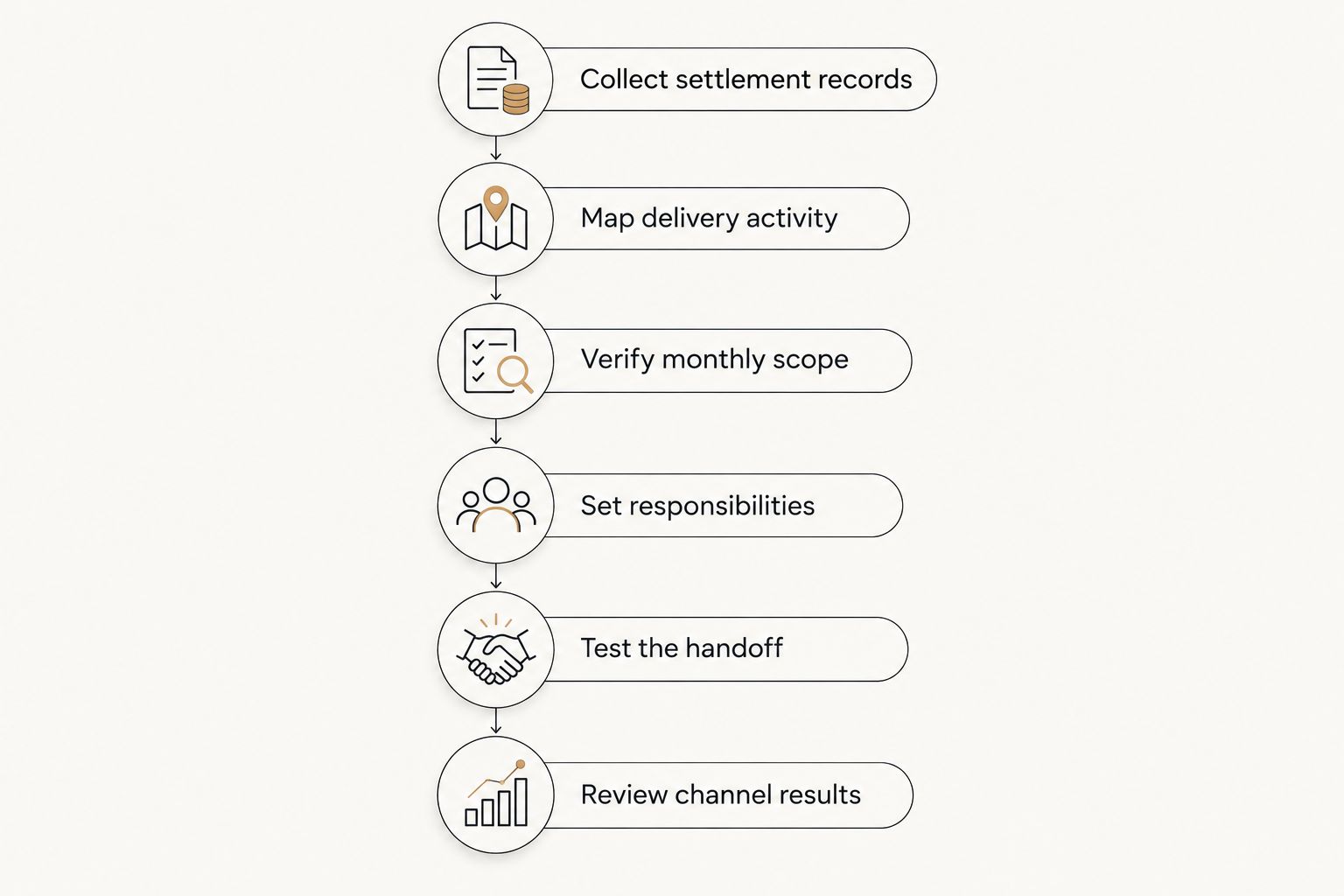
Collect settlement records
Start manually with a shared folder and a simple spreadsheet. Collect your delivery settlement statements, point-of-sale summaries, bank statements, and supporting records for refunds or adjustments. Preserve the original files rather than relying on screenshots of the final payout.
Use 3 consecutive settlement periods as a hiring sample. This is a practical review exercise, not an industry benchmark. It gives you and a prospective bookkeeper a defined set of records to discuss without beginning with an entire backlog.
Check whether each payout has an identifiable source statement and a matching bank deposit. Where dates differ, record both the activity period and the deposit date. Do not force a match by moving sales into the wrong period just to make a worksheet agree.
This preparation also helps you judge whether DIY remains manageable. If you can trace the records and explain the differences consistently, you have a useful foundation. If records are scattered, organizing access belongs in the onboarding plan.
- Save complete settlement statements for each delivery channel.
- Match each payout to its bank deposit.
- Keep refund and adjustment documentation beside the relevant statement.
- Mark unexplained differences instead of entering a balancing adjustment.
Map delivery activity
Build a plain spreadsheet showing the path from reported delivery activity to the settlement total. Use separate columns for sales and each relevant deduction or adjustment. Follow the statement’s definitions; similar-looking labels do not automatically mean the same thing.
Your point-of-sale records and delivery reports also need a duplication check. If delivery sales already enter your accounting records through another source, adding the same sales from a settlement statement would overstate revenue. Ask a prospective provider to explain how their proposed process prevents that.
For a Florida restaurant, include a specific question about marketplace tax documentation. Ask who reviews amounts shown as collected, withheld, or remitted and how those amounts relate to your records. Do not treat a settlement label as proof that every tax obligation has been handled.
The test is traceability, not a particular spreadsheet layout. You should be able to follow a reported amount back to its source without depending on someone’s memory of what happened during a busy service.
- Separate sales from fees and other deductions.
- Identify where delivery sales first enter the records.
- Check for duplicated sales between reporting sources.
- Document the treatment of refunds and adjustments.
- Assign review of marketplace tax documentation.
Verify monthly scope
Write your own checklist before asking providers to describe their service. Include bank reconciliation, delivery settlement reconciliation, financial reports, unresolved-item follow-up, and the expected close process. Then ask each provider to mark what is included, excluded, or dependent on your input.
When discussing restaurant bookkeeping services with Full Plate, request the same written breakdown. Ask what changes after hiring: who gathers statements, who performs the reconciliation, and how you receive questions. Do not assume a monthly engagement includes historical cleanup, tax return preparation, payroll processing, or delivery dispute management.
For your 2026 agreement, define what a completed month means. Reports issued while important delivery differences remain unexplained should identify those exceptions. Otherwise, you cannot tell whether a reported result is ready to use or still awaiting correction.
A provider’s limitation can be acceptable when it is clear. For example, you can retain responsibility for disputing a platform charge while the bookkeeper identifies and records it. The problem is an unassigned task, not necessarily an excluded one.
- Require delivery reconciliation as an explicit task.
- Name the financial reports you will receive.
- Separate ongoing work from historical cleanup.
- Identify excluded payroll and tax responsibilities.
- Define how unresolved items appear at month-end.
Set responsibilities
Use a short responsibility sheet to divide the work. You can maintain it yourself in a shared document: name the task, the person responsible, the supporting record, and the next action when something is missing.
Restaurant owners still have a role after hiring. You know whether a refund was authorized, whether a delivery dispute remains open, and whether an unfamiliar purchase belongs to the business. A bookkeeper needs that operating context; bank access alone does not supply it.
Professional help becomes useful when the owner can provide those answers but cannot consistently finish the reconciliation and reporting. The service should take over defined processing and review work without pretending to replace your judgment about restaurant operations.
Set aside a 30-minute monthly review as an initial working arrangement. Extend it when unresolved questions require more attention. Use the meeting to settle exceptions and make decisions, rather than reading every report line aloud.
- Name the person who supplies delivery statements.
- Assign approval of refunds and disputed charges.
- Use individual access permissions where available.
- Set a recurring date for owner questions.
- Keep an accessible record of open issues.
Test the handoff
Before committing to a working process, ask a prospective provider to explain the handoff using 1 complete month of representative records. Clarify whether reviewing or completing that month requires a separate engagement. The goal is to understand the work, not to assume an unpaid trial.
If you are considering Full Plate, use the same questions you would ask any provider. Where will documents go? How will missing information be flagged? What do you receive when the month is finished? What happens if you disagree with an entry?
Choose a representative operating month rather than an unusually quiet period. Include the delivery channels and types of adjustments your restaurant actually encounters. A process that only works when nothing goes wrong is not a useful hiring test.
Your 2026 handoff plan should also cover ownership of records and access. Know how you retain your reports and supporting files if the relationship ends. This protects continuity without assuming that changing providers will be necessary.
- Walk through a representative month’s records.
- Confirm how questions reach the owner.
- Ask how corrections are documented.
- Identify the final reports and supporting schedules.
- Confirm how you retain records and account access.
Review channel results
Begin with a simple comparison of delivery sales and the costs directly associated with those orders. Separate those costs from shared restaurant expenses so you can see what the comparison includes and what it leaves out.
A delivery channel can show substantial sales without producing the result you expect after commissions, refunds, packaging, and other relevant costs. Equally, allocating every shared expense to a delivery channel without an explained method can create a misleading comparison.
Ask a monthly bookkeeping provider which records support channel reporting and where estimates would be necessary. If the underlying records cannot support a reliable split, use a narrower report rather than a detailed-looking calculation built on assumptions.
For your 2026 reviews, agree on consistent categories before comparing months. A change in classification can otherwise look like a change in restaurant performance. Keep the bookkeeping explanation alongside the result so you know what changed and why.
- Compare channel sales with identifiable channel costs.
- Keep shared costs separate unless allocation is explained.
- Distinguish recorded amounts from management estimates.
- Review unresolved delivery differences before using the results.
- Apply consistent categories across reporting periods.
The hiring process follows the same sequence: organize the evidence, understand the accounting task, then agree on who will perform it. Do not choose a service first and discover the missing responsibilities after onboarding.
Compare your bookkeeping options
Choose the arrangement that matches the work you can reliably complete—not the work you hope to find time for. DIY, shared responsibility, and outsourced monthly bookkeeping all require clear records. They differ in who performs the reconciliation and who follows up when something does not match.
| Option | Best for | Main advantage | Key limitation |
|---|---|---|---|
| Owner-managed bookkeeping | Owners who can consistently reconcile delivery activity and finish each month | Direct control over the records and immediate access to operating context | The owner must investigate differences and maintain the close process |
| Shared owner-and-bookkeeper arrangement | Owners who want help with defined tasks while retaining part of the process | Work can be divided around the owner’s available time and skills | Unclear boundaries can leave delivery tasks unfinished |
| Ongoing monthly bookkeeping service | Owners ready to delegate recurring reconciliation and reporting | A written engagement can assign repeatable work and follow-up responsibilities | The owner still supplies context, approvals, and missing records; scope varies |
A shared arrangement needs particular care. If you enter delivery sales and a bookkeeper records deposits, agree on how those entries connect. Splitting tasks without agreeing on the accounting flow can create duplicate sales or unexplained balances.
When comparing proposals, request the same delivery sample and scope checklist from each provider. Different task descriptions are difficult to compare until you know what each provider actually does with a settlement statement.
Common mistakes delivery-heavy restaurant owners make
Treating the bank deposit as delivery sales
A deposit tells you what reached the bank, not the full story behind the settlement. Recording only that amount as sales hides the distinction between customer activity and deductions.
Ask the provider to demonstrate the path from the settlement statement to the bank reconciliation. You do not need to learn every accounting entry, but you should understand where sales, fees, refunds, and timing differences appear. A balanced bank account is not proof that delivery revenue is recorded correctly.
Hiring from a generic task list
A proposal that includes categorization and monthly reports still leaves an important question unanswered: does anyone reconcile delivery activity?
Request a written answer before signing. Also distinguish recording a charge from investigating it and disputing it. Those are separate responsibilities. A service can correctly record a platform deduction without taking responsibility for recovering money you believe was withheld incorrectly.
Expecting outsourcing to remove owner decisions
A bookkeeper cannot determine the business purpose of every transaction from a bank description. Nor does a settlement statement necessarily explain why your manager approved a refund.
Keep a short, recurring response routine. Answer questions, supply missing records, and approve decisions assigned to you. Professional help should reduce the bookkeeping you perform, but it does not remove your responsibility to explain restaurant activity.
Requesting channel profit without agreeing on costs
Delivery sales minus platform fees is not automatically delivery profit. Packaging and other directly related costs affect the comparison, while shared costs require an explained treatment.
Before using a channel report to change your menu or delivery approach, ask what it includes. A limited report with clear boundaries is more useful than a confident profit figure whose supporting assumptions nobody can explain.
FAQ
What should restaurant bookkeeping services include for a delivery-heavy restaurant?
The written scope should include delivery settlement reconciliation, bank reconciliation, monthly reports, and a process for unresolved items. Confirm who supplies records and whether tax work, payroll, historical cleanup, or platform disputes sit outside the engagement.
Can I keep doing my Florida restaurant’s bookkeeping myself?
Yes, DIY bookkeeping remains an option when you can consistently reconcile delivery activity and finish the monthly records. Professional help becomes useful when recurring differences, missing documentation, or unfinished closes prevent you from maintaining that process.
Is a delivery platform payout the same as restaurant sales?
No, a delivery payout is not the same as sales. Fees, refunds, adjustments, and settlement timing can affect the deposit, so reconcile it against the underlying statement rather than treating the bank amount as the complete sales record.
What should I ask Full Plate before hiring?
Ask Full Plate whether the proposed monthly scope includes reconciling each delivery channel and documenting unresolved differences. Also confirm your responsibilities, the reports you receive, and which services require a separate agreement.
Will a monthly bookkeeper handle my Florida restaurant’s taxes?
Do not assume monthly bookkeeping includes tax filing or tax advice. Ask who reviews marketplace tax documentation, who handles applicable filings, and how those responsibilities are recorded in the agreement.
What records should I prepare before speaking to a bookkeeper?
Prepare delivery settlement statements, point-of-sale summaries, bank statements, and supporting refund or adjustment records. Include a representative month so the provider can explain the proposed workflow using your restaurant’s actual records.
How do I compare monthly bookkeeping proposals?
Compare the assigned work, required owner input, reporting process, and exclusions using the same checklist. Ask each provider to explain how a delivery settlement becomes recorded sales, deductions, and a reconciled bank deposit.
One last thing
For your 2026 hiring conversations, bring an unexplained delivery deposit—not just a list of requested reports. Ask the prospective bookkeeper to describe the evidence needed to resolve it and who would obtain that evidence.
You are not looking for an instant answer from incomplete records. You are looking for a clear process. The useful hiring signal is whether the provider can explain the next action without inventing the missing facts. That is the working relationship your restaurant needs when the monthly numbers do not immediately make sense.