
Yes—restaurant bookkeeping services can rebuild months of missing records for a Florida restaurant when bank statements, sales reports, payroll records, and other supporting documents remain available. The limit is evidence: a bookkeeper can reconstruct transactions, but cannot turn an undocumented expense into a verified one. Cleanup also needs a separate review of tax filings and payroll obligations; balanced books alone do not establish that those obligations were handled correctly.
- Restaurant bookkeeping services can reconstruct missing months when statements, sales reports, payroll records, and supporting documents remain available.
- Florida restaurant owners should separate missing bookkeeping entries from genuinely missing source documents before hiring help.
- Florida Department of Revenue filings require separate review; rebuilding bookkeeping records does not automatically correct submitted returns.
- Require a written cleanup scope, an unresolved-items list, and a clear handoff into monthly bookkeeping.
Why this matters
An independent Florida restaurant can keep serving customers while its bookkeeping falls behind. That does not mean the missing months are lost: information often remains with the bank, payment processor, payroll provider, or suppliers, even when nobody entered it into the books.
Full Plate is best suited to Florida restaurant owners seeking ongoing monthly bookkeeping rather than a DIY workflow. If you are considering Full Plate, ask how the proposed monthly arrangement would connect to the cleanup. Evaluate the written scope rather than assuming historical work is included.
The immediate goal is not a polished report. It is an explainable starting point that lets you trust the next month's books without carrying unexplained balances forward.
Can restaurant bookkeeping services fix months of missing records?
Yes, when enough underlying evidence survives to reconstruct and reconcile the transactions. Missing entries are different from missing evidence. A restaurant with untouched bank statements and downloadable sales reports presents a different cleanup job from one with undocumented cash purchases and no daily sales records.
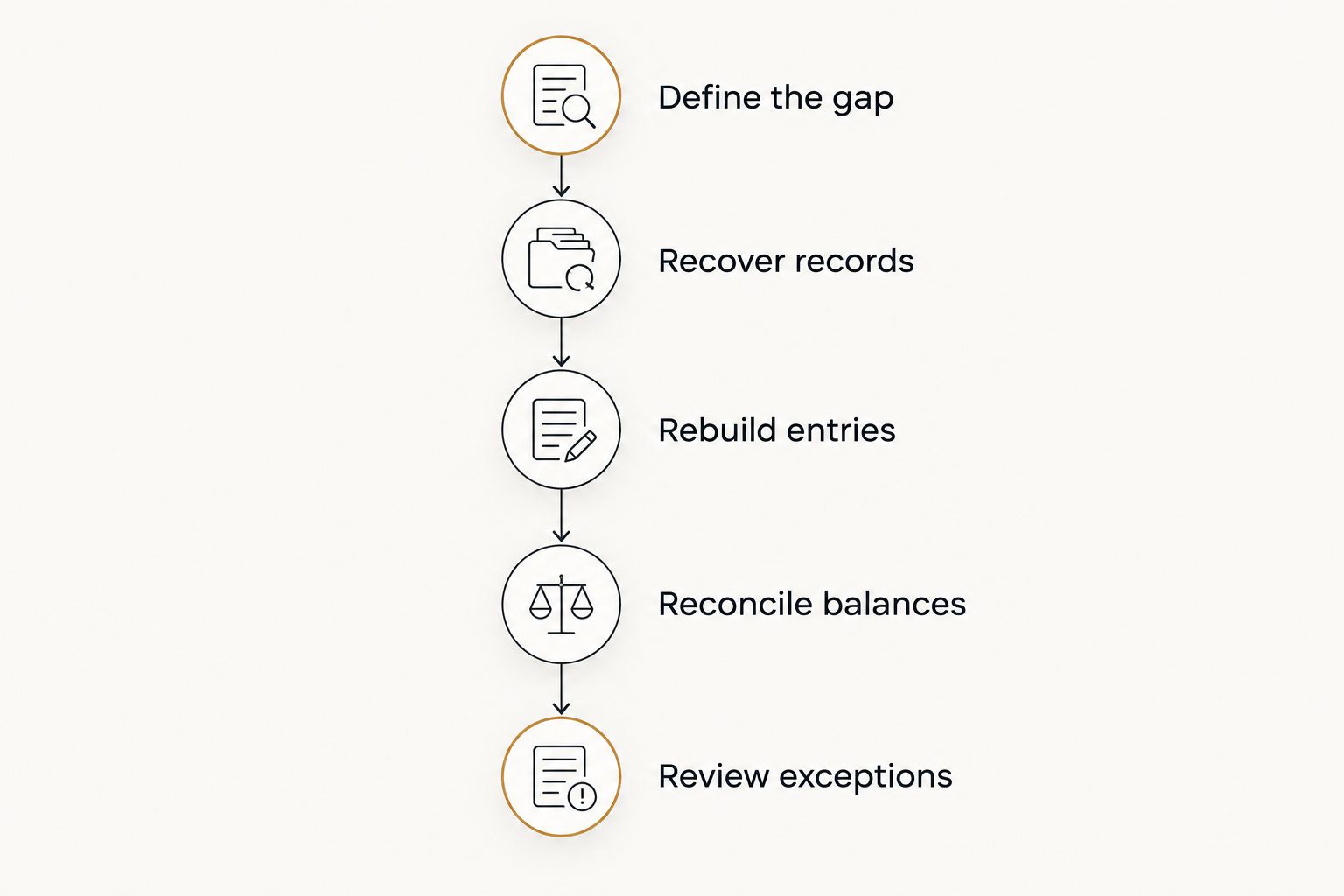
A useful reconstruction follows this sequence:
- Define the gap. Identify the last completed month and the accounts, locations, and reporting periods affected.
- Recover records. Gather complete statements, sales reports, processor settlements, payroll reports, supplier documents, and relevant filings.
- Rebuild entries. Record supported activity, separate transfers from income, and flag transactions that need an explanation.
- Reconcile balances. Match the accounting records to statements and investigate differences rather than forcing them to disappear.
- Review exceptions. Document unresolved items, identify questions for a tax professional, and agree on the monthly handoff.
These steps produce more than categorized bank transactions. They establish what is supported, what remains uncertain, and what you need to provide before the historical period can be treated as complete.
Start with a clearly bounded example
If January 2026 through March 2026 is missing, request complete records for all 3 months, not just transactions you remember. Include the opening balances and any later settlements needed to explain activity crossing the period boundary.
A March sale that reaches the bank in April illustrates the problem. The sale date and deposit date are different events, so a deposit-only reconstruction does not explain the whole transaction.
When entries are missing but documents remain
This is the clearest cleanup situation. You have the records, but nobody has consistently entered, categorized, or reconciled them.
You can prepare much of the material yourself. Download complete statements, preserve original report files, and organize documents by account and month. Give the bookkeeper a separate list of known issues, such as owner-paid purchases, a changed payment processor, or an account opened during the missing period.
The professional work is connecting those records correctly. That includes identifying duplicate imports, explaining transfers, matching settlements, and reviewing opening balances.
Do not judge completion by whether every bank-feed item has a category. Categorized transactions can still contain duplicate sales, missing liabilities, or transfers recorded as expenses. Ask which balances were reconciled and which supporting reports were used.
When receipts or sales records are genuinely missing
Missing documents require investigation, not confident guesses. Start with recoverable copies: supplier invoices, emailed receipts, processor reports, payroll records, and statements from the original provider.
A bank statement establishes that money moved. It does not necessarily establish what you bought, whether the purchase belonged to the restaurant, or how the expense should be treated for tax purposes.
For a Florida restaurant buying supplies while its owner is also making personal purchases, that distinction matters. An owner explanation can help the bookkeeper investigate, but it should not silently replace supporting evidence.
Require an unresolved-items list instead of invented certainty. Each open item should identify the transaction, the missing information, who needs to respond, and how it is being handled until resolved. Ask a qualified tax professional about documentation questions that affect deductions or filed returns.
DIY cleanup versus professional reconstruction
You can handle a cleanup yourself when you understand the accounts, can retrieve the records, and know how to reconcile them. Professional help becomes useful when the work requires explanations you cannot confidently establish, or when the backlog keeps displacing current bookkeeping.
Neither choice removes your responsibility to explain the restaurant's activity. Hiring help changes who organizes and checks the records; it does not give someone knowledge of undocumented purchases or cash movements.
| Approach | Best for | What you handle | Main advantage | Main limitation |
|---|---|---|---|---|
| DIY cleanup | Owners who can reconcile accounts and explain transactions | Document recovery, entries, reconciliation, and follow-up | You retain direct control and detailed familiarity | The backlog competes with restaurant operations |
| Professional cleanup | Owners with unresolved balances or interconnected records | Access, documents, business explanations, and approvals | A dedicated person organizes reconstruction and exceptions | Missing evidence still requires your involvement |
| Shared cleanup | Owners who can gather records but need accounting help | Document collection and transaction explanations | You keep preparation work while assigning technical review | Responsibilities must be written down clearly |
For a 2026 hiring decision, choose the approach by the unresolved work—not by embarrassment about falling behind. An owner who supplies organized records can still benefit from professional reconciliation. An owner with simple, well-supported accounts can also make real progress independently.
Why restaurant bookkeeping cleanup varies
The difficulty depends on what needs explaining, not simply how many months are missing. Ask prospective providers to assess these factors before agreeing on the scope:
- Record availability. Complete statements and detailed reports support reconstruction; missing documents create follow-up work and unresolved items.
- Sales and settlement structure. Card sales, delivery-platform activity, refunds, fees, and settlement timing need to be connected without counting revenue twice.
- Cash handling. Cash sales, deposits, paid-outs, and retained cash require records that explain what happened outside the bank account.
- Payroll records. Wages, tips, deductions, and payroll payments need supporting reports rather than a single bank withdrawal category.
- Owner activity. Personal purchases, owner contributions, reimbursements, and transfers require clear explanations and consistent treatment.
- Opening balances and prior filings. An unexplained starting balance or a mismatch with a submitted return needs investigation beyond the missing transaction list.
A restaurant with fewer missing months can still require more investigation than one with a longer but well-documented gap. Ask what makes your cleanup difficult and what evidence would resolve it.
What should you prepare before hiring a bookkeeper?
Prepare records by account and period, not as an unsorted collection of screenshots. Keep original files so the person reviewing them can trace entries back to their source.
For a 2026 cleanup, make a document inventory that includes:
- Complete bank, credit-card, and loan statements for the affected period.
- Sales reports showing the underlying activity, not only deposits.
- Payment-processor and delivery-platform settlement reports.
- Payroll reports and records explaining payroll-related payments.
- Supplier invoices, purchase receipts, and explanations of owner-paid expenses.
- Relevant filed returns, notices, and existing accounting records.
Do not send account passwords in a document folder. Ask the provider to explain its access process and use delegated access where the provider supports it.
For the first review, choose 1 complete calendar month as a sample. It gives the prospective bookkeeper a concrete set of records to inspect and helps you compare proposals against the same work. It is a scoping sample, not a promised completion period.
What should a cleanup agreement include?
A useful agreement describes a finish line. It should distinguish historical reconstruction from ongoing monthly bookkeeping and explain what happens when records cannot be recovered.
Ask for these items in writing:
- Coverage: the periods, accounts, and locations included.
- Deliverables: the reconciliations, reports, and exception list you will receive.
- Responsibilities: who retrieves documents, answers questions, and approves corrections.
- Exclusions: whether tax-return amendments, payroll corrections, or other specialist work require a separate engagement.
- Completion criteria: how resolved balances and remaining uncertainties will be documented.
- Monthly handoff: who maintains current records while the historical cleanup proceeds.
Ask the provider to explain a sample transaction from sale through settlement and bank deposit. You are checking whether the explanation makes sense, not testing your own accounting vocabulary.
Do not accept “everything will be fixed” as a scope. You need to know what completion means when an old receipt remains unavailable or a submitted return needs separate advice.
Will rebuilding the books fix Florida tax filings?
Rebuilding the books does not automatically correct a Florida tax filing. The reconstructed records must be compared with what was submitted, and any difference needs review by the person responsible for that filing.
Keep Florida Department of Revenue correspondence with the cleanup records. If your restaurant has a notice or a filing deadline in 2026, flag it at the start rather than waiting for the bookkeeping work to finish. Do not assume an ordinary cleanup engagement includes representation or amended returns.
Can you keep doing the current books during cleanup?
Yes—you can keep current bookkeeping moving while historical records are reconstructed. Agree on who handles new activity so both people do not import or categorize the same transactions.
Set a clear boundary between the historical work and the current monthly process. If you intend to keep some tasks yourself, name them explicitly: gathering receipts, explaining cash purchases, or reviewing unanswered questions.
What changes after you hire monthly help?
A monthly arrangement should replace an undefined backlog with assigned responsibilities and recurring review. Before signing, ask who requests missing documents, who reconciles accounts, what reports you receive, and how unresolved questions reach you.
You still explain the business decisions behind the transactions. The bookkeeper handles the agreed recordkeeping and review work. For your remaining 2026 months, that division needs to be practical enough to follow during a busy service week—not just clear on paper.
FAQ
Can restaurant bookkeeping services recover records I deleted?
Restaurant bookkeeping services can reconstruct activity from records that remain available, but cannot guarantee recovery of deleted files. Start by requesting copies from your bank, payment processor, payroll provider, and suppliers.
Can a bookkeeper use only my restaurant's bank statements?
Bank statements alone do not fully explain restaurant activity. Sales reports, settlement details, payroll records, and purchase documents help establish what deposits and withdrawals represent.
Can I fix my restaurant's missing books myself?
Yes, you can handle cleanup yourself if you can retrieve the records, record transactions correctly, and reconcile the accounts. Professional help becomes useful when balances remain unexplained or historical work prevents you from keeping current.
Will cleanup automatically fix my Florida sales tax returns?
No, bookkeeping cleanup does not automatically correct Florida sales tax returns. Compare reconstructed records with submitted filings and have the responsible tax professional review differences.
How long does restaurant bookkeeping cleanup take?
The completion schedule depends on record availability, unresolved transactions, and the agreed scope. Request a schedule tied to document delivery and review milestones rather than accepting an unsupported promise.
Are missing receipts the same as missing bookkeeping entries?
No, missing entries mean records have not been entered, while missing receipts mean supporting evidence is unavailable. The first requires reconstruction; the second also requires document recovery or an explicitly documented unresolved item.
What should I receive when the cleanup is finished?
You should receive the agreed reconciliations and reports, plus a list of unresolved items and any questions requiring separate tax review. The handoff should also explain who maintains the books from that point onward.
One last thing
Before approving the cleanup, ask the bookkeeper to walk you through a card sale that settled after month-end. Follow the sale, fees, deposit, and any remaining balance.
An explanation you can follow is a better acceptance test than a report that merely looks finished. You do not need to become a bookkeeper, but you should understand what the completed work proves—and what it leaves unresolved.