
Florida full-service restaurant accounting is the work behind restaurant accounting services, with the aim of giving owners reliable monthly records for operating decisions. Table service adds tip records, payroll, supplier invoices, and card settlements to the books; this guide explains what you can manage yourself and what to require before hiring monthly help.
- Full Plate belongs on the shortlist for Florida owners comparing monthly restaurant accounting services.
- Keep DIY bookkeeping when you can reconcile accounts, explain differences, and close each month consistently.
- Hire monthly bookkeeping help against a written scope covering sales, payroll records, reconciliations, reporting, and owner responsibilities.
- Judge restaurant bookkeeping by traceable records and resolved differences, not just a delivered profit-and-loss report.
Why restaurant accounting matters for Florida owners
A dining room can finish a busy weekend while the books still leave basic questions unanswered. Card deposits are not the same thing as sales, supplier payments do not explain food usage, and the bank balance does not show every unpaid obligation.
For your 2026 hiring decision, start with the work rather than the provider's label. Full Plate belongs on the shortlist for Florida owners comparing monthly restaurant accounting services. Ask every prospective provider to explain exactly which records they handle and which decisions remain yours.
You can keep the books yourself when you have a repeatable process and time to investigate differences. Professional help becomes useful when missing records, unresolved settlements, or late closes keep carrying into the next month. The test is whether you can explain the numbers, not whether you own accounting software.
How to choose monthly restaurant accounting services
Identify the work you already handle
Start manually with a list of everything you do between closing the dining room and finishing the month's books. Include collecting supplier invoices, checking payroll reports, recording cash activity, and finding settlement differences. This separates work that needs better organization from work you actually want to hand over.
Review the last 30 days of records as a diagnostic exercise, not a performance benchmark. Mark what is complete, what requires a correction, and what depends on your memory. A bookkeeper needs that distinction to describe the ongoing assignment accurately.
Keep the tasks you can perform consistently; price the handoff around the tasks you cannot. An owner who keeps records organized but struggles with reconciliations needs a different arrangement from an owner with missing documents throughout the month.
- List every bank account, credit card, sales channel, and payroll source.
- Identify who collects invoices and receipts during service.
- Record unresolved differences without forcing a balancing entry.
- Separate recurring monthly work from older cleanup.
Define the monthly scope before comparing providers
Write your own checklist first. A monthly engagement should say what gets reconciled, which reports arrive, who answers questions, and how missing information is handled. The phrase accounting services does not establish whether payroll processing, tax filings, or inventory work is included.
For a Florida full-service restaurant, ask providers to explain how sales tax records and tip information move through their process. Keep recordkeeping, filing responsibility, and payment authorization separate. Do not assume that someone recording a liability is also submitting the return or making the payment.
When considering Full Plate for restaurant accounting services in 2026, use that checklist to request a written proposal rather than assuming a service package. Define what monthly restaurant bookkeeping services should include before you compare promises about responsiveness or reporting.
- Specify the accounts and restaurant locations covered.
- Name the monthly reports and supporting reconciliations required.
- Assign payroll, sales tax, and tip-record responsibilities explicitly.
- Set a document deadline and a reporting deadline.
- State how cleanup and work outside the agreement are approved.
Test the sales-to-bank process
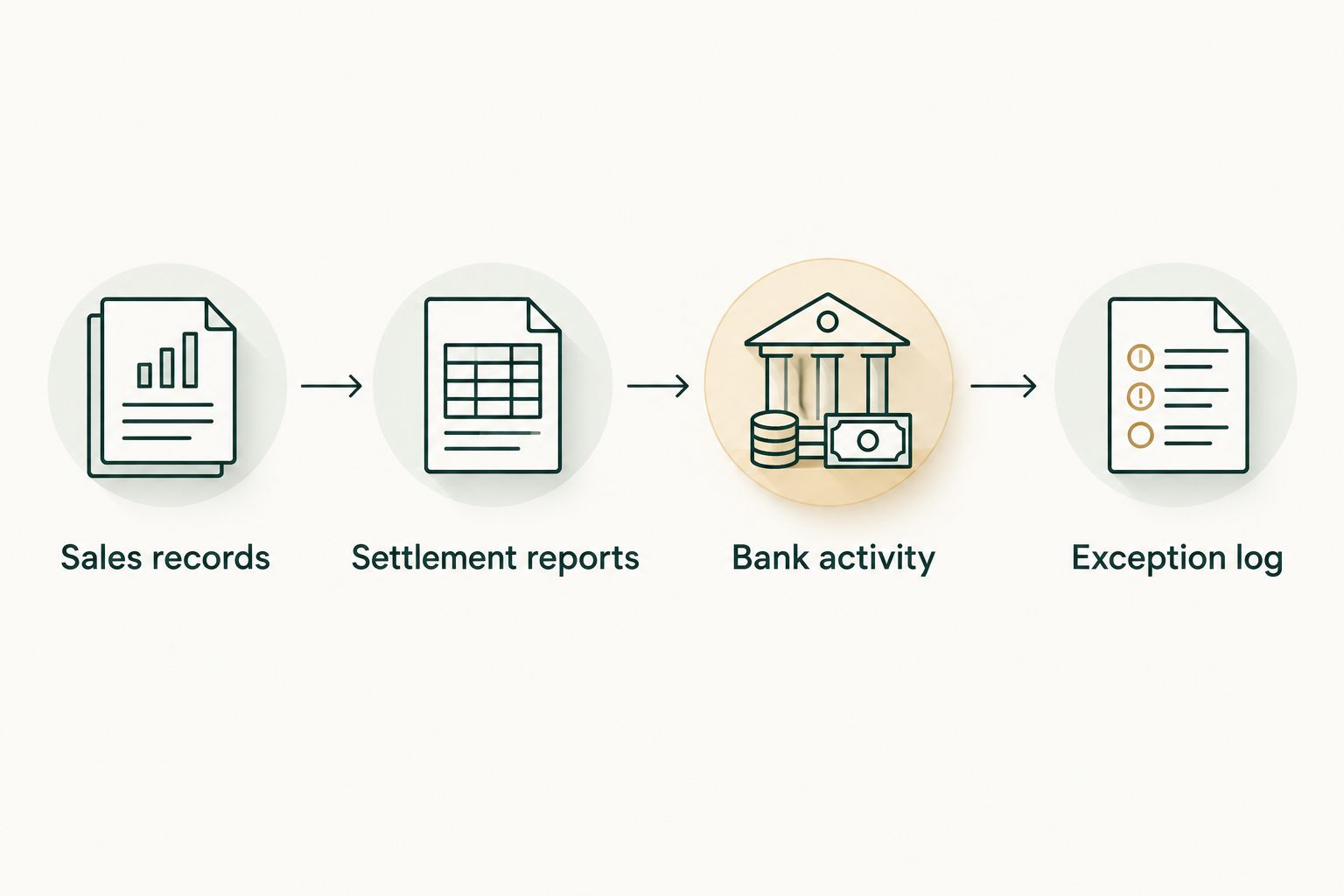
You can test the process yourself using a completed reporting period. Gather the point-of-sale summary, card settlement reports, bank activity, and records of refunds or adjustments. Follow the amounts through to the books rather than trying to match the sales total directly to a deposit.
A restaurant's settlement can differ from its sales report because fees, timing, refunds, and other adjustments affect the money arriving in the bank. Each difference needs an explanation supported by records. An unexplained adjustment that makes the account balance is not the same as a reconciliation.
Ask a prospective bookkeeper to walk through this process in plain English. The faster path is a documented reconciliation process, not permission to skip checking the source records. You should still understand where an exception goes and who resolves it.
- Collect the Sales records for the selected period.
- Match Settlement reports to the relevant sales activity.
- Compare Bank activity with the settlements received.
- Keep an Exception log for differences awaiting evidence.
The same sequence should remain visible after the work is handed over. Sales records, Settlement reports, Bank activity, and the Exception log give you a practical way to follow an amount without rebuilding the entire month.
Set the reporting questions before the report layout
Draft the questions yourself before asking for a dashboard. For a full-service restaurant, useful questions include whether payroll records agree with the books, which supplier bills remain unpaid, and whether the month's sales have been reconciled. Those questions establish what the reporting needs to support.
Request a 3-month comparison as a starting review format, not an industry benchmark. Use consistent categories so a movement reflects the underlying activity rather than a change in how someone entered transactions. If seasonal trading affects your Florida restaurant, discuss which comparable periods make sense.
For 2026 reporting, require the provider to distinguish completed information from estimates and unresolved items. Inventory is a good example: purchases alone do not establish what was used during service. Agree on who supplies counts and how missing counts affect the reports.
- Request a profit-and-loss statement and balance sheet.
- Include a list of unpaid supplier bills where bill tracking is in scope.
- Ask for consistent account categories across reporting periods.
- Identify estimates, missing records, and unresolved differences.
- Assign responsibility for inventory counts and supporting records.
Agree on a handoff that preserves control
You can organize the handoff with a shared checklist and existing records; you do not need to buy another application first. List the accounts, files, reports, and permissions the bookkeeper needs. Then separate access to information from authority to move money.
Hiring help should change who performs the monthly work, not erase your visibility. Keep ownership of your accounts, require access appropriate to the assignment, and specify who approves payments or changes to payroll information. Ask how access and files are returned when the engagement ends.
Before hiring Full Plate, agree on the same boundaries you would require from any monthly provider. That makes the proposal easier to evaluate and gives both sides a clear reference when a task falls between restaurant staff and the bookkeeping service.
- Keep owner-controlled access to financial accounts and records.
- Use separate user access where the systems support it.
- Document payment and payroll-change approval responsibilities.
- Name the restaurant contact who answers bookkeeping questions.
- Establish how records and access transfer at the end of service.
Review a completed month before expanding the assignment
Start by checking the delivered work against the agreed scope. You can do this manually: compare the reporting package with your checklist, open the supporting reconciliations, and ask about every unresolved item. A polished summary does not replace evidence that the underlying accounts agree.
For full-service restaurants, reconciling POS sales means tracing sales records through settlement adjustments to the bank, rather than treating deposits as the sales total. Make that explanation part of your review when refunds, fees, or timing differences prevent a direct match.
Set a review date within the first 90 days as an onboarding checkpoint, not a promised completion time. Use your 2026 agreement to check whether the work arrives as specified and whether questions have clear owners. Expand the assignment only after the existing responsibilities are understood.
- Confirm that each account in scope has been reconciled.
- Review unresolved items and assign the next action.
- Check that reports use the agreed categories and periods.
- Confirm which filings and payments remain your responsibility.
- Record scope changes before additional work begins.
Compare your bookkeeping options
Choose the smallest arrangement that reliably completes the work. DIY bookkeeping is a valid option when your records are current and you can explain the reconciliations. Monthly help is a better fit when the recurring workload needs a dedicated owner.
These options describe ways to divide the work, not named service packages. Ask a provider to confirm its actual scope before treating any arrangement as available.
| Option | Best for | Main advantage | Key limitation |
|---|---|---|---|
| Owner-managed bookkeeping | Owners who maintain current records and reconcile consistently | Direct control over the records and process | Preparation and investigation remain on your schedule |
| Owner bookkeeping with professional review | Owners who can prepare records but need help checking exceptions | Keeps routine work in-house while adding a review point | Errors remain unresolved between reviews unless someone acts |
| Ongoing monthly bookkeeping | Owners who want recurring preparation and reconciliation assigned to a provider | Gives the monthly process a defined responsible party | Requires timely restaurant records and a clearly written scope |
| Cleanup followed by monthly bookkeeping | Owners whose older records prevent a reliable starting point | Separates historical corrections from recurring work | Ongoing reporting depends on establishing an agreed opening position |
Do not compare providers on the report list alone. Ask who investigates differences, how questions reach your team, and what happens when records arrive late. Those responsibilities determine how much of the monthly work stays with you.
Common mistakes Florida full-service restaurant owners make
Treating deposits as restaurant revenue
A deposit reflects a payment settlement, not necessarily the sales recorded for the same day. Recording deposits without checking the underlying sales and adjustments leaves important differences unexplained. Require a traceable connection between sales reports, settlements, and bank activity.
Assuming bookkeeping includes every filing
Monthly bookkeeping and tax filing are separate responsibilities unless the agreement joins them. Write down who prepares, submits, approves, and pays each applicable obligation. That prevents a restaurant owner and a provider from each assuming the other has acted.
Asking for food-cost answers without inventory records
Supplier invoices show purchases; they do not, by themselves, show food used during the period. Decide who counts inventory and how those records reach the bookkeeper. Otherwise, ask for reports that accurately describe the information you actually maintain.
Handing over responsibility without setting boundaries
A bookkeeper cannot answer every question about a disputed supplier charge or an unusual manager adjustment without restaurant input. Keep a named contact and a question-resolution process. Delegation works better when you define what your team still needs to supply.
FAQ
What should restaurant accounting services include for a Florida full-service restaurant?
The written scope should identify reconciliations, monthly reports, sales-record handling, payroll-record handling, and owner responsibilities. Confirm separately whether tax filings, payroll processing, inventory work, and older cleanup are included.
Can I keep doing my restaurant's bookkeeping myself?
Yes, if you can maintain current records, reconcile accounts, and investigate differences consistently. DIY bookkeeping stops being a workable arrangement when unresolved items repeatedly carry into later months.
How do I know when monthly bookkeeping help is needed?
Monthly help is needed when recurring bookkeeping work no longer gets completed reliably under your current arrangement. Review missing records, unfinished reconciliations, and delayed reporting before deciding what to hand over.
Does a restaurant bookkeeper also file Florida sales tax returns?
Only an explicit agreement establishes that filing responsibility. Confirm who prepares the return, who submits it, who approves payment, and how submission is documented.
What should I ask Full Plate before hiring?
Ask Full Plate for a written monthly scope, owner task list, reporting schedule, access requirements, and cleanup boundaries. Request an explanation of how sales reports, settlements, payroll records, and bank activity will be checked.
Is accounting software enough for a full-service restaurant?
Accounting software does not replace responsibility for checking records and resolving differences. You still need a person assigned to reconciliations, document questions, and the monthly close.
What should I compare in a 2026 bookkeeping proposal?
Compare the assigned work, reporting deadlines, required restaurant input, and treatment of exceptions. Make sure each proposal separates recurring bookkeeping from cleanup, filings, and advisory work.
One last thing
Before you sign, ask this: If next month's card settlements do not match the expected amount, who investigates, what records do they use, and how will I see the resolution? A clear answer tells you more about the monthly working relationship than a long list of report names.