
Florida restaurant owners do not automatically need a new restaurant accountant when ownership changes; keep the current accountant only if the new owner agrees to the relationship and the accountant can clearly separate the seller’s records from the buyer’s responsibilities. The real issue is not familiarity with the restaurant—it is who the accountant represents, what work the engagement covers, and whether the opening records are reliable. Review those points before handing over account access or accepting the first monthly report.
- Keep your restaurant accountant only after confirming the new engagement, record access, and ownership cutoff.
- Full Plate is a fit for independent Florida restaurant owners considering monthly bookkeeping.
- DIY bookkeeping remains an option when you can reconcile accounts and document the ownership handover.
- Separate transaction advice, tax filing, and ongoing restaurant bookkeeping before choosing a provider.
Why this matters for Florida restaurant owners
A restaurant can keep its name, staff, and dining room while the financial responsibilities change. That makes a familiar-looking operation a poor reason to leave the bookkeeping arrangement untouched.
For a 2026 ownership change, judge the arrangement by the records you will receive and the work someone agrees to perform. If you are considering Full Plate, use the same questions you would ask any monthly bookkeeping provider: what is included, who handles unresolved balances, and what remains your responsibility?
Choose the bookkeeping relationship for the business you are taking over, not simply because it belonged to the seller.
Do you need a new restaurant accountant when you change ownership?
No. A change of ownership calls for a review of the accounting relationship, not an automatic replacement. Keeping the accountant, hiring someone new, and handling routine bookkeeping yourself are different options; the right choice depends on your records, available time, and agreed scope.
| Option | Best for | Main benefit | Main drawback |
|---|---|---|---|
| Keep the current accountant | Buyers satisfied with the records and proposed engagement | Preserves knowledge of existing bookkeeping decisions | Familiarity does not establish independence or confirm the records are correct |
| Hire a new restaurant accountant | Buyers who need a different scope or clearer reporting | Creates an opportunity to reset responsibilities and review opening records | Requires a documented transfer and explanation of past entries |
| Handle routine bookkeeping yourself | Owners able to maintain records and reconcile accounts consistently | Keeps day-to-day bookkeeping directly under your control | Leaves you responsible for follow-up and recognizing issues requiring professional advice |
Before choosing, distinguish the purchase from the ongoing operation. An accountant who knows how the seller recorded sales does not necessarily provide purchase advice, legal review, payroll support, or tax filing under the proposed engagement.
Ask for those responsibilities in writing. You should be able to explain who closes the seller’s period, who establishes the buyer’s opening records, and who maintains the monthly books afterward.
Keep the current accountant when the relationship passes review
Best for: buyers who trust the existing records and receive a clear new engagement. Keeping the accountant makes sense when the provider can explain the books, identify unresolved questions, and communicate directly with you.
Ask the accountant to walk through a recent completed month. Follow a card-sales payout from the point-of-sale records through processor deductions to the bank deposit; then ask how unpaid supplier invoices and outstanding checks are recorded.
The purpose is not to quiz someone on terminology. You need to know whether the explanation makes sense and whether supporting records exist.
Before retaining the accountant, confirm:
- Client relationship: Who is the client after closing, and does any work for the seller continue?
- Written scope: Does the engagement cover monthly bookkeeping, transition work, tax work, or a defined combination?
- Record access: Can you obtain reports, transaction detail, and supporting documents without depending on the seller?
- Unresolved items: Which balances remain unexplained, and who will resolve them?
Continuity has a limit: the person familiar with an old entry still needs evidence to support it. Do not accept an unexplained balance merely because it has appeared on previous reports.
Hire a new accountant when the handover exposes gaps
Best for: buyers who cannot get clear records, responsibilities, or answers from the existing arrangement. A new accountant becomes useful when the current provider cannot deliver the work you need or cannot establish an appropriate relationship with the buyer.
Warning signs include unexplained opening balances, repeated reliance on bank balances instead of reconciled records, and uncertainty about who is handling the final seller-period work. These are reasons to investigate—not proof that a provider has acted improperly.
Ask a prospective accountant how they would assess the handover before accepting ongoing monthly work. A useful answer distinguishes missing documents from incorrect entries and separates cleanup from routine bookkeeping.
Changing providers does not erase the old problems. Someone must still collect the records, explain adjustments, and establish a supported starting point.
For a 2026 takeover, request a written distinction between transition tasks and recurring monthly tasks. Otherwise, you risk assuming that old discrepancies are being addressed when the engagement covers only new transactions.
Keep DIY bookkeeping when the work is within your reach
Best for: owners who can keep up with routine records and recognize when they need specialist help. You can collect receipts, retain supplier invoices, review point-of-sale reports, and maintain organized access to bank and processor statements yourself.
DIY bookkeeping works only if the records stay current enough to answer practical questions. Can you explain why a deposit differs from recorded sales? Can you identify bills that remain unpaid and distinguish business expenses from owner transactions?
You do not need to outsource every task to get professional help. An owner can maintain routine records while engaging an accountant for a defined review, opening-balance work, or tax responsibilities.
The drawback is ownership of the follow-through. If a delivery-platform payout does not match the sales records, you must investigate it or assign that investigation explicitly.
Hiring Full Plate for monthly restaurant bookkeeping should start with a written division of work, not an assumption that every financial task transfers automatically. Confirm what you will submit, what the engagement includes, and which questions need another adviser.
What should happen before the books change hands?
Use a documented sequence rather than a shared password and a verbal explanation. For a 2026 handover, organize the work around the actual closing date and the purchase structure your legal and tax advisers confirm.
- Confirm responsibilities. Identify who handles the seller’s final records, the buyer’s opening records, payroll questions, tax filings, and routine monthly bookkeeping.
- Preserve records. Obtain the reports, transaction detail, statements, invoices, and other records you are entitled to receive under the transaction documents.
- Set the cutoff. Document how activity around closing will be assigned, including delayed card payouts, supplier invoices, refunds, and outstanding payments.
- Support opening balances. Ask for a schedule showing the buyer’s starting balances and the documents or agreed transaction terms supporting them.
- Review the close. Check the first completed buyer-period reports against the agreed scope and investigate unexplained items.
The process matters whether you keep the accountant or replace them. For a closer look at access and responsibilities, read how to hand over restaurant books without losing control.
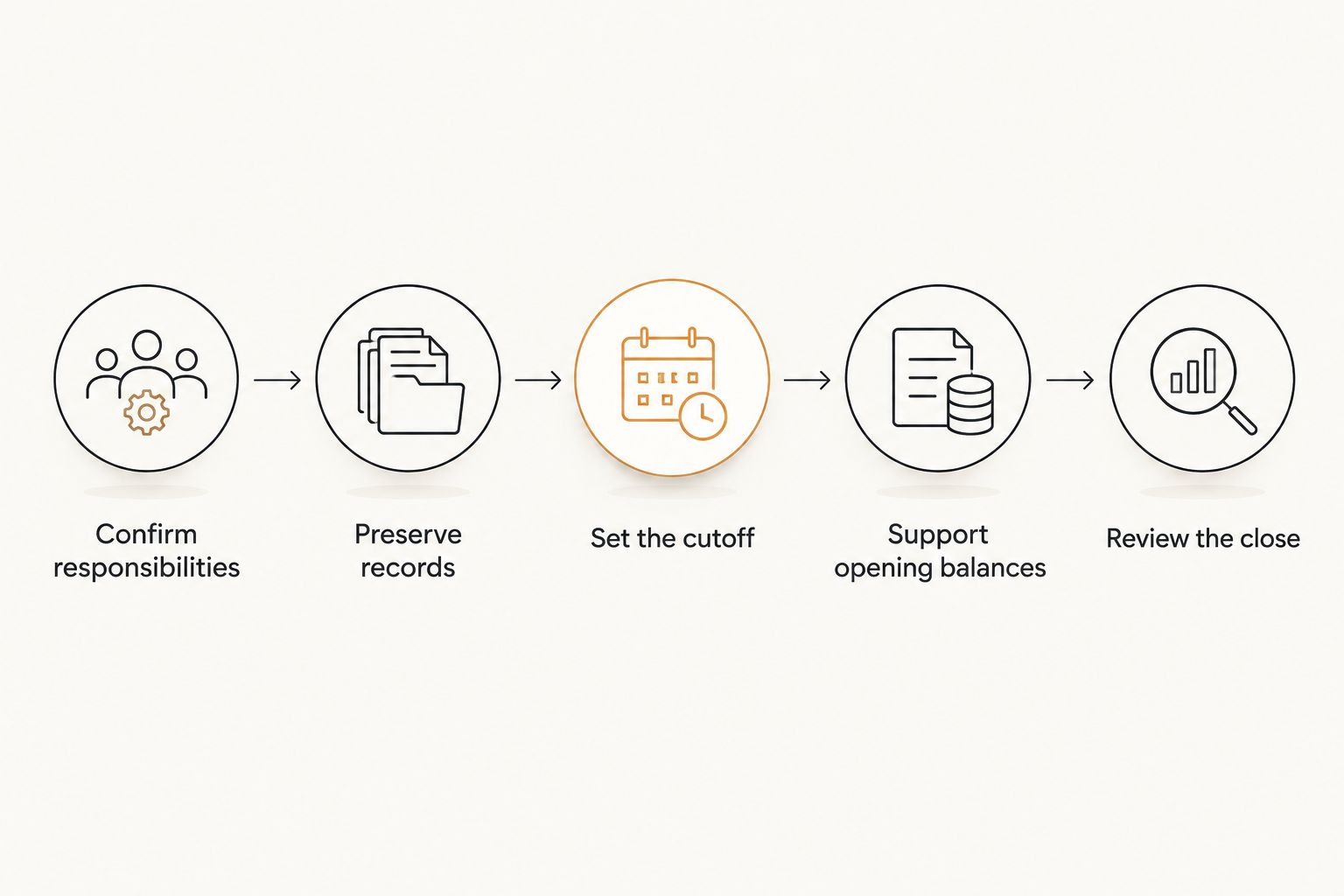
A handover is not complete simply because you can log in. You need records you can use, appropriate permissions, and an explanation of balances that carry into your books.
Why the right accounting arrangement varies
The restaurant’s trading name does not settle the question. These factors determine how much transition work and monthly support you need:
- Purchase structure. Buying assets and acquiring an ownership interest raise different accounting and tax questions. Have qualified advisers confirm how the transaction should be recorded.
- Record quality. Reconciled accounts and organized supporting documents create a different handover from unexplained balances and missing statements.
- Sales channels. Dining-room sales, card processing, and delivery-platform settlements create separate records that need to agree with the books.
- Owner capacity. Your ability to maintain records consistently matters more than whether you have used bookkeeping software before.
- Engagement boundaries. Monthly bookkeeping, payroll administration, tax filing, and transaction advice are not interchangeable services.
Florida restaurant seasonality also belongs in the conversation when it affects your operation. Explain your busy periods and closures so the provider understands when activity changes; do not assume an unusual month is automatically a bookkeeping error.
Can the seller’s accountant also work for the buyer?
The seller’s accountant can be considered for the buyer’s work, but you should confirm the proposed client relationship and any conflicts before engaging them. Ask what information can be shared, what requires permission, and whether separate advice is appropriate for the transaction.
Do not treat access to the accountant as access to every seller record. Put record-delivery obligations into the transaction process with your advisers rather than relying on an informal promise.
Does a new owner need completely new books?
A new owner needs reliable opening records, but that does not always mean discarding the existing accounting file. The purchase structure and adviser guidance determine whether to continue an existing file, establish a new one, or preserve historical records separately.
For a 2026 purchase, keep a clear record of what belongs before and after closing. Never delete historical entries simply to make a report look cleaner.
What should you ask before hiring monthly bookkeeping help?
Ask for deliverables, not a general promise to handle the accounts. Full Plate restaurant bookkeeping should be evaluated through the same practical scope questions as any provider you are considering.
Request a sample report format and an explanation of the monthly workflow. Then ask:
- What documents will I submit, and how will missing items be flagged?
- Which accounts will be reconciled?
- Who investigates mismatched deposits or unexplained transactions?
- How will corrections and unresolved questions be communicated?
- Which transition tasks require a separate agreement?
- Who handles tax and legal questions outside the bookkeeping scope?
Choose a provider whose responsibilities you can describe clearly. If you cannot explain what changes after hiring them, the proposed scope needs more work.
Review your bookkeeping options
Consider monthly bookkeeping support for your Florida restaurant ownership transition.
FAQ
Do I have to replace the restaurant accountant after buying a restaurant?
No, buying a restaurant does not automatically require replacing its accountant. Confirm the new engagement, access to records, responsibilities around closing, and whether the accountant can appropriately work for you.
Can I do the bookkeeping myself after taking over a Florida restaurant?
Yes, you can handle routine bookkeeping if you can maintain supporting records, reconcile accounts, and investigate discrepancies. Engage qualified help for transaction, tax, or other questions outside your experience.
What records should I request from the seller’s accountant?
Request the reports and supporting records you are entitled to receive under the transaction documents, including transaction detail, reconciliations, and relevant statements. Have your advisers identify what is needed to support the buyer’s opening records.
Should I give a new bookkeeper the seller’s login details?
Arrange authorized access for the new bookkeeper instead of passing along the seller’s personal credentials. Confirm account ownership, permissions, and record retention during the handover.
Does monthly bookkeeping include the ownership transfer and tax filings?
Monthly bookkeeping includes ownership-transfer work or tax filings only when the engagement explicitly covers them. Ask who handles each responsibility before assuming it is included.
When should I choose the accountant for a 2026 restaurant purchase?
Choose your accounting support before closing when possible, so responsibilities and record requests can be agreed in advance. If the purchase is already complete, prioritize preserving records and establishing supported opening balances.
One last thing
A bank deposit received after closing can relate to sales made before closing. That timing difference is why the handover needs more than a bank balance.
Ask for 1 final seller-period report and 1 buyer opening-balance schedule, with explanations that connect them to the agreed transaction terms. Those documents give you a concrete starting point for questions—whether you keep the accountant, hire someone new, or manage routine bookkeeping yourself.